
Show

Forgot your password?

Error message here!

Error message here!

Error message here!

Error message here!

Show Error message here!

Show Error message here!

Lost your password? Please enter your email address. You will receive a link to create a new password.

Error message here!

Back to log-in

Close

For Sale

The following items are listed by for sale by users of the site and dealers. They are in no way endorsed or guaranteed by www.antiquearmsresearch.com

Add a Classified Item
to

Clicking on the sword will take you through to the relevant classified item or dealer site.
Don't miss out! - Do you want to be kept informed weekly of new aditions? Just join our weekly update list.

You can also receive regular email notifcations when items match your keywords. To recieve them just register or logon at the top right of this page.
Page 37 of 118
  • Nation : Swiss
  • Local Price : $1,995.00
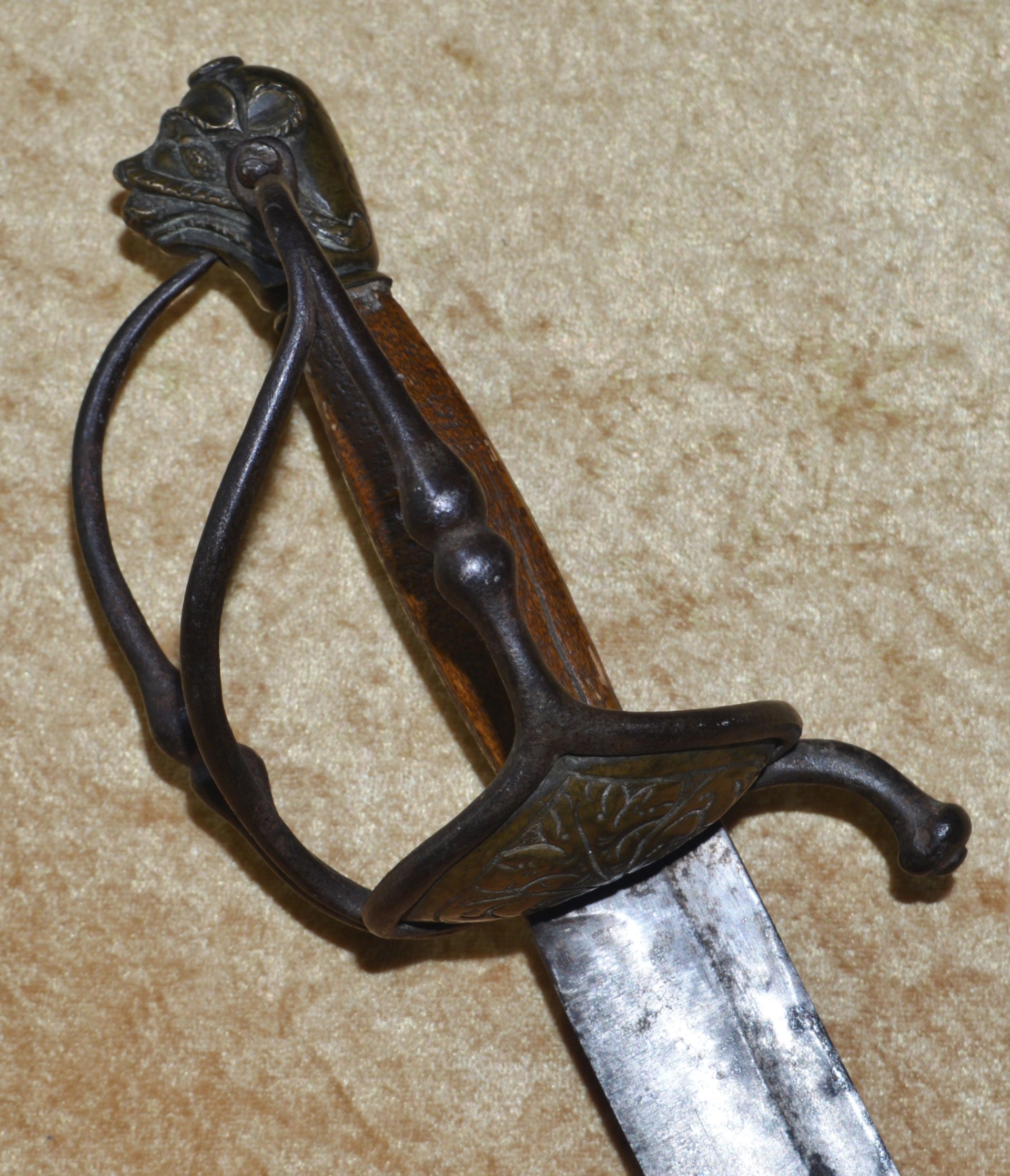
Swiss Dog-Head Cavalry Saber, 2nd Half 17th C. Featuring iron guard comprising single side ring, reverse scroll quillon with acorn finial, knuckle bow and side bar with double knobs connected by a diagonal bar and attached to the brass dog-head pommel; thumb ring on reverse. Side ring filled with brass plate embossed with acanthus decoration. Hexagonal-section wood grip, lacking wire wrap, but retaining braided brass Turks head at the base. Broad 29 1/4″ (74.3 cm) curved single- edged blade, the last 10″ double-edged; 3/4-length fuller near the back edge. Blade with scattered age staining and light pitting. Guard with even dark patina, the brass with rich golden brown patina. Overall length 35″ (88.9 cm).
  • Nation : British
  • Local Price : £1995.00
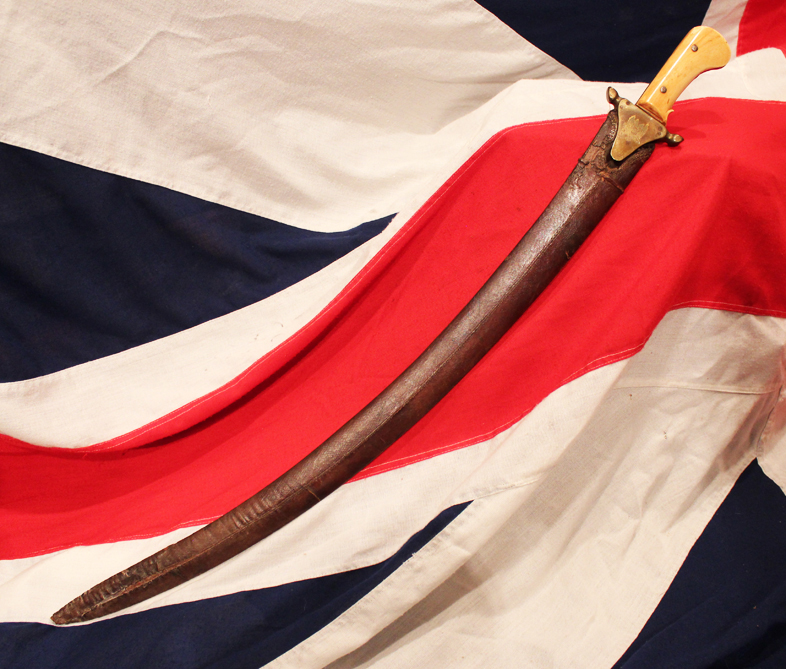
A Very Good, Original, Napoleonic Wars Period, Imperial Russian Romanov Cavalry Sabre Engraved With The Russian Double Eagle Crest. French Invasion and Retreat From Moscow Period of 1812. Probably 18th to early 19th century from the era of Catherine the Great to Czar Alexander Ist. Russian campaign sabre from the 1812 Russian campaign, Borodino, Smolensk and Moscow. In the cossack sasqua style, worn with the blade cutting side up. With walrus tooth hilt and engraved quillon bearing the Russian Romanov double crowned twin headed eagle crest with two cyrillic letters English equivalent M E within a shield. Leather scabbard with chequered decoration and wire decorative seaming at the throat. A little known fact about the Napoleon's campaign into Russia is that Napoleon’s army actually lost more men on the way to Moscow than on the way back. The heat, disease, battle and desertion meant that by the time the Russian capital was seen on the horizon he had lost half his men. Nevertheless, what was important to the Corsican General was that he had reached the city. Battles at Smolensk and Borodino along the way had been costly and hard-fought, but nothing Tsar Alexander had done had been able to halt the Imperial juggernaut in its tracks though he had managed to extricate most of the Russian army intact from the fighting. In September the exhausted and bloodied Grand Arm?e reached Moscow with its promise of food and shelter, but it was not to be. So determined were the Russians to resist the invader that they burned their own old and beautiful capital in order to deny its uses to the French. Camped in a burned and empty shell, Napoleon dithered about whether to remain over the bitter winter or claim victory and march home. He was mindful of earlier campaigns into Russia such as that of Charles XII of Sweden a century earlier and made the fateful decision to return to friendly territory rather than face the snows without adequate shelter. When it became clear that the Russians would not accept a favourable peace, Napoleon marched his troops out of the city in October. It was already too late. As the once-great army trudged across the empty vastness of Russia, the cold set in, as early as the French generals could possibly have feared. And that was the least of their worries. The horses died first, for there was no food for them. Then after the men ate them they started dying too, for all the supplies in Moscow had been burned a month earlier. All the time, hordes of cossacks harassed the increasingly bedraggled rearguard, picking off stragglers and making the survivor’s lives a constant misery. Meanwhile, Alexander ? advised by his experienced generals refused to meet Napoleon’s military genius head-on, and wisely let his army dribble away in the Russian snows. Astonishingly, by the time the remnants of the Grand Armee reached the Berezina river in late November it numbered just 27,000 effective men. 100,000 had given up and surrendered to the enemy, while 380,000 lay dead on the Russian steppes. 89.5 cm long overall
  • Nation : British
  • Local Price : £1995.00
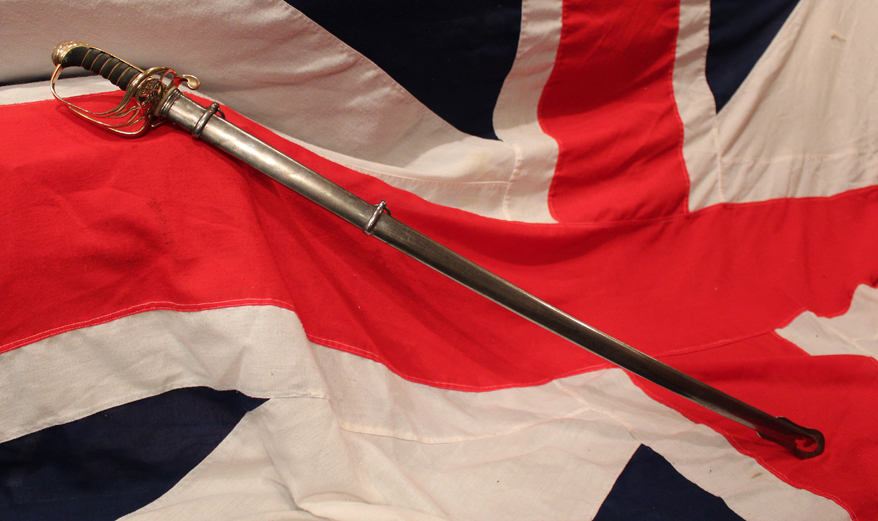
A Very Rare and Historical 1822 Presentation Sword to Ensign Alexander Samson of the Caribbean, 1st West India Regt. In 1855, From Col. Lockyer Freestun ‘Great Officer’ of the Knights Hospitallers of Jerusalem. Two Men Of The Regt. Were V.C. Winners. The West Indian Regiment was one of the great British colonial regiments, it was awarded 11 battle honours, and two of its other ranks volunteers, during its most notable history, were awarded the Victoria Cross, the rarest and most valuable medal for valour and gallantry in the entire military world. The regiment was made up of black volunteers, and was one of the greatest and heroic regiments, fighting in the British Army, first for the King then for the Queen and Country. In many respects this is one of the forgotten historic regiments of the British Army, formed, in greater part, for the benefit of British freed slaves fleeing from the Americas, that was as heroic as the famous, WW2, US Army Airforce and 500 RAF airmen, known as the Tuskegee Airmen, but, around 100 years before. This is very rare sword indeed, with a fabulous pierced VR Gothic half basket hilt, sharkskin multi wire bound grip, all steel combat scabbard and deluxe grade fully etched blade, presentation inscribed, and it is in simply beautiful condition for its age. Surviving, antique, British Army, West India Regimental swords are exceptionally rare, but an officer's presentation sword is so rare that this is the first we have ever seen in over 40 years, and it is possible no other surviving example may still be in existance within the collecting world, or even in museum collections. Presented by a most highly decorated and exceptional army officer who was both a Colonel of The British Army of Queen Victoria, A Colonel of the Spanish Army of The Queen of Spain and a ‘Great Officer’ of the Knights Hospitallers of Jerusalem. Presented in 1855 by Col William Lockyer Freestun, formerly of the 93rd Highland Regt. Of Foot was also a Colonel in the service of Her Catholic Majesty the Queen Regent of Spain. Who was granted the titles of Knight and Star of the Royal and Distinguished Order of Charles 3rd, Knight of the First Class of the National and Military Order of San Fernando, and Knight of the Royal Order of Isabella the Catholic for his gallantry and approbations in facing the enemy in the field. These orders he was granted permission to accept by Her Majesty Queen Victoria, personally, on August 14th 1840, and with concession and especial mark of Her Royal favour, be thus granted all due titles in Her Majesty's College of Arms. On the 23rd of June 1860 Her Majesty further granted a British Knighthood to Col. Lockyer Freestun who was also a Great Officer of the Knights Hospitallers of Jerusalem. Ensign Sansom served with much honour in the West Indian Regiment for around 38 years rising to the esteemed rank of Colonel of the regiment. The West India Regiments (WIR) were infantry units of the British Army recruited from and normally stationed in the British colonies of the Caribbean between 1795 and 1927. The new West India Regiments saw considerable service during the period of the Napoleonic Wars, including participation by the First WIR in the occupation of the French island of Marie-Galante in 1808. The Regiments were later involved in the War of 1812, both on the Atlantic coast and in the Gulf of Mexico, taking part in the British attack on New Orleans. In 1800 there were 12 battalion-sized regiments which were seen as valuable also for dealing with revolts in the West Indies colonies. With numbers decreased by the effects of the Slave Trade Act of 1807, there was a shortfall of around five thousand at the start of the War of 1812, and the war offered hope of new recruitment from slaves, yearning to serve as free men, fleeing the United States. However only eight joined the regiments from the Chesapeake Bay area in 1814, and a further thirteen on the coast of Georgia early in 1815. Following the end of the War of 1812, numbers were progressively reduced incorporating into the 1st West India Regiment the Carolina Corps that had been in existence since 1779, the original intention was both to recruit free black personel from the West Indian population and to purchase slaves from the West Indian plantations. The eighth of the newly raised regiments (Skerrett's) was disbanded the following year but the quality of the new corps led to a further five West India Regiments being raised in 1798. In 1807 all serving black soldiers recruited as slaves in the West India Regiments of the British Army were freed under the Mutiny Act passed by the British parliament that same year. In 1808 the Abolition Act caused all trading in slaves to be "utterly abolished, prohibited and declared to be unlawful". In 1812 a West African recruiting depot was established on Blance Island in Sierre Leone to train West African volunteers for the West India Regiments. But it needs also to be remembered that we were in the forefront of abolishing the slave trade and that, even as Napoleon threatened our very survival, we devoted a substantial part of the Royal Navy to hunting down and destroying the slave traders. Many British ships and lives were lost in the process. By 1816 the end of the Napoleonic Wars and the reduction of the West India regiments to six enabled this depot to be closed. The free WIR soldiers became a valued part of the British forces garrisoning the West Indies, where losses from disease and climate were heavy amongst white troops. The black Caribbean soldiers by contrast proved better adapted to tropical service. They served against locally recruited French units that had been formed for the same reasons. Free black Caribbeans soldiers played a prominent and often distinguished role in the military history of Latin America and the Caribbean The 1st West India Regiment from Jamaica went to the Gold Coast of Africa to fight in the Ashanti War of 1873-4 Battle honours Dominica, Martinique 1809, Guadeloupe 1810, Ashantee 1873?74, West Africa 1887, West Africa 1892-93 & 94, Sierra Leone 1898 The Great War (2 battalions): Palestine 1917?18, E. Africa 1916-18, Cameroons 1915-16. Honours and awards Private Samuel Hodge of the WIR was awarded the Victoria Cross in 1866 for courage shown during the capture of Tubab Kolon in the Gambia. Private Hodge was the second black recipient of this decoration the first being Able Seaman William Hall of the Royal Navy. In 1891, Lance Corporal William Gordon of the 1st Battalion WIR received a VC for gallantry during a further campaign in the Gambia. Promoted to sergeant, Jamaican-born William Gordon remained in employment at regimental headquarters in Kingston until his death in 1922.
  • Nation : -
  • Local Price : $1,995.00
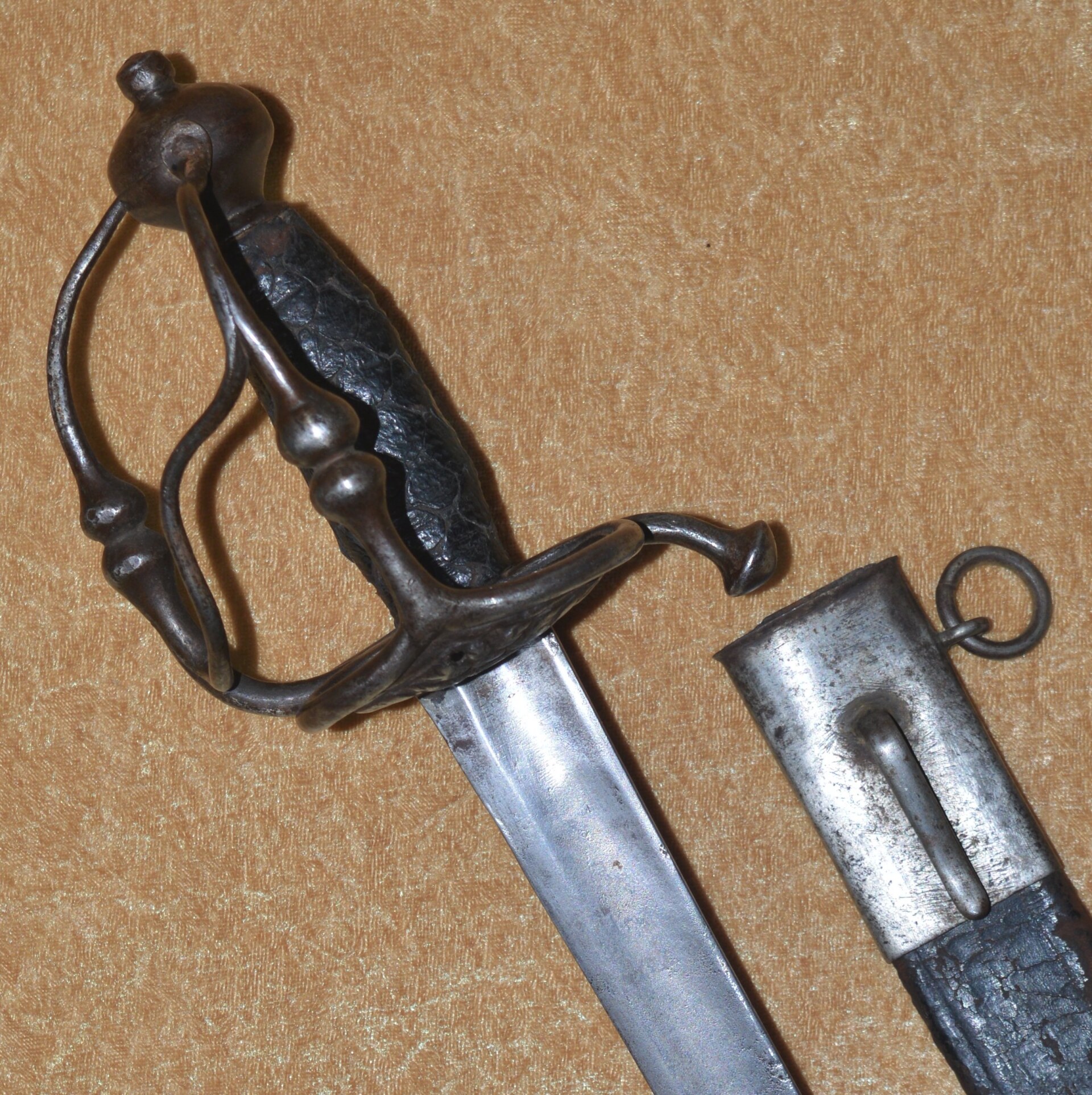
North European “Walloon” Cavalry Sword, Mid-17th C. Featuring iron hilt comprising asymmetrical side-rings, each enclosing a sprung-in plate; the outer one embossed and chased with foliage, the inner plate later and pierced with small holes. Side-bar and knuckle-guard, each with double central moulding, linked by a slender recurved bar and connecting to the spherical pommel, the latter with prominent tang button; rear quillon with button terminal. Grip with scaled leather wrap (shows age & wear). Straight unmarked 29 1/2″ (75 cm) single-edged blade with broad full-length fuller. Original black leather scabbard (damaged and in two parts) with iron chape and throat, the latter with frog hook and carry ring. Blade cleaned, showing lamination and small areas of light pitting; hilt with dark patina. Overall length 34 3/4″ (88.3 cm), not including scabbard. These nearly four century-old scabbards are extremely rare and this example certainly worth restoration.
  • Nation : German
  • Local Price : $1,995.00
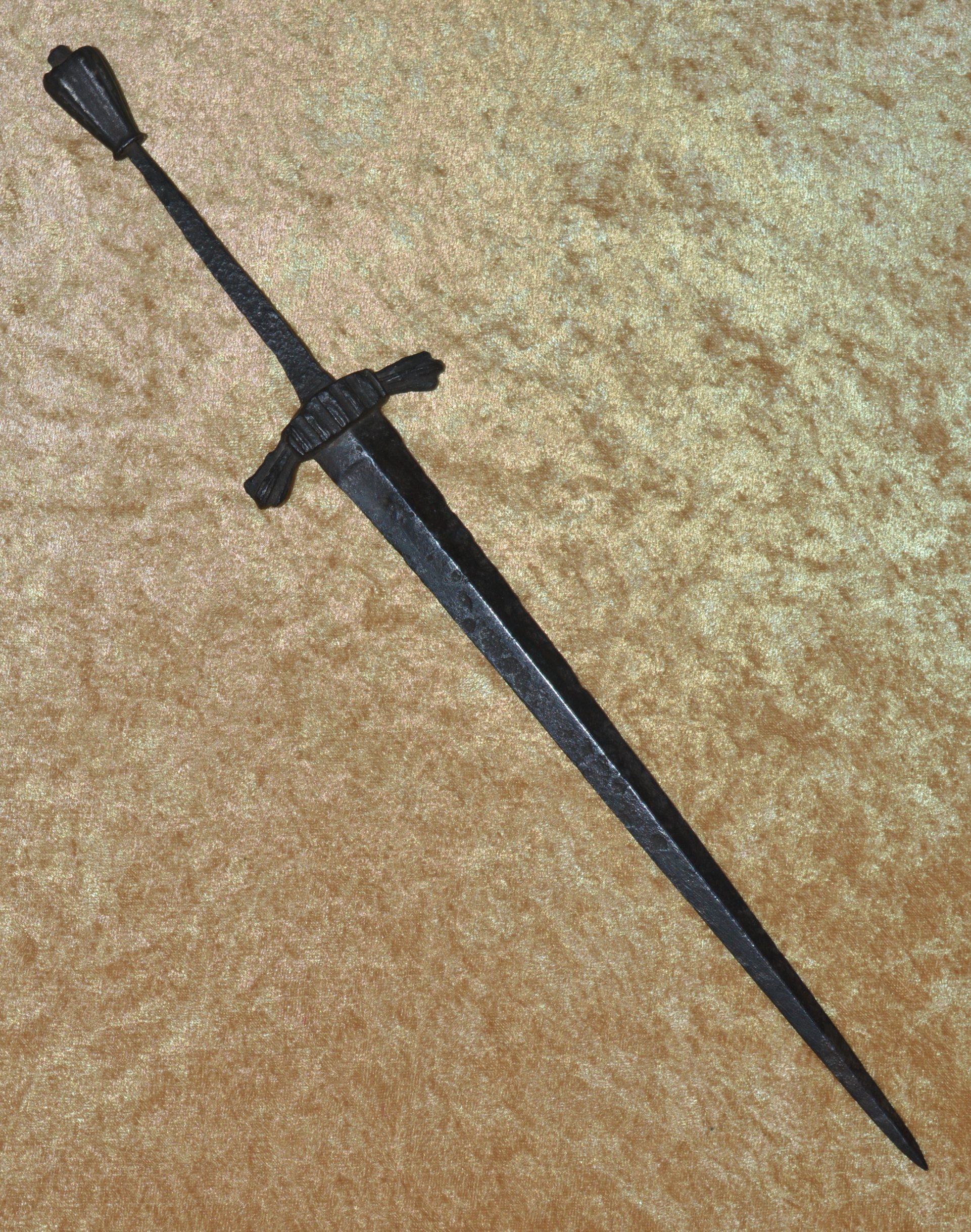
German Knightly Dagger, ca. 1540. Featuring 10 5/8” (27 cm) blade of flattened diamond section, tapering to a sharp point. Vertically fluted quillon block and down-turned quillions with button finials, chiseled ensuite. Guard is fused to the blade by corrosion. Fluted stopper-shaped pommel with button (loose), retaining what appears to be remnants of its original grip inside the cavity. In excavated condition, lacking grip, with scattered moderate to heavy pitting and dark patina. Possibly a river find, as it is in generally better condition than most ground finds. Overall length 16 1/4” (41.3 cm). Provenance: Hermann Historica, Munich, Oct. 11, 2023, Lot 1145
  • Nation : Unknown
  • Local Price : £1,950.00
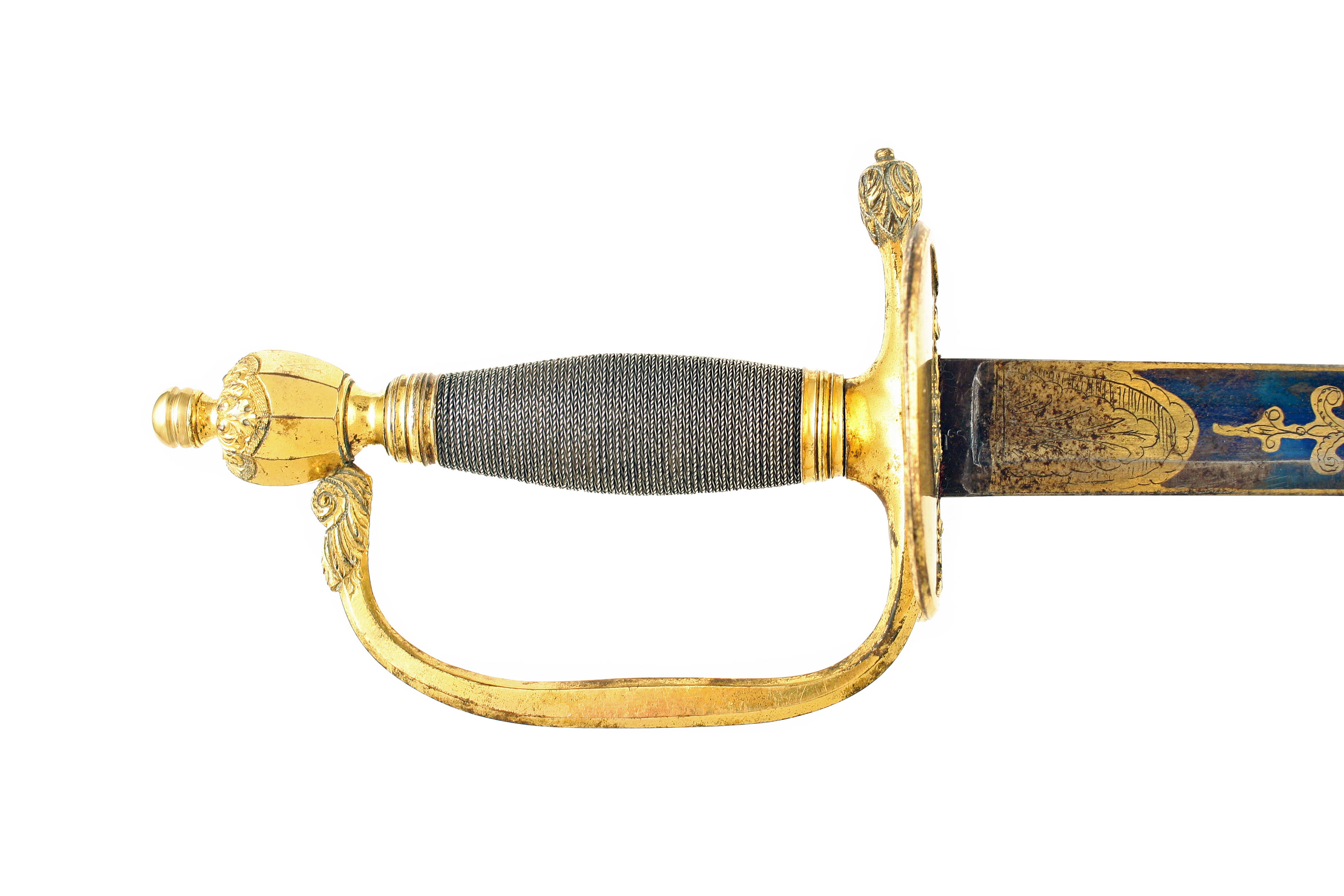
A 1796 Blue & Gilt Infantry Officers Sword.. A 1796 Blue & Gilt Infantry Officers Sword. With tapering fullered blade, double edged at the point, etched and gilt upon a blue ground with foliage, stands of arms and an officer, regulation ormolu hilt with double sell-guard (one folding), knuckle guard and pommel (a replacement) cast and chased with foliage, swelling rear quilon grip and bound with silver wire, in its original gilt brass mounted leather scabbard with two suspension rings. Dimensions: Blade Length: Overall Length:
  • Nation : Unknown
  • Local Price : £1,950.00
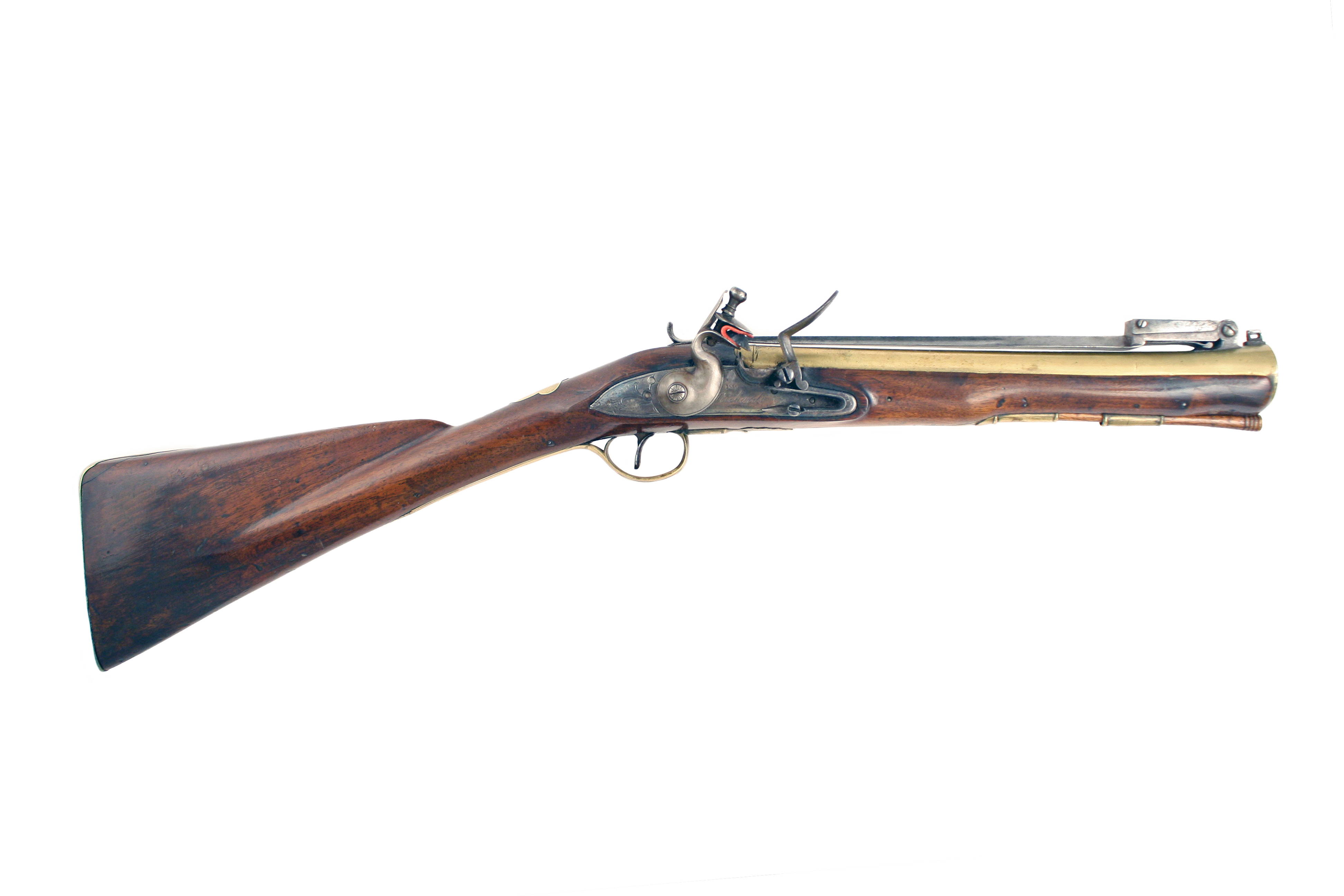
A Flintlock Blunderbuss by J & W Richards.. With belled brass barrel, struck at the breech with Tower of London private proofs and decorated with a foliate scroll, fitted with a sprung bayonet above, line engraved tang incorporating bayonet release catch, signed double border line engraved lock, decorated with a spray of foliage at the tail, full-stocked in walnut with brass mounts comprising an unusual acorn shaped escutcheon, foliate engraved butt-plate, border engraved trigger guard, decorated with a flower head on the bow and acanthus leaf finial, turned ramrod pipes and a replacement wooden ramrod. J & W Richards Dimensions: Bore: n/a Barrel Length: 11.75 Inches (29.85 cm) Overall Length: 27.5 Inches (69.85 cm)
  • Nation : Austro-Hungarian
  • Local Price : £1950.00
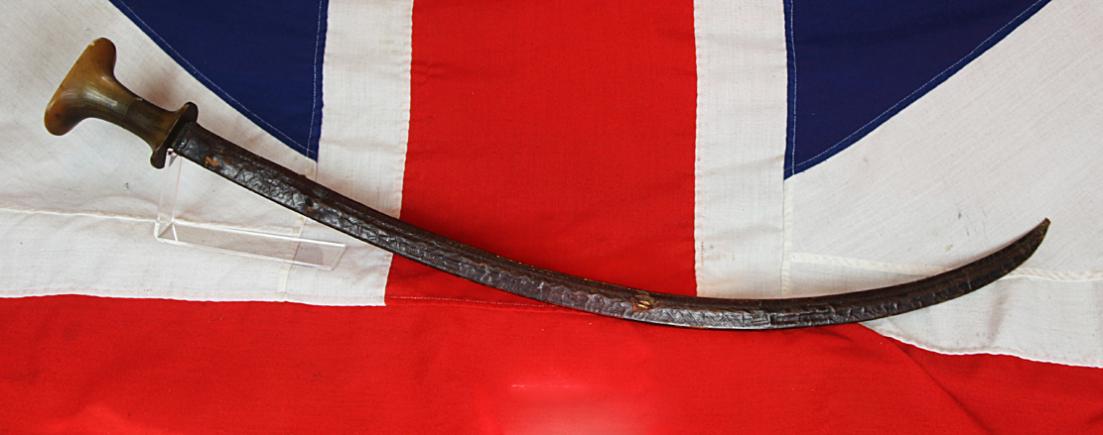
⚔️Original 19th Century Coin Hilted Emperor Menelik IInd Ethiopian Shotel With Deeply Curved Fully Etched Blade With Scrolling, Amharic Script & a 1780 Silver Austro Hungarian Thaler Pommel. & Used Into Reign of Emperor Haile Selassie. Bearing a a carved horn hilt, of with fine colouration, indicates this was the sword of the highest rank within the guard of the last Ethiopian Emperors. Curved blade fully etched in its tooled brown leather scabbard. These very unusual swords with very curved blades come from the "Horn of Africa," which includes Abyssinia, which we now know as Ethiopia. Made famous just before WWII by the Italian Invasion of that Country, and the appeal by it's Emperor Haile Selassie to the League of Nations, which the Western Powers basically ignored. It's Capital is Addis Ababa, a city dating back some 2,000 years and more. A country much in the news but also a land largely still in the middle ages in some respects. The sword, oft described as a shotel but actually it is a gorade, with its very characteristic curved blade. The swords dates back to the reign of Amda Seyon the 1st, known as "the Pillar of Zion" who was Emperor from 1314 - 1344. Called shotel, while technically the proper term locally for sabre was 'gorade'. Shotel which is not an Amharic word, Amharic for sword is gorade .The blade is etched with the profile of Emperor Menelik II, and also the symbol of the emperor, the Lion of Judah. The rest of the blade is etched with fancy scrolls. Menelik II baptised as Sahle Maryam (17 August 1844 – 12 December 1913) was Emperor of Ethiopia from 1889 to his death in 1913 and King of Shewa from 1866 to 1889. At the height of his internal power and external prestige, the process of territorial expansion and creation of the modern empire-state was completed by 1898. He is widely honoured by many Ethiopians and commemorated during the celebration of the Battle of Adwa, which is celebrated on March 1 or 2 across Ethiopia and in the diaspora. Many Pan-Africans regard him as an advocate for African independence against European powers during the Scramble for Africa. Emperor Haile Selassie was one of the most famous leaders in Ethiopian history. As the emperor, he was exiled during the Italian occupation of Ethiopia due to the status he held. Selassie would go onto return to Ethiopia and help in taking back control of the country from Italy. On April 2, 1930, Ras Tafari Makonnen became Emperor Haile Selassie. Selassie was the last reigning monarch of Ethiopia’s Solomonic Dynasty. The Solomonic Dynasty traces its ancient ancestry to King Solomon of Israel and the Queen of Sheba, biblical figures who may have lived during the 10th century BCE. Ethiopia is often acknowledged as the only nation in Africa never to have been colonized, and Selassie emerged as a powerful international figure as other African countries sought independence in the 20th century. His long reign and enduring policies (such as support for African unity and the abolition of slavery in Ethiopia) earned him a privileged position at international summits. For instance, Selassie was one of the highest-ranking diplomats at the funeral of U.S. President John Kennedy. Emperor Selassie’s greatest impact may have been on the island of Jamaica. Jamaican religious leaders adopted a version of his birth name, Tafari (Ras was an official title) and Rastafarians regard Selassie as a god. (Selassie himself remained a Christian throughout his life.). Photo in the gallery of Emperor Hallie Selassie in full dress uniform. The Maria Theresa taler is a silver bullion coin and a type of Conventionstaler, first minted in 1741. The official weight is 28.0668 grams (0.99003 oz) and contains 23.386 grams (0.752 troy ounces) of fine silver. It has a silver content of .833 and a copper content of .166 of its total millesimal fineness. In 1751 this new standard Conventionstaler was effectively adopted across the German-speaking world when it was accepted formally in the Bavarian monetary convention. This new, post-1751 thaler has continued as a trade coin ever since. The last year of minting was in 1780, the year in which Maria Theresia died. As this coin type was very popular they continued the production, always been dated 1780. The Maria Theresia taler quickly became a standard trade coin and several nations began striking Maria Theresa talers. The following mints have struck Maria Theresia talers: Birmingham, Bombay, Brussels, London, Paris, Rome and Utrecht, in addition to the Habsburg mints in Günzburg, Hall, Karlsburg, Kremnica, Milan, Venice Prague, and Vienna. The Maria Theresa talers could also be found throughout the Arab world, especially in Saudi Arabia, Yemen, and Muscat and Oman, in Africa, especially in Somalia, Ethiopia, Kenya. Overall in very nice condition, small edge nibbling to the hilt.
Page 37 of 118