
Show

Forgot your password?

Error message here!

Error message here!

Error message here!

Error message here!

Show Error message here!

Show Error message here!

Lost your password? Please enter your email address. You will receive a link to create a new password.

Error message here!

Back to log-in

Close

For Sale

The following items are listed by for sale by users of the site and dealers. They are in no way endorsed or guaranteed by www.antiquearmsresearch.com

Add a Classified Item
to

Clicking on the sword will take you through to the relevant classified item or dealer site.
Don't miss out! - Do you want to be kept informed weekly of new aditions? Just join our weekly update list.

You can also receive regular email notifcations when items match your keywords. To recieve them just register or logon at the top right of this page.
Page 38 of 118
  • Nation : -
  • Local Price : $1,995.00
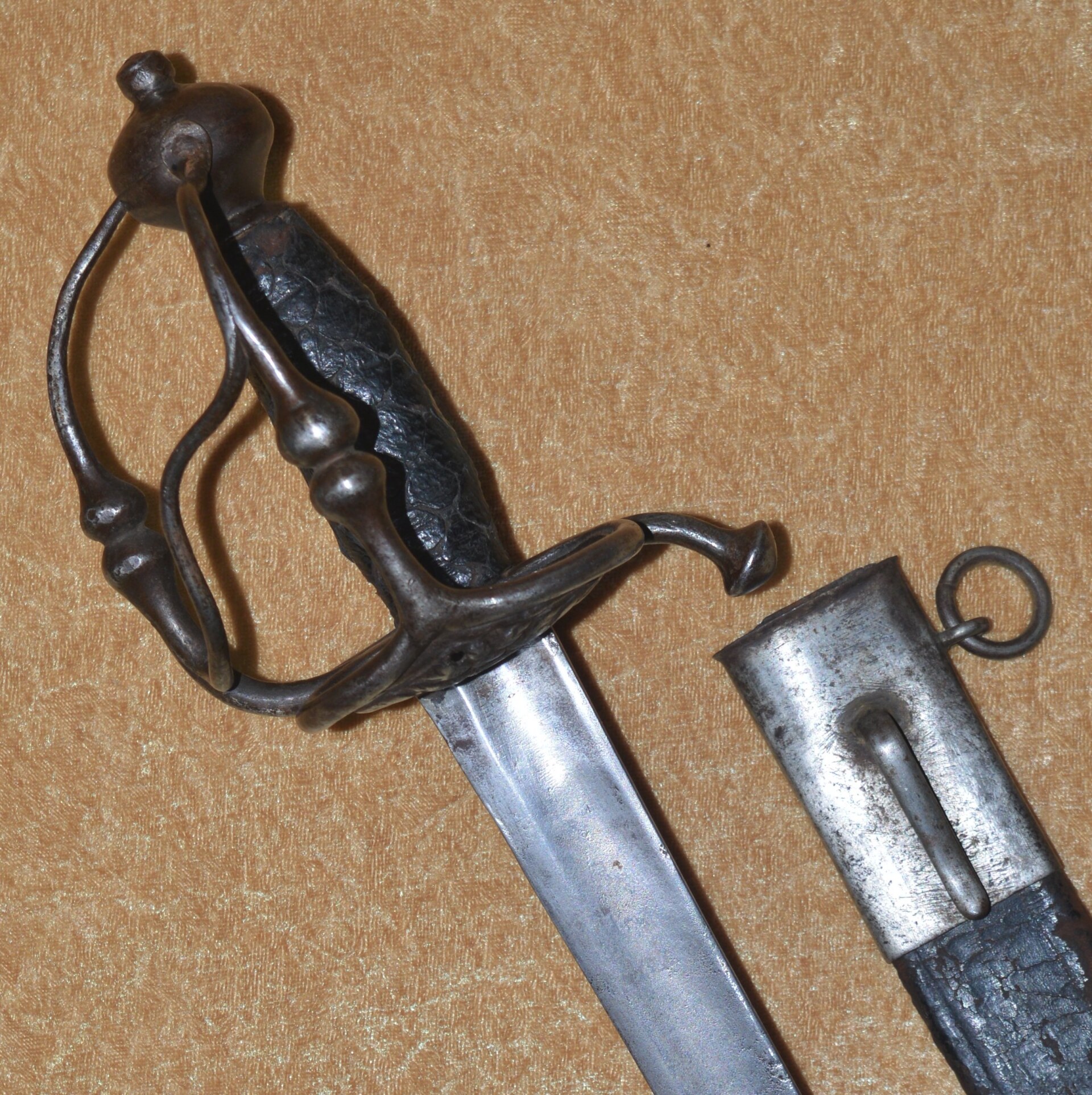
North European “Walloon” Cavalry Sword, Mid-17th C. Featuring iron hilt comprising asymmetrical side-rings, each enclosing a sprung-in plate; the outer one embossed and chased with foliage, the inner plate later and pierced with small holes. Side-bar and knuckle-guard, each with double central moulding, linked by a slender recurved bar and connecting to the spherical pommel, the latter with prominent tang button; rear quillon with button terminal. Grip with scaled leather wrap (shows age & wear). Straight unmarked 29 1/2″ (75 cm) single-edged blade with broad full-length fuller. Original black leather scabbard (damaged and in two parts) with iron chape and throat, the latter with frog hook and carry ring. Blade cleaned, showing lamination and small areas of light pitting; hilt with dark patina. Overall length 34 3/4″ (88.3 cm), not including scabbard. These nearly four century-old scabbards are extremely rare and this example certainly worth restoration.
  • Nation : German
  • Local Price : $1,995.00
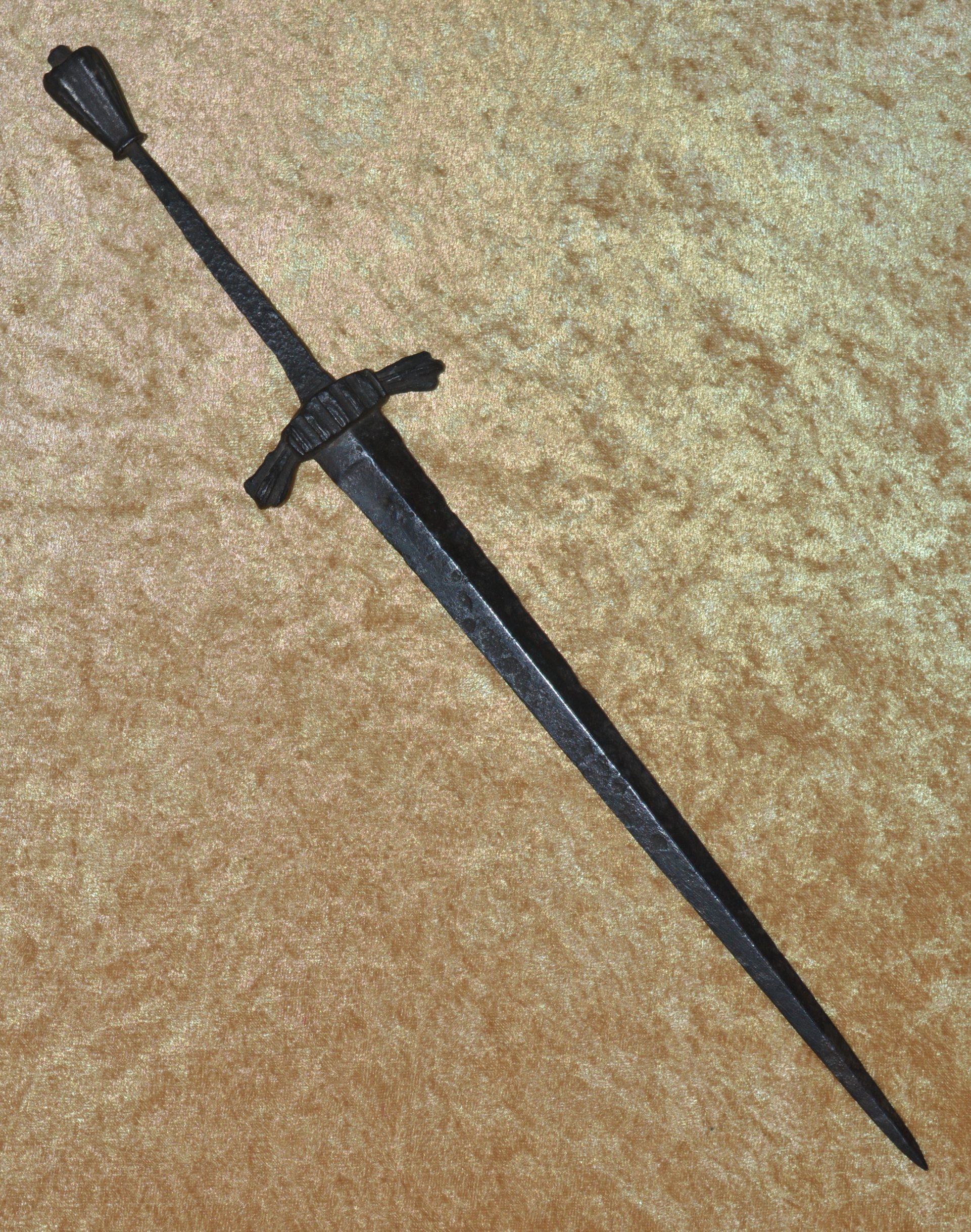
German Knightly Dagger, ca. 1540. Featuring 10 5/8” (27 cm) blade of flattened diamond section, tapering to a sharp point. Vertically fluted quillon block and down-turned quillions with button finials, chiseled ensuite. Guard is fused to the blade by corrosion. Fluted stopper-shaped pommel with button (loose), retaining what appears to be remnants of its original grip inside the cavity. In excavated condition, lacking grip, with scattered moderate to heavy pitting and dark patina. Possibly a river find, as it is in generally better condition than most ground finds. Overall length 16 1/4” (41.3 cm). Provenance: Hermann Historica, Munich, Oct. 11, 2023, Lot 1145
  • Nation : Unknown
  • Local Price : £1,950.00
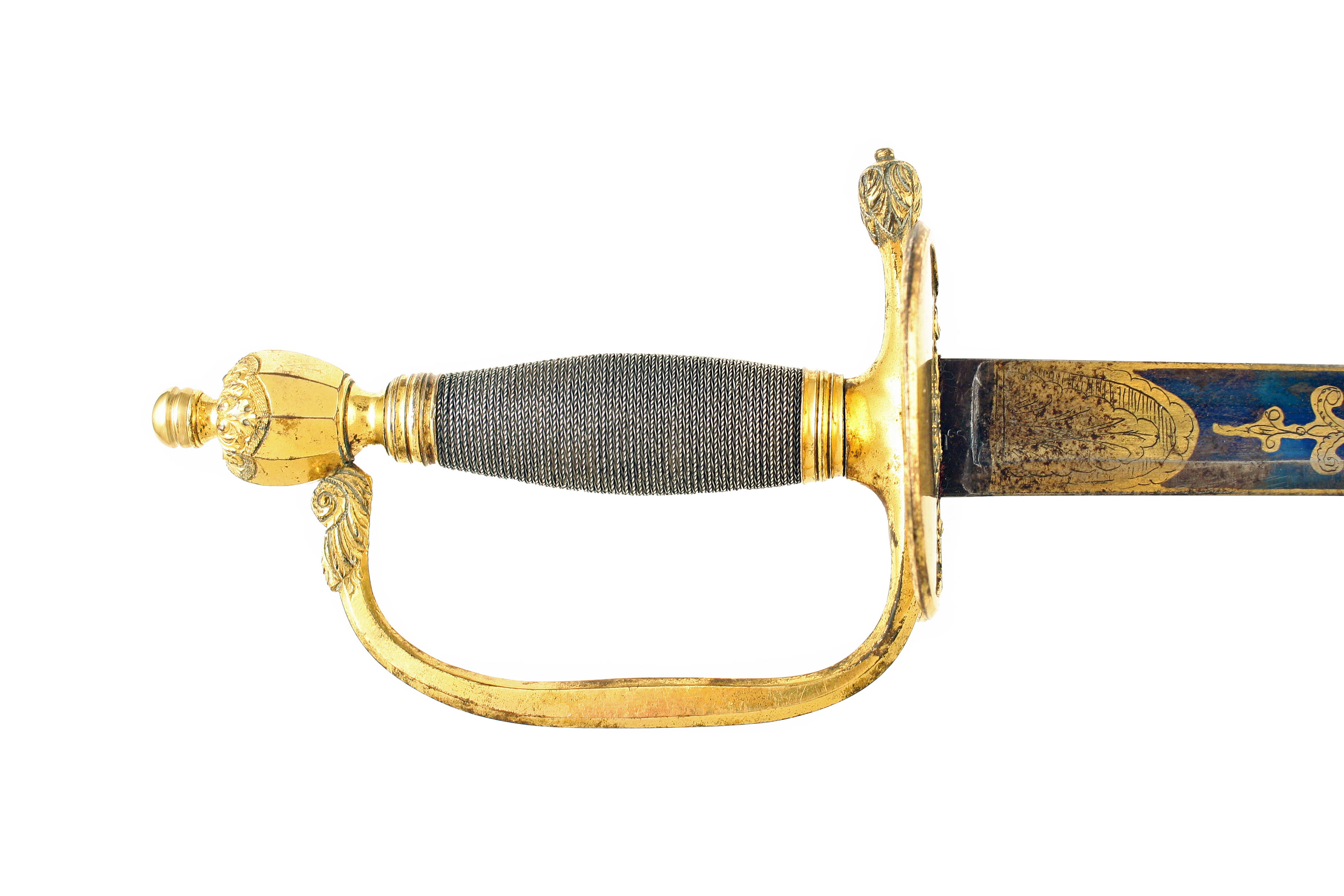
A 1796 Blue & Gilt Infantry Officers Sword.. A 1796 Blue & Gilt Infantry Officers Sword. With tapering fullered blade, double edged at the point, etched and gilt upon a blue ground with foliage, stands of arms and an officer, regulation ormolu hilt with double sell-guard (one folding), knuckle guard and pommel (a replacement) cast and chased with foliage, swelling rear quilon grip and bound with silver wire, in its original gilt brass mounted leather scabbard with two suspension rings. Dimensions: Blade Length: Overall Length:
  • Nation : Unknown
  • Local Price : £1,950.00
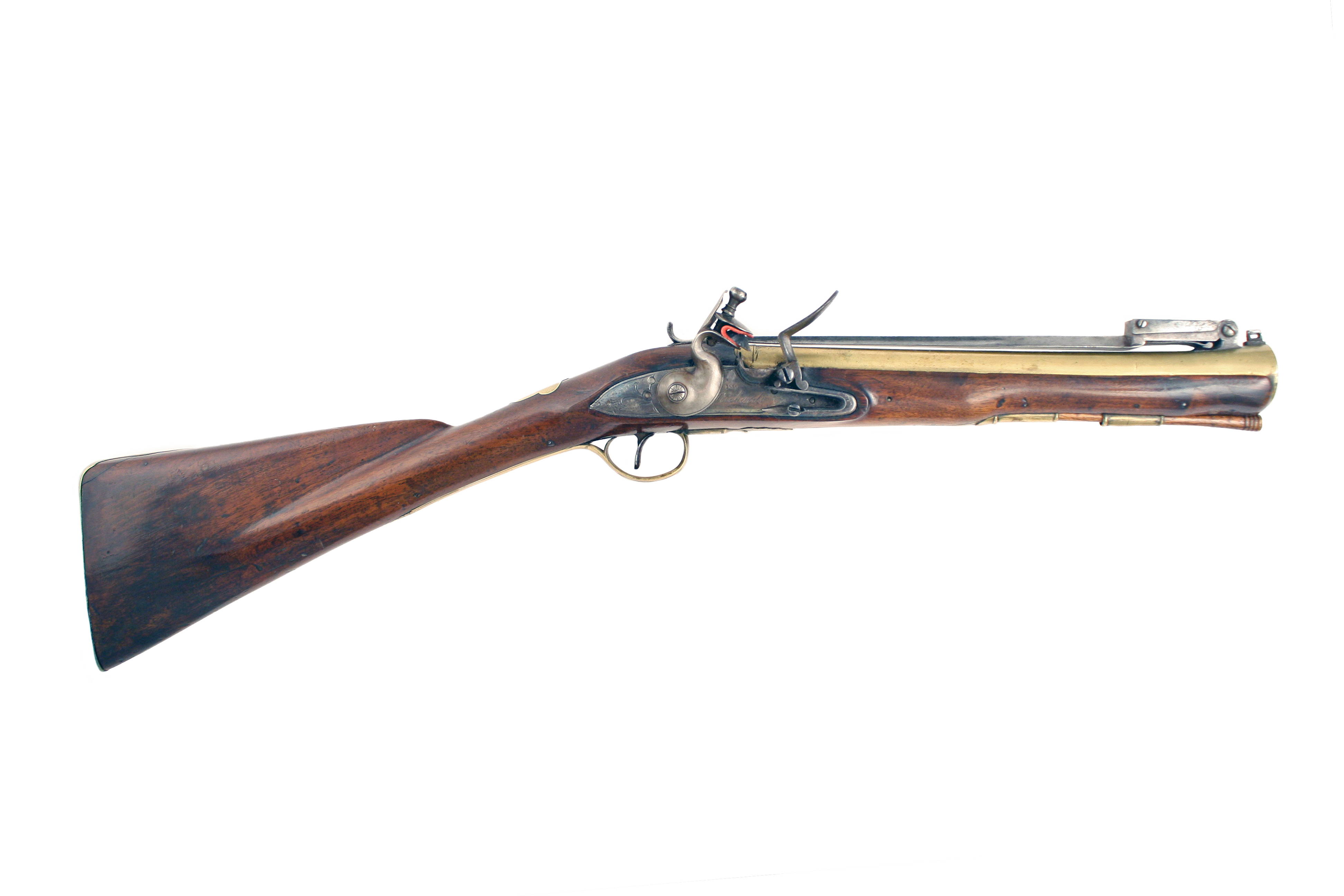
A Flintlock Blunderbuss by J & W Richards.. With belled brass barrel, struck at the breech with Tower of London private proofs and decorated with a foliate scroll, fitted with a sprung bayonet above, line engraved tang incorporating bayonet release catch, signed double border line engraved lock, decorated with a spray of foliage at the tail, full-stocked in walnut with brass mounts comprising an unusual acorn shaped escutcheon, foliate engraved butt-plate, border engraved trigger guard, decorated with a flower head on the bow and acanthus leaf finial, turned ramrod pipes and a replacement wooden ramrod. J & W Richards Dimensions: Bore: n/a Barrel Length: 11.75 Inches (29.85 cm) Overall Length: 27.5 Inches (69.85 cm)
  • Nation : Austro-Hungarian
  • Local Price : £1950.00
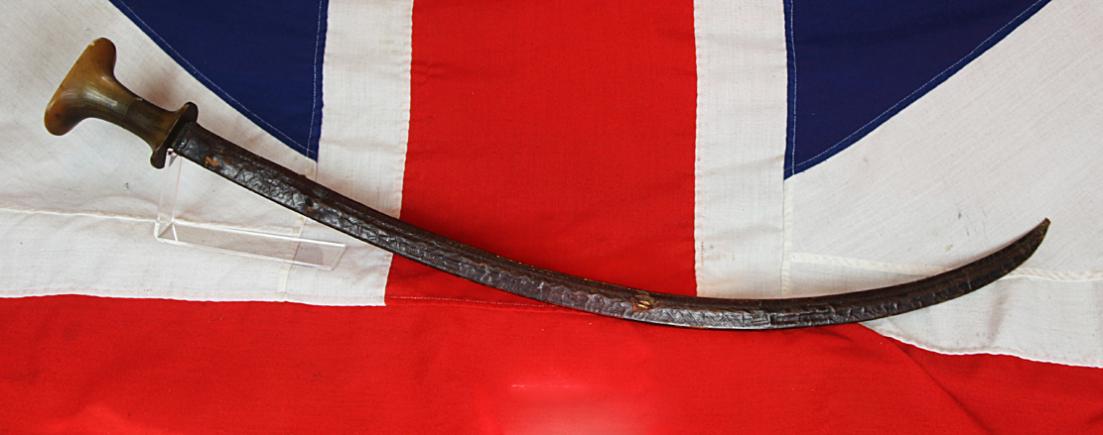
⚔️Original 19th Century Coin Hilted Emperor Menelik IInd Ethiopian Shotel With Deeply Curved Fully Etched Blade With Scrolling, Amharic Script & a 1780 Silver Austro Hungarian Thaler Pommel. & Used Into Reign of Emperor Haile Selassie. Bearing a a carved horn hilt, of with fine colouration, indicates this was the sword of the highest rank within the guard of the last Ethiopian Emperors. Curved blade fully etched in its tooled brown leather scabbard. These very unusual swords with very curved blades come from the "Horn of Africa," which includes Abyssinia, which we now know as Ethiopia. Made famous just before WWII by the Italian Invasion of that Country, and the appeal by it's Emperor Haile Selassie to the League of Nations, which the Western Powers basically ignored. It's Capital is Addis Ababa, a city dating back some 2,000 years and more. A country much in the news but also a land largely still in the middle ages in some respects. The sword, oft described as a shotel but actually it is a gorade, with its very characteristic curved blade. The swords dates back to the reign of Amda Seyon the 1st, known as "the Pillar of Zion" who was Emperor from 1314 - 1344. Called shotel, while technically the proper term locally for sabre was 'gorade'. Shotel which is not an Amharic word, Amharic for sword is gorade .The blade is etched with the profile of Emperor Menelik II, and also the symbol of the emperor, the Lion of Judah. The rest of the blade is etched with fancy scrolls. Menelik II baptised as Sahle Maryam (17 August 1844 – 12 December 1913) was Emperor of Ethiopia from 1889 to his death in 1913 and King of Shewa from 1866 to 1889. At the height of his internal power and external prestige, the process of territorial expansion and creation of the modern empire-state was completed by 1898. He is widely honoured by many Ethiopians and commemorated during the celebration of the Battle of Adwa, which is celebrated on March 1 or 2 across Ethiopia and in the diaspora. Many Pan-Africans regard him as an advocate for African independence against European powers during the Scramble for Africa. Emperor Haile Selassie was one of the most famous leaders in Ethiopian history. As the emperor, he was exiled during the Italian occupation of Ethiopia due to the status he held. Selassie would go onto return to Ethiopia and help in taking back control of the country from Italy. On April 2, 1930, Ras Tafari Makonnen became Emperor Haile Selassie. Selassie was the last reigning monarch of Ethiopia’s Solomonic Dynasty. The Solomonic Dynasty traces its ancient ancestry to King Solomon of Israel and the Queen of Sheba, biblical figures who may have lived during the 10th century BCE. Ethiopia is often acknowledged as the only nation in Africa never to have been colonized, and Selassie emerged as a powerful international figure as other African countries sought independence in the 20th century. His long reign and enduring policies (such as support for African unity and the abolition of slavery in Ethiopia) earned him a privileged position at international summits. For instance, Selassie was one of the highest-ranking diplomats at the funeral of U.S. President John Kennedy. Emperor Selassie’s greatest impact may have been on the island of Jamaica. Jamaican religious leaders adopted a version of his birth name, Tafari (Ras was an official title) and Rastafarians regard Selassie as a god. (Selassie himself remained a Christian throughout his life.). Photo in the gallery of Emperor Hallie Selassie in full dress uniform. The Maria Theresa taler is a silver bullion coin and a type of Conventionstaler, first minted in 1741. The official weight is 28.0668 grams (0.99003 oz) and contains 23.386 grams (0.752 troy ounces) of fine silver. It has a silver content of .833 and a copper content of .166 of its total millesimal fineness. In 1751 this new standard Conventionstaler was effectively adopted across the German-speaking world when it was accepted formally in the Bavarian monetary convention. This new, post-1751 thaler has continued as a trade coin ever since. The last year of minting was in 1780, the year in which Maria Theresia died. As this coin type was very popular they continued the production, always been dated 1780. The Maria Theresia taler quickly became a standard trade coin and several nations began striking Maria Theresa talers. The following mints have struck Maria Theresia talers: Birmingham, Bombay, Brussels, London, Paris, Rome and Utrecht, in addition to the Habsburg mints in Günzburg, Hall, Karlsburg, Kremnica, Milan, Venice Prague, and Vienna. The Maria Theresa talers could also be found throughout the Arab world, especially in Saudi Arabia, Yemen, and Muscat and Oman, in Africa, especially in Somalia, Ethiopia, Kenya. Overall in very nice condition, small edge nibbling to the hilt.
  • Nation : Turkish
  • Local Price : £1,400.00
RARE**NAPOLEONIC WARS ERA**CAPTURED** Anglo-Turkish War 1807 - 1809 Ottoman Infantry Varsak / Kulakli (Eared) Hilt, Yataghan Blade Sword With Original Brass Scabbard Period Presentation Engraved With Dardanelles Campaign 1807 Battle Honours. Sn 23560 -. The Anglo-Turkish War of 1807–1809, part of the Napoleonic Wars, was fought between Great Britain & the Ottoman Empire. The Anglo-Turkish War Yataghan sword called a varsak or kulaklı (eared) sword, is an iconic 16th- to 19th-century Ottoman blade. The weapon was highly favoured by elite Ottoman infantry troops like the Janissaries. Captured Ottoman swords were often gifted, or specifically engraved by English soldiers during the 1807-1809 conflict. These weapons often feature English script, military unit markings and engraved battle honours on the scabbard or blade. This original rare to find, Anglo-Turkish War Ottoman Yataghan varsak / kulakli sword, a captured presentation piece, has a 22 ½”, single yataghan blade (27 ¾” overall length). One side has faint hot stamp maker’s mark (illustrated). The forte has silver niello scrollwork. It has silver niello work grips of typical style with correct ‘eared’ pommel. The sword is contained in its original brass scabbard with two floral locket studs, one fitted with original period cord loop. One side of the scabbard has some un-readable script , Ottoman script and Dardanelles campaign battles for 1807 including battles of Lemnos, Rosetta, El Hamed and Alexandria. The price for this rare piece worthy of further research includes UK delivery. Sn 23560
  • Nation : British
  • Local Price : £1,400.00
17th Century English Rapier. 104cm long (94cm blade) English rapier from the mid 17th century. Asymmetrical double shell guard with curled iron quillions and oval pommel. Attractive twisted copper wire wrap finished with turks heads top and bottom. Tapering slender blade with diamond section, moderate pitting throughout
  • Nation : Japanese
  • Local Price : £1,395.00
Pre 1938 / WW2 Japanese Officer’s Type 98 Shin Gunto Arsenal Katana Sword With Nakaishime Smith Signed Tang ‘E-Saka (Family name) Yoshi Kuni (Art Name) Saku (Made This)’ Best Quality Monkey Hand Sarute Knot Loop, Scabbard & Expert Assessme. An original pre WW2 Japanese Officer’s Type 98 Sword with smith signed tang. The sword has been assessed by UK Japanese sword expert Bill Tagg. A copy of his hand written notes and illustrations accompany the sword. “A Type 98 Shin Gunto (Army Officers) Sword. Although there is no Seki or Showa inspector’s stamp, I think this is a pre 1938 made blade, a Showa to of medium quality with an oil tempered bar stock blade. It has typical Seki Mino type forging, a gunome midare hamon with nioi crystal ha buchi (edge line). It has a nakaishimei signature written by a kanji writer employed in Seki arsenal. See John Slough’s book on swordsmiths page 197 to see an oshigata of his work. ‘E-Saka (Family name) Yoshi Kuni (Art Name) Saku (Made This)’. In old original polish, one finger rust and some scratching & stains otherwise good for its age. Saya / gunto metal parade with green paint with leather campaign cover, some wear & small damage OK for its age. Tsuba gunto pattern cast or die stamp brass, some gilt left & good quality, with several matching seppa (washers) each side. Tsuka (hilt) gunto pattern, good quality and condition pre war standard mounts in original finish, working locking catch & best quality monkey hand sarute (knot loop). Fish skin wrap OK, been rebound post war with black ito (linen) tape. Otherwise untouched & original example of Japanese sword from 2nd war. N.B. Instead of signing their swords a lot of swordsmiths gave them to a man employed just to sign sword tangs (nakaishimei)”. In his illustrations Bill translates the tang signature. He measures the cutting edge as 63.5 cms, total length 84.5 cms and describes other blade and tang measurements & characteristics which can be seen in image 2. The price includes UK delivery. Sn 23511
Page 38 of 118