
Show

Forgot your password?

Error message here!

Error message here!

Error message here!

Error message here!

Show Error message here!

Show Error message here!

Lost your password? Please enter your email address. You will receive a link to create a new password.

Error message here!

Back to log-in

Close

For Sale

The following items are listed by for sale by users of the site and dealers. They are in no way endorsed or guaranteed by www.antiquearmsresearch.com

Add a Classified Item
to

Clicking on the sword will take you through to the relevant classified item or dealer site.
Don't miss out! - Do you want to be kept informed weekly of new aditions? Just join our weekly update list.

You can also receive regular email notifcations when items match your keywords. To recieve them just register or logon at the top right of this page.
Page 40 of 124
  • Nation : French
  • Local Price : $1,295.00
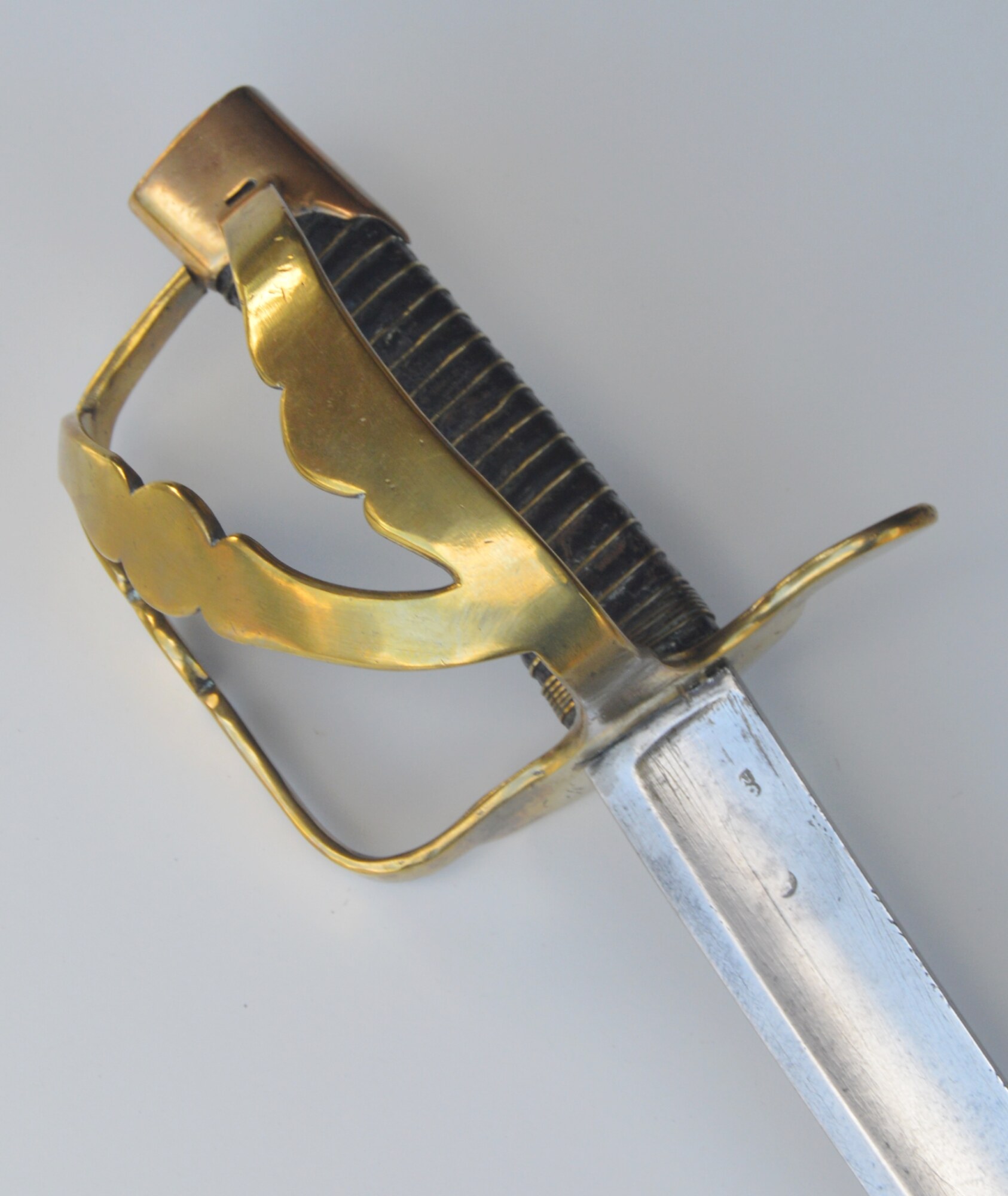
Rare French Chasseurs a’ Cheval de la Garde Trooper’s Saber, Late 18th C. This rare sword of the French Revolution and First Empire period features the distinctive half basket hilt formed of flat high copper content brass. Broad integral knuckle bow attached to the front of the pommel and stamped with two indistinct marks. Another broad bar set at 90 degrees to the knuckle bow and attached to the side of the pommel, with a broad bar extending diagonally from its base to the upper portion of the knuckle bow. Flat oval-shaped rear quillon, stamped on top with an “E”. Original leather-bound grip (minor wear), with single-strand brass wire wrap. Curved 35″ single-edged blade with broad fuller extending to within 4 ½” of the point, stamped with two indistinct inspection marks; the spine engraved “ M=f/ture de Klingenthal Coulax freres Entrep/rs ” in script. This mark was used in the 1790’s before the establishment of the First Empire under Napoleon Bonaparte. Very good condition; the guard and blade cleaned in European fashion, the blade with light scratches in, and parallel with, the fuller. From a large European collection of French Napoleonic era firearms and edged weapons. Overall length 41″. No scabbard. The Chasseurs a’ Cheval were light cavalry also trained to fight on foot.
  • Nation : British
  • Local Price : $1,295.00
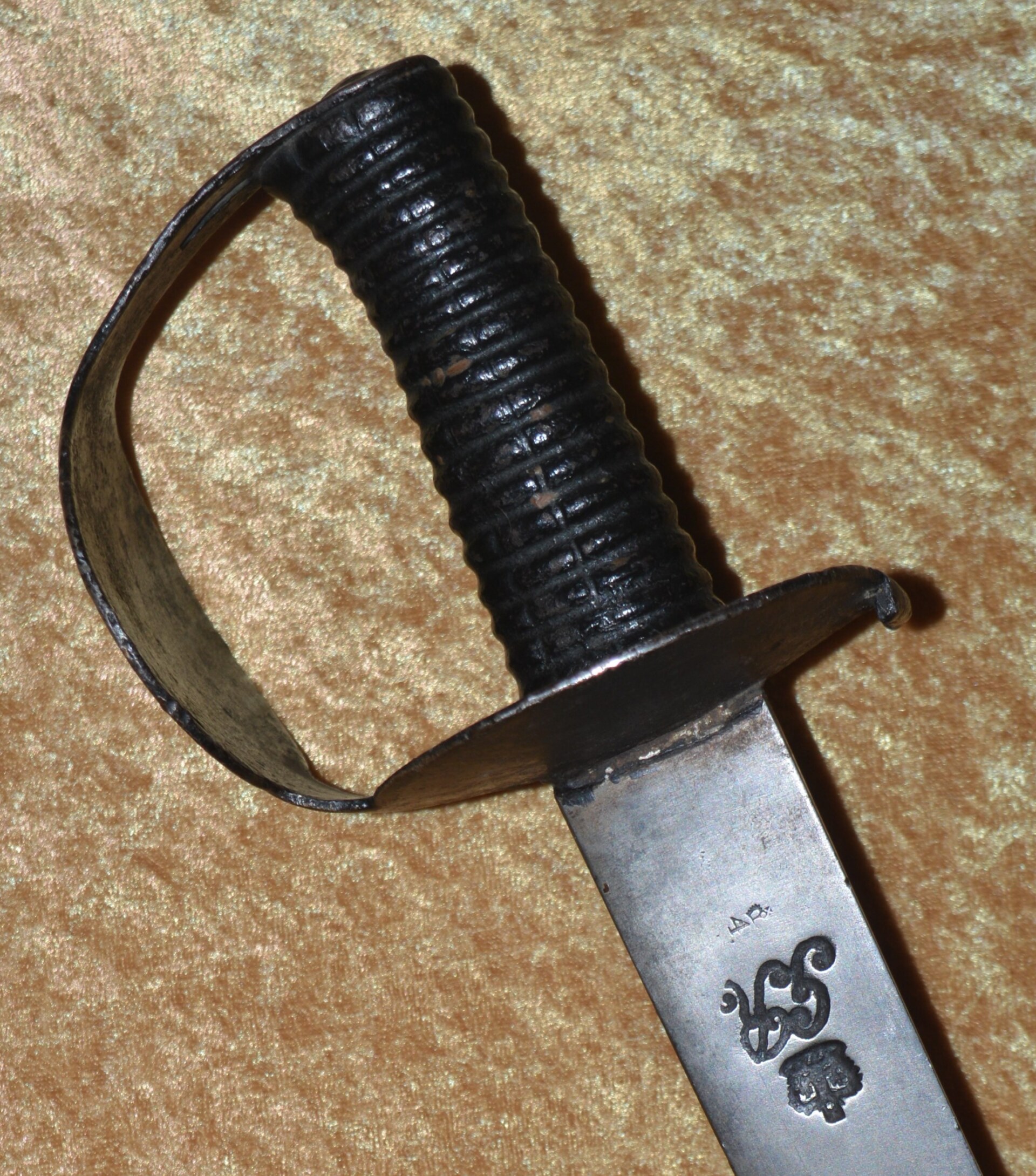
British 1804 Pattern Naval Cutlass. In 1804 the British Board of Ordnance ordered 10,000 cutlasses of a pattern provided by Henry Osborn. Most of these were manufactured between 1804 and 1816. They were issued to the ships, rather than to individual sailors, and were generally stored in racks, thus there was no need for a scabbard. Some examples were provided a scabbard, but few survive, as most were either discarded or wore out in the harsh saltwater conditions. It featured a black-painted iron figure-eight shaped guard and iron horizontally ribbed iron grip with an additional 6 narrow vertical grooves. Stout 29 1/4″ straight unfullered single-edged blade with spear point; this example deeply stamped with crowned GR cypher and a smaller crown over “4″; the blade spine stamped with maker’s name “BATE”. Thomas Bate of Birmingham was a silversmith, gunmaker, toymaker, and swordmaker, having contracts with the Board of Ordnance during the Napoleonic Wars. Very good condition, the blade with scratches and several shallow edge nicks; hilt repainted at some point and showing a few small chips in the paint. Overall length 33 3/4″.
  • Nation : British
  • Local Price : £1,295.00
**NAPOLEONIC WARS ERA** British Cavalry Officer’s Private Purchase 1796 Pattern Type Sabre With Brass Fittings & Scabbard. Sn 23484:40 -. The Pattern 1796 Light Cavalry Sabre was used primarily by British Light Dragoons and Hussars during the Napoleonic Wars (see page 77 to 93 of World Swords by Withers where variations of 1796 pattern swords are illustrated). This original 1796 type Sabre is in excellent condition for its age. It has a single edged, fullered 29 ½” Sabre blade (34 ½” overall). The blade has staining consistent with age and use and a few minor nibbles to the cutting edge. The blade has no visible maker or date marks. Its cross guard with rounded langets, knuckle guard & pommel with back strap are the same as pattern 1796 sabres but are brass rather than steel indicating private purchase. Its grooved leather bound wood grip with wire binding are in excellent condition. The Sabre is complete with its original leather scabbard with brass mounts, frog locket & 2 hanging rings. The sword fits the scabbard snugly. The leather of the scabbard is clean and all stitching intact. The price for this Napoleonic Wars era Cavalry Officer’s Sword with Scabbard includes UK delivery. Sn 23484:40
  • Nation : Japanese
  • Local Price : £1,295.00
**ANCIENT 16th CENTURY BLADE**Japanese Soshuden School Ko (Small) Wakizashi Sword Blade In Wood Shira Saya Resting Mounts Sayagaki Signature ‘Soshu Masa Mune’ With Carry Bag / Cover & Expert Assessment. Sn 22238 -. This ancient blade has been assessed by UK Japanese sword expert Bill Tagg. A copy of Bill’s hand written notes and illustrations accompany the blade. In extracts from his notes Bill states “Ko (small) Wakizashi unsigned cut down from a larger blade. Blade shoulders (machi) moved down and tang reshaped. Looks like done along time ago with ancient rust on tang. Hard to define with alteration to tang shape but blade work looks Soshuden (School)work. There is a Sayagaki on the saya in ink experts written opinion saying Soshu Masa Mune, one man using this name nearly 800 years ago, most famous smith in history. Definitely not him but a lot of other smiths used this art name working in the 16th century more likely to be just an ordinary maker using famous name. Had work done in Japan in 20th century. Polish, polish and Shira Saya when this inscription put on by an unknown man, just his personal seal on end of saya. Interesting old blade with some flaws and tired spots”. In his illustrations of the blade he describes the cutting edge of blade as just under 34 cms. Total length just under 45 cms. He also translates the saya signature & describes other blade characteristics and dimensions (illustrated). The Wakizashi comes with a clean undamaged quilted Carry Bag / Cover. The price includes UK delivery. Sn 22238 (Tanto box armoury)
  • Nation : British
  • Local Price : £1,295.00
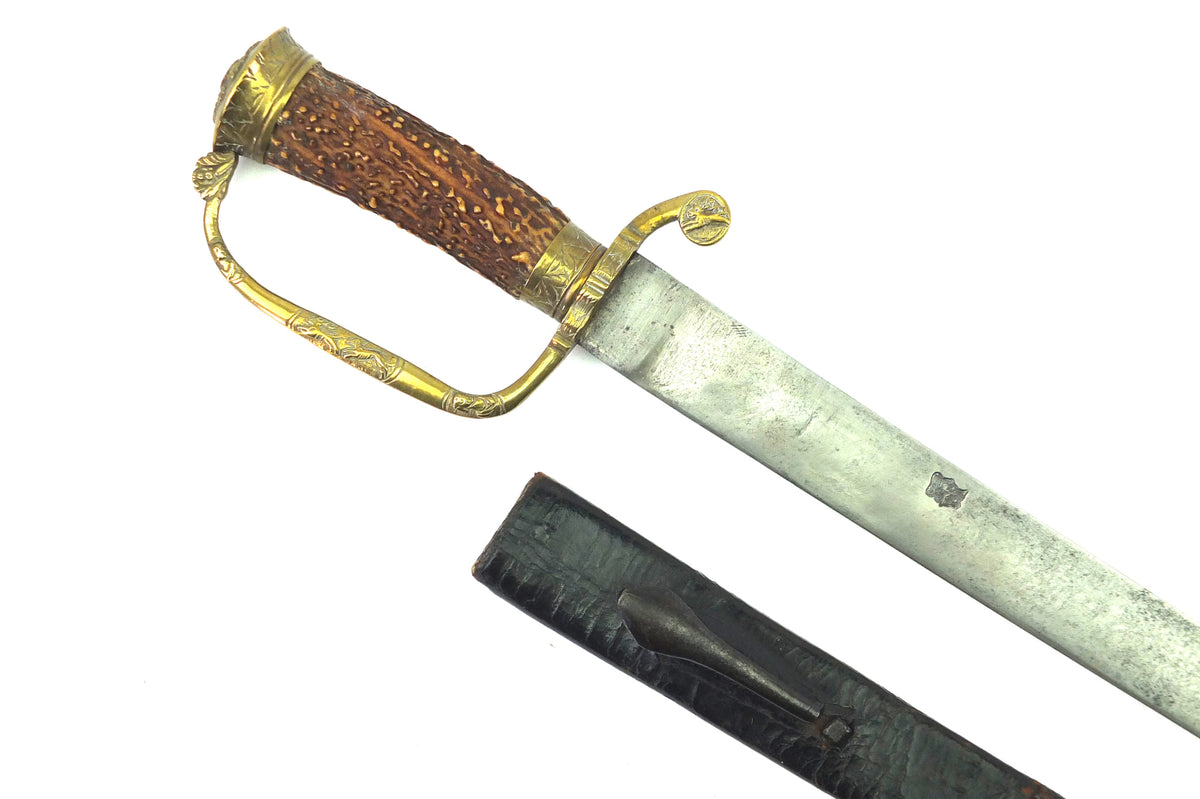
Fine English Hunting Hanger. Ref 9274. A Fine English Hunting Hanger. 26&157; overall, 21&157; slightly curved blade double edged over nearly half its length to the point, the forte on both sides deeply struck with a King’s head mark. &194;&160;Brass hilt comprising ´D´ shaped knucklebow cast with stags, hares, hounds & masks, recurved quillon with lobed terminal with mask & stag, strawberry leaf engraved collar and pommel cap with Green man masks. Natural buckhorn grip, in its original tooled black leather scabbard with brass chape (old replacement) & iron frog hook. Circa 1700&194;&160; &194;&160;&194;&160; Very attractive sword in good condition.&194;&160; &194;&160; &194;&160; &194;&160; &194;&160; &194;&160; &194;&160; &194;&160; &194;&160; &194;&160; &194;&160; &194;&160; &194;&160; &194;&160; &194;&160; &194;&160; &194;&160; &194;&160; &194;&160; &194;&160; &194;&160; Images courtesy of West Street Antiques (https://antiquearmsandarmour.com/)
  • Nation : French
  • Local Price : £1,295.00
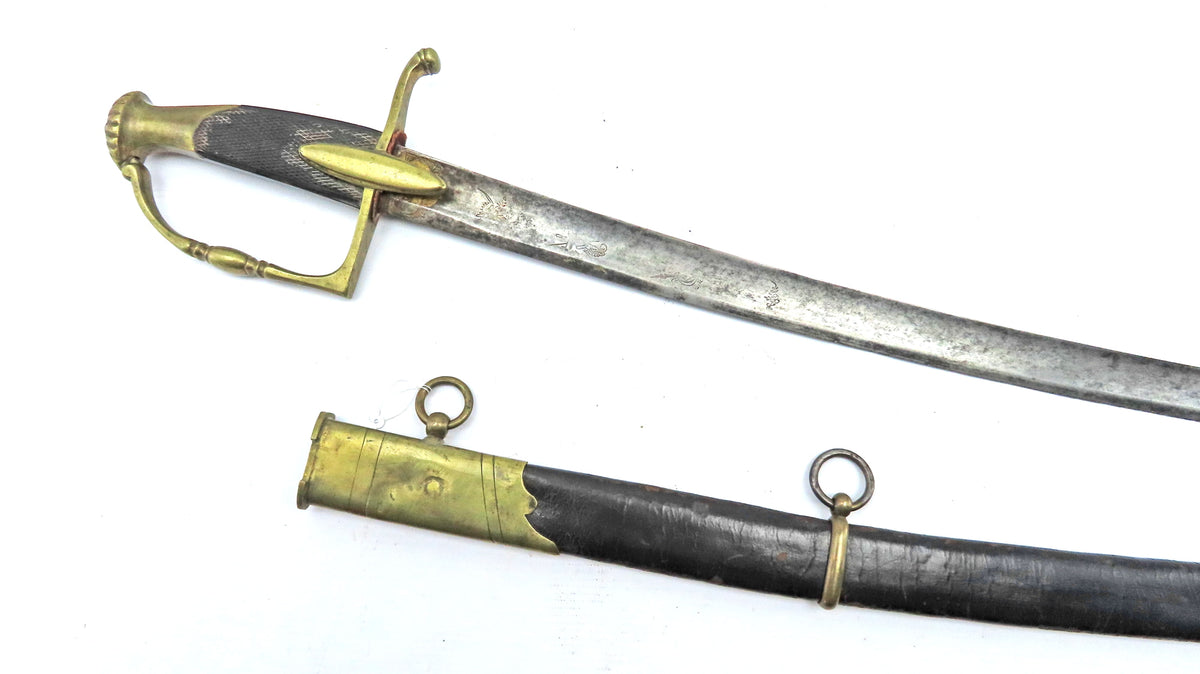
French Field Officers Sword. Ref X3414. A French Field Officers Sword. 35&157; overall, 30&157; curved&194;&160;&194;&160;blade with one broad fuller, engraved on both sides with Military trophies. Brass hilt with double langets, ´D´ shaped chamfered knuckle bow, canted fluted pommel, chequered ebony grip. In its original black leather & brass mounted scabbard with twin hanging rings. Circa 1807-15. &194;&160;&194;&160;&194;&160;&194;&160;&194;&160;&194;&160;&194;&160;&194;&160;&194;&160;&194;&160;&194;&160;&194;&160;&194;&160;&194;&160;&194;&160;&194;&160;&194;&160;&194;&160;&194;&160;&194;&160;&194;&160;&194;&160;&194;&160;&194;&160;&194;&160;&194;&160;&194;&160;&194;&160;&194;&160;&194;&160;&194;&160;&194;&160;&194;&160;&194;&160;&194;&160;&194;&160;&194;&160;&194;&160;&194;&160;&194;&160;&194;&160;&194;&160;&194;&160;&194;&160;&194;&160;&194;&160;&194;&160;&194;&160;&194;&160;&194;&160;&194;&160;&194;&160;&194;&160;&194;&160;&194;&160;&194;&160; Uncommon sword in quite good condition, blade engraving rubbed. Images courtesy of West Street Antiques (https://antiquearmsandarmour.com/)
  • Nation : Japanese
  • Local Price : £1,295.00
WW2 Japanese Army Officer’s Type 98 Shin Gunto Seki Arsenal Sword with Smith Signature ‘NOSHU SEKI JU HATTORI MASA HIRO SAKU’, Scabbard with Leather War Service Cover & Expert Assessment. Sn 20599 -. This sword has been assessed by a UK based Japanese sword expert Bill Tagg. His assessment accompanies this piece. In exerts from the assessment he states “A Type 98 Shin Gunto . This is a medium grade showa-To oil tempered blade made Seki arsenal using Yaki Ire process to produce its temperline (Hamon) not visible with rust. It is signed Kazu Uchi Mei, I think this means another man actually signed the Nakago, probably his job to sign for a lot of other arsenal smiths ‘‘NOSHU (province) SEKI (city) JU (living in) HATTORI (family name) MASA HIRO (art name) SAKU (made this)’. He is rated as making either low to medium grade Showa-To (nontraditional forged) or medium grade Gendaito (hand forged). This is a good example of his work but needs a polish to see what is in it. Saya is Honoki wood, leather covered for war service, used condition with a period reinforcing brass collar put on mouth of Saya. Tsuba good quality Gunto pattern with lots of gilt on it, also good quality Gunto mounts, some gilt and colour remaining. Ito wrap & fish skin good but skin shrunk revealing small gaps. Needing a sarute (knot loop) to complete it”. In his illustrations of the blade he describes the cutting edge of blade as 66 cms. Total length 86 cms. He also translates the tang signature & describes other blade characteristics and dimensions (illustrated). The price for this sword with expert assessment includes UK delivery. Sn 20599
  • Nation : East India Company
  • Local Price : £1295.00
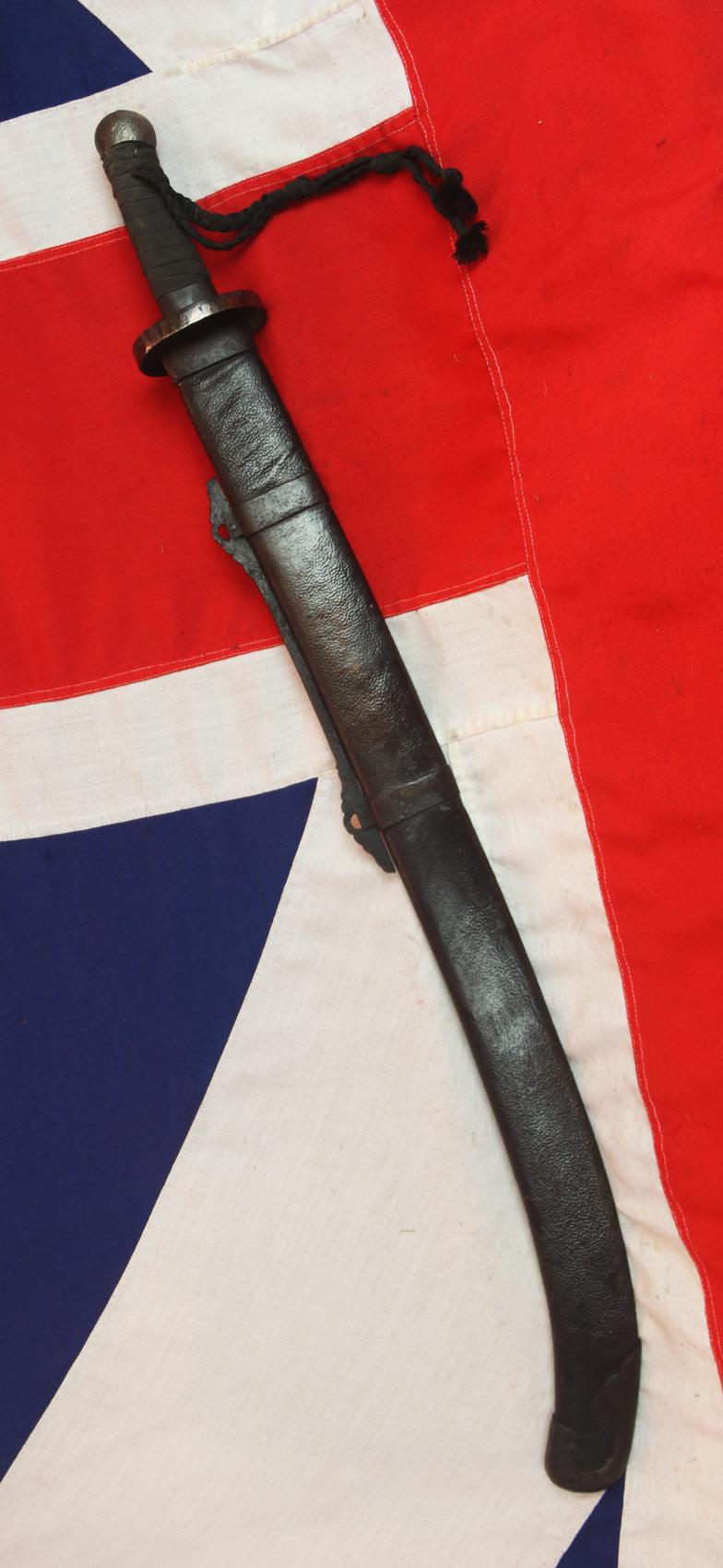
A Fine Scarce, Antique, Chinese Dadao Sword, Ching Dynasty. Used From the Opium Wars and The Boxer Rebellion. The Ching or Qing Dynasty Was Founded From 1644 and Ruled Until 1912.. A big and impressive sword with a long single edged blade. Black iron mounts to the leather bound scabbard and sword guard, round pommel wide cord wrapped grip, with plaited sword knot. Made in the Ching {Qing} Dynasty. Used during the Taiping Rebellion, the Opium Wars and into the Boxer Rebellion era, and most likely brought back to England by a soldier that either served in the Taiping Rebellion the Opium War, or defended the legations at the siege in Peking. This weight of sword was frequently used not only in battle but for executions. All black finish. The Taiping Rebellion was a widespread civil war in southern China from 1850 to 1864, led by heterodox Christian convert Hong Xiuquan, who having received visions, maintained that he was the younger brother of Jesus Christ against the ruling Manchu-led Qing Dynasty. About 20 million people died, mainly civilians, in one of the deadliest military conflicts in history. Hong established the Taiping Heavenly Kingdom, officially the "Heavenly Kingdom of Great Peace", with its capital at Nanjing. The Kingdom's army controlled large parts of southern China, at its height containing about 30 million people. The rebels attempted social reforms believing in shared "property in common" and the replacement of Confucianism, Buddhism and Chinese folk religion with a form of Christianity. The Taiping troops were nicknamed "Long Hair" by the Qing {Ching} government. The Taiping areas were besieged by Qing forces throughout most of the rebellion. The Qing government crushed the rebellion with the eventual aid of French and British forces. The Opium Wars, also known as the Anglo-Chinese Wars, divided into the First Opium War from 1839 to 1842 and the Second Opium War from 1856 to 1860, were the climax of disputes over trade and diplomatic relations between China under the Qing Dynasty and the British Empire. After the inauguration of the Canton System in 1756, which restricted trade to one port and did not allow foreign entrance to China, the British East India Company faced a trade imbalance in favour of China and invested heavily in opium production to redress the balance. British and United States merchants brought opium from the British East India Company's factories in Patna and Benares, in the Indian state of Bengal, to the coast of China, where they sold it to Chinese smugglers who distributed the drug in defiance of Chinese laws. Aware both of the drain of silver and the growing numbers of addicts, the Dao Guang Emperor demanded action. Officials at the court who advocated legalization of the trade in order to tax it were defeated by those who advocated suppression. In 1838, the Emperor sent Lin Zexu to Guangzhou where he quickly arrested Chinese opium dealers and summarily demanded that foreign firms turn over their stocks. When they refused, Lin stopped trade altogether and placed the foreign residents under virtual siege, eventually forcing the merchants to surrender their opium to be destroyed. In response, the British government sent expeditionary forces from India which ravaged the Chinese coast and dictated the terms of settlement. The Treaty of Nanking not only opened the way for further opium trade, but ceded territory including Hong Kong, unilaterally fixed Chinese tariffs at a low rate, granted extraterritorial rights to foreigners in China which were not offered to Chinese abroad, a most favoured nation clause, as well as diplomatic representation. When the court still refused to accept foreign ambassadors and obstructed the trade clauses of the treaties, disputes over the treatment of British merchants in Chinese ports and on the seas led to the Second Opium War and the Treaty of Tientsin. Hero of China, British General Gordon, was presented with an identical example, and he is carrying his, while dress in his Chinese garb, in the picture shown in the gallery. He was known affectionately as "Chinese" or "China" Gordon. Overall very good condition. He later became known as Gordon of Khartoum, as he was assassinated by the Mahdi's warriors at the end of the siege of Khartoum The Qing dynasty, officially the Great Qing, was the Manchu-led last dynasty in the imperial history of China. It was proclaimed in 1636 in Manchuria, in 1644 entered Beijing, extended its rule to cover all of China proper, and then extended the empire into Inner Asia. The dynasty lasted until 1912. The Qing Dynasty fell in 1911, overthrown by a revolution brewing since 1894 when western-educated revolutionary Sun Zhongshan formed the Revive China Society in Hawaii, then Hong Kong. In 1911, the Nationalist Party of China held an uprising in Wuchang, helped by Qing soldiers, and 15 provinces declared their independence from the empire. Within weeks the Qing court agreed to the creation of a republic with its top general, Yuan Shikai, as president. Xuantog abdicated in 1912, with Sun creating a provisional constitution for the new country, which ushered in years of political unrest centered around Yuan. In 1917, there was a brief attempt to reinstate the Qing government, with Xuantog being restored for less than two weeks during a military coup that ultimately failed. The Boxer Rebellion, more properly called the Boxer Uprising, or the Righteous Harmony Society Movement was a violent anti-foreign, anti-Christian movement called the "Society of Righteous and Harmonious Fists" in China, but known as the "Boxers" in English. The main 'Boxer' era occurred between 1898 and 1901. This fascinating era was fairly well described in the Hollywood movie classic ' 55 Days in Peking' Starring Charlton Heston and David Niven. The film gives a little background of Ching Dynasty's humiliating military defeats suffered during the Opium Wars, Sino-French War and Sino-Japanese war or the effect of the Taiping Rebellion in weakening the Ching Qing Dynasty. However, situations in which the various colonial powers exerted influence over China (a great source of outrage that drove many Chinese to violence) are alluded to in the scene in which Sir Arthur Robinson and Major Lewis visit the Empress after the assassination of the German minister. * Dowager Empress - "….the Boxer bandits will be dealt with, but the anger of the Chinese people cannot be quieted so easily. The Germans have seized Kiaochow, the Russians have seized Port Arthur, the French have obtained concessions in Yunnan, Kwan See and Kwantang. In all, 13 of the 18 provinces of China are under foreign control. Foreign warships occupy our harbours, foreign armies occupy our forts, foreign merchants administer our banks, foreign gods disturb the spirit of our ancestors. Is it surprising that our people are aroused?" * Sir Arthur Robinson - "Your Majesty if you permit me to observe, the violence of the Boxers will not redress the grievences of China" * Dowager Empress - "China is a prostrate cow, the powers are not content milking her, but must also butcher her." * Sir Arthur Robinson - "If China is a cow your majesty, she is indeed a marvelous animal. She gives meat as well as milk…." The Dadao was continually used by Chinese Nationalist Army in the 1930's. the Pictures in the gallery of the Boxers 1900 and the combat in the siege.
Page 40 of 124