
Show

Forgot your password?

Error message here!

Error message here!

Error message here!

Error message here!

Show Error message here!

Show Error message here!

Lost your password? Please enter your email address. You will receive a link to create a new password.

Error message here!

Back to log-in

Close

For Sale

The following items are listed by for sale by users of the site and dealers. They are in no way endorsed or guaranteed by www.antiquearmsresearch.com

Add a Classified Item
to

Clicking on the sword will take you through to the relevant classified item or dealer site.
Don't miss out! - Do you want to be kept informed weekly of new aditions? Just join our weekly update list.

You can also receive regular email notifcations when items match your keywords. To recieve them just register or logon at the top right of this page.
Page 39 of 152
  • Nation : Chinese
  • Local Price : £1495
Click and use the code >24876 to search for this item on the dealer website Archaic Chinese Warrior´s Bronze Sword, Around 2500 Years Old, From the Zhou Dynasty to the Qin Dynasty, Including the Period of the Great Military Doctrine ´The Art of War´ by General Sun-Tzu
  • Nation : Iberian
  • Local Price : £1495
Click and use the code >25041 to search for this item on the dealer website Most Fine 18th to Early 19th Century Ottoman Empire Jannisaries YataÄ&159;an Sword, Carved Horn ´Eared´ Hilt & Original Hide Covered Wooden Combat Scabbard
  • Nation : Turkish
  • Local Price : £1495
Click and use the code >24262 to search for this item on the dealer website Beautiful Mughul High Ranking Warrior´s Sword Talwar 17th-18th Century, Likely Wootz or Damascus Kilij Form Blade
  • Nation : British
  • Local Price : £1495
Click and use the code >25457 to search for this item on the dealer website Fabulous Knight&#acute;s Seal Ring, From Agincourt to the Wars of the Roses Period. A 15th Century Ring with an Intaglio Stylized Engraving of An Armoured Knight on Horseback Holding Aloft His Knightly Sword, a Fabulous and Beautiful Piece.
  • Nation : -
  • Local Price : $1,495.00
European Field Sword/Rapier, Last Quarter 17th C. Iron hilt with single side ring filled with plate pierced and chiseled with scrolling acanthus decoration; diagonal scrolled quillon, and knuckle bow connected to ovoid pommel; each chiseled with diagonal fluting. Grip with original fine twisted iron wire, finished with Turks heads top and bottom. Slender 28 3/4” (73 cm) blade of flattened diagonal section, with 7 1/4” central fuller with stylized stamped “EN TOLEDO” on both sides and anchor mark at the fuller’s end. Very good original condition, showing wear and light pitting, having never been apart. Overall length 34” (86.4 cm).
  • Nation : -
  • Local Price : $1,495.00
English Plug Bayonet by John Hathaway, ca. 1690. Featuring tapering 11 ½” single-edged wedge-section blade, double-edged for the last 5 1/4″. The forte is deeply stamped on one side with the Blazing Star mark assigned to John Hathaway by the Worshipful Company of Cutlers of London on September 26, 1689 and also an unidentified King’s Head mark (KH18 in R.D.C. Evans’ “The Plug Bayonet”) . While the King’s Head was a mark used by Solingen makers Weyersberg and Wundes, this mark is clearly different, as all the German Kings Head marks are left facing profiles, whereas this one is right facing. The brass hilt is of the type known as the Winged Figure Series in Evans’ book and the slightly upturned quillons and pommel both feature this three-dimensional figure. The grip is of turned walnut with a brass ferrule at the base and tapering crimped pommel cap with integral winged figure finial. Overall length 17 5/8″. Blade with light pitting, hilt and grip near excellent. A very fine example of a classic English plug bayonet of the period of James II and the ascension of William of Orange. Another example by this maker, formerly in the 2003 catalog of Peter Finer, Ltd. is currently being offered by a UK dealer for 2825 British Pounds (nearly $4000 USD).
  • Nation : British
  • Local Price : £1480
English Silver Hilted Small Sword by Joseph Clare (II) Hallmarked for 1769 / 1770. An English silver hilted small sword by Joseph Clare (II) of London with hallmarks for 1769 / 1770.  The hilt is mounted with an oval shaped dish guard which is exquisitely pierced and engraved with  bold star shaped florets surrounded by  scrolls  and sprays which form the main design theme.  This design pattern is common to the pommel,  ricasso and knucklebow, which attests to the originality and homogeneity of the parts. The sword is well-balanced and mounted with a hollow ground triangular section blade which retains its original decorative engraving on its three sides near the hilt. The baluster shaped grip is covered with spirally wrapped silver crimped strip, the strip separated by triple length twisted wire. Silver cap terminals are present top and bottom of the grip engraved with scallops. The cross guard is mounted with forward and rear drooping tear drop shaped quillons and shallow pas d’ane rings. Joseph Clare was a talented silversmith and silver-hilted sword maker. From 1732 he was apprenticed to Jeremiah Marlow of the Goldsmiths’ Company. After being made free he practiced at a few addresses within the City of London and died in 1771. Clare registered at least four marks with Goldsmiths’ Hall, most being simple representations of his initials in panels which was most usual for silversmiths at the time. The mark on this sword is distinctive in its complexity in that it contains the four letters of his name “C L A R E” inside a panel (see Grimwade Number 358), the first two letters above and the following three below. This mark was registered on 1st  October 1767 and replaced an earlier simpler mark, but was in turn replaced by his last registered mark 16th September 1768. This distinctive mark, therefore, was used for less than a year and is a rare survivor. For examples of Clare’s work see “London Silver-Hilted Swords”, their makers, suppliers and allied traders, with directory, by Leslie Southwick, 2001, Royal Armouries, plates 5, 53 and 61 (the latter two are in the Royal Armouries collection references: ix.798 and ix.1861) respectively, and for Clare’s biography page 72 The hilt is an example of the high standards of design and execution required of the 18th century London silversmith as well as an example of one of the most effective weapons of the 17th and 18th centuries. The hilt retains its original pleasing contours and the blade is in fine clean condition. The engraved designs on the dish guard are clear and exhibit delicate working life repairs in two small areas on each side of the hilt either side of the blade. It appears that an opponent’s blade may have punctured the delicate guard in these places which has led to the repair. The grip maintains its pleasing profile but the wire wrapping is distressed. The blade is discoloured with age related blemishes but is in fair condition. For a further reference see Arthur G Grimwade, 1990, “London Goldsmiths 1697 – 1837 Their Marks and Lives” for a precis of the known records for Clare,  and a summary of his marks. The blade is just over 32 inches (81.5 cm) long and the overall the sword is 38.5 inches (97.75 cm) long.
  • Nation : British
  • Local Price : £1,475.00
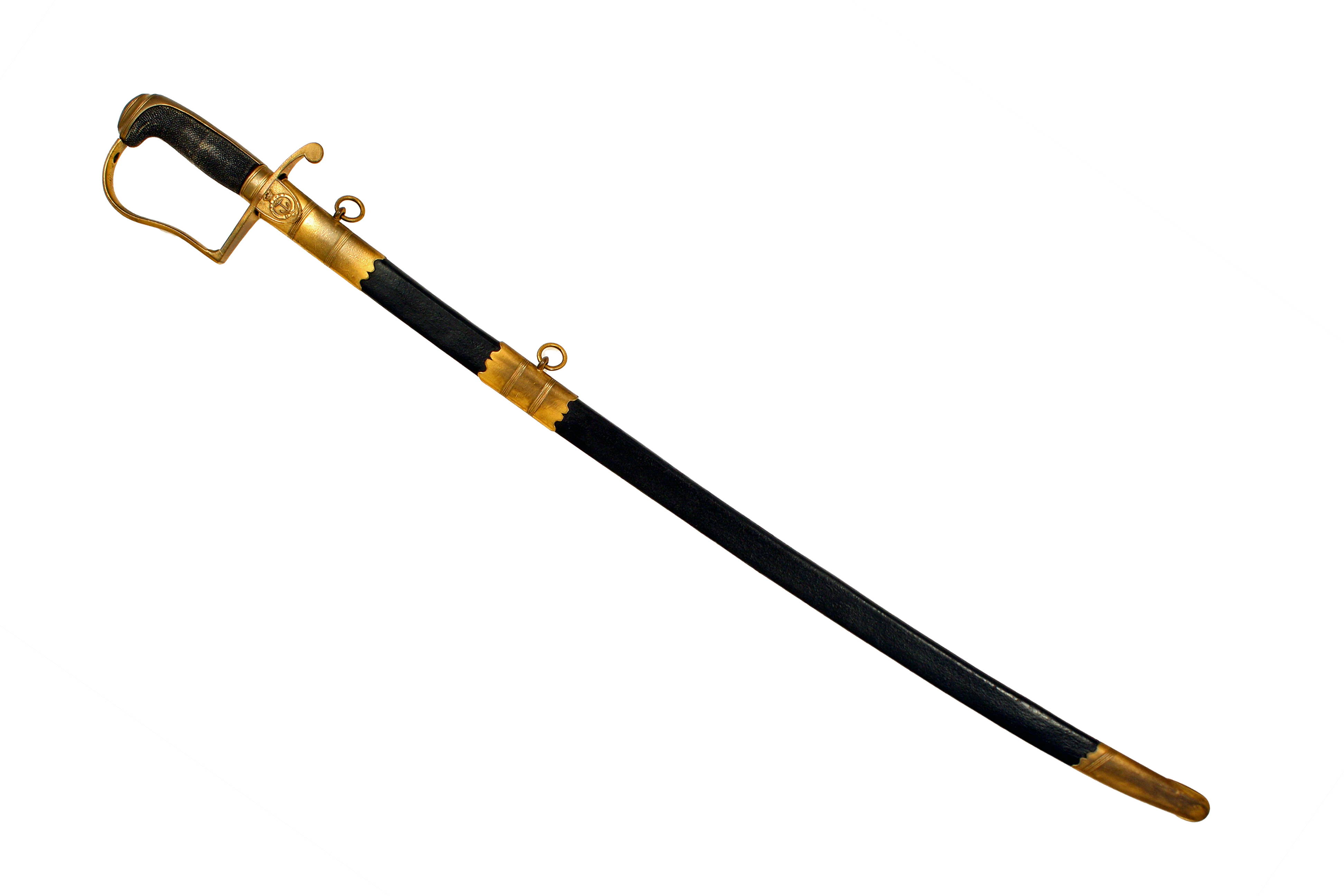
**ATTRIBUTED**WW1 1915 British Henry Wilkinson P 1912 Cavalry Officer’s Sword Etched Monogram Blade Number 48745 To 2nd LT Ferguson Scottish Horse Yeomanry Killed Egypt 1916 With Field Service Scabbard & Provenance. Sn 23484:103 -. The Scottish Horse was a Yeomanry regiment of the British Army’s Territorial Army raised in 1900 for service in the Second Boer War. It saw heavy fighting in both the First World War, as the 13th Battalion, Black Watch, and in the Second World War, as part of the Royal Artillery. It amalgamated with the Fife and Forfar Yeomanry to form the Fife and Forfar Yeomanry/Scottish Horse in 1956. The lineage is maintained by "C" Fife and Forfar Yeomanry/Scottish Horse Squadron of The Scottish and North Irish Yeomanry based in Cupar in Fife. 2nd Lieut Alexander Robertson Ferguson served with the 1/3rd Scottish Horse Yeomanry during WW1 and was accidentally killed on 14th June 1916 while serving in Egypt This is an original, WW1 British 1912 Pattern Heavy Cavalry Officer’s Sword to 2nd Lieut Alexander Robertson Ferguson. The Sword has an undamaged 35" single edged blade with fuller (43" overall). The blade is clean & etched on one side with stylise ‘ARF’ combined monogram (Alexander Robertson Ferguson). The ricasso is crisply marked on one side by the manufacturer ‘Henry Wilkinson Pall Mall London’ together with Royal Warrant. The reverse has the ordnance acceptance star and inlaid proof roundel. It has a full bowl guard with fish skin wire bound handle with correct thumb recess for grip. The fish skin & wire binding is all clean and intact. The hilt is fitted with its original buff leather officer’s cord and leather portepee. The back of the blade is numbered ‘48745’ (Wilkinson records state that this sword was sold to Ferguson Scottish Horse 10th April 1915). It is complete with its original leather bound field service scabbard. All leather and stitching of the scabbard are clean & intact. Copies of some Family antecedents, the Officer’s field service record reporting his death in 1916, a copy of his Commonwealth War Graves Kantara (Egypt) war memorial record & copies of archive records from Wilkinson Sword stating that this sword number 48745 was sold to Ferguson Scottish Horse 10th April 1915 accompany the sword. The price for this WW1 Officer’s sword worthy of further research includes UK delivery. Sn 23484:103
Page 39 of 152