
Show

Forgot your password?

Error message here!

Error message here!

Error message here!

Error message here!

Show Error message here!

Show Error message here!

Lost your password? Please enter your email address. You will receive a link to create a new password.

Error message here!

Back to log-in

Close

For Sale

The following items are listed by for sale by users of the site and dealers. They are in no way endorsed or guaranteed by www.antiquearmsresearch.com

Add a Classified Item
to

Clicking on the sword will take you through to the relevant classified item or dealer site.
Don't miss out! - Do you want to be kept informed weekly of new aditions? Just join our weekly update list.

You can also receive regular email notifcations when items match your keywords. To recieve them just register or logon at the top right of this page.
Page 42 of 156
  • Nation : Japanese
  • Local Price : £1,545.00
1885 Period Into WW1 & WW2 Japanese Officer’s Army Kyu Gunto Parade Sword With Gendaito Hand Forged Blade, Scabbard With Leather Field Combat Cover & Expert Assessment. Sn 16923 -. This is an original Japanese Officer’s Army Officer’s Parade sword. The sword has been assessed by UK Japanese sword expert Bill Tagg. A copy of his hand written notes accompany the sword. In extracts from his notes he states “An 1885 period Kyu Gunto sword with traditional Gendaito hand forged blade. Looks like Hizen school work from tang shape & forging which is Suguha (straight) with Nie crystals on the Ha-Buchi. Blade has a cutting edge of 27”. Hada is very fine wood grain. The tang is un signed. Hilt is missing a family mon badge, can see small hole in fuchi where it would have been. The whole sword is of 19th century manufacture, a sword carried in both world wars”. The hilt has a push button scabbard retaining clip which is complete but does not lock into the throat mount of the scabbard. The Ray skin covered handle has small areas of wear to be expected and its original wire binding is intact. All the fittings are original. The sword is complete with wood scabbard which has a single hanging ring. The scabbard is fitted with a replacement field combat cover. All leather and stitching of the cover are intact. The price includes UK delivery. Sn 16923
  • Nation : British
  • Local Price : £1,500.00
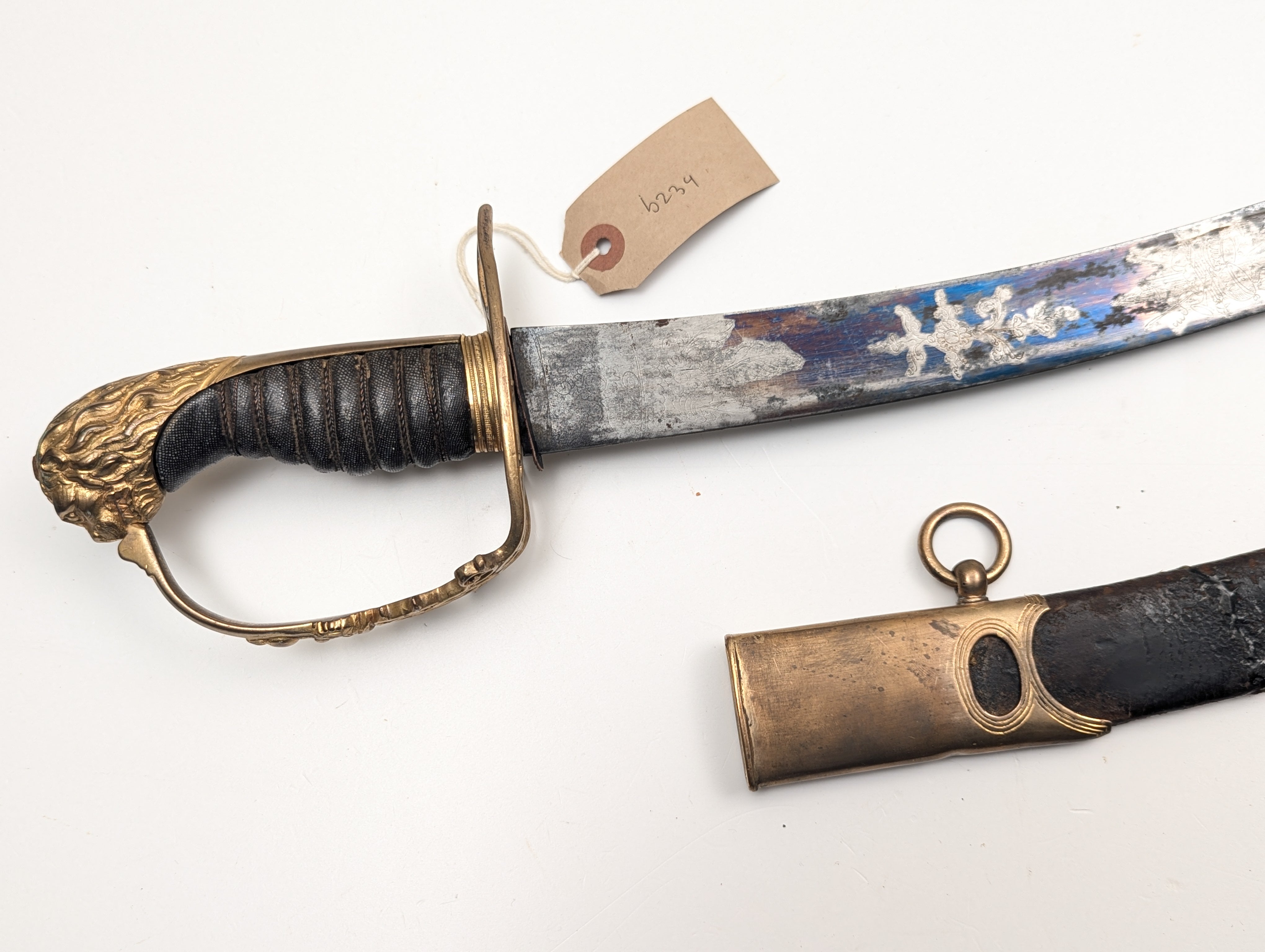
British 1827 Pattern Naval Flag Officer&#acute;s Sword with &#acute;Andrea Ferrara&#acute; Broadsword Blade. Description Triple-fullered broadsword blade 29 inches in length, 35 inches overall. Gilt brass half-basket hilt cast with a crown and fouled anchor within a cartouche, hinged inner guard, brass backstrap with lion head pommel cap, white shagreen grip, brass ferrule with sword knot ring. Black leather scabbard with gilt brass fittings at the throat, chape and middle, the throat with two opposed hanging rings and the middle piece with one hanging ring. The blade is engraved on both sides with &#acute;ANDREA FARARA&#acute; [sic], and also features the royal crown and coat of arms with motto &#acute;HONI SOIT QUI MAL Y PENSE&#acute;, a quatrefoil design, a sunburst at the ricasso and feathers (possibly the three feathers heraldrically associated with the Prince of Wales). The top piece of the scabbard is engraved with the maker&#acute;s mark &#acute;PROSSER Maker to the King and Royal Family LONDON&#acute;. The level of decoration of the scabbard signifies that this was the sword of a flag officer “ that is, an officer with a rank higher than Captain. It conforms to regulations laid down in 1832 for flag officer&#acute;s scabbards, with one modification “ a third hanging ring was added later on the opposite side of the chape piece to the original. This was a change introduced in 1847, showing that this sword was still being carried by that date. Higher-ranking naval officers could get away with significant variations in their uniform swords “ some are even recorded as having carried foreign swords or British models that had been declared obsolete. This scabbard may have been produced at a later date than the sword, either after the 1832 regulations or upon the officer&#acute;s promotion to flag rank, since the ring fixed to the ferrule typically indicates an early example of the 1827 Pattern sword hilt. The use of a broadsword blade in a British naval sword is not unheard of: the National Maritime Museum at Greenwich holds seven examples of such blades. However, these all date from 1870-1882 and result from the use of standard-pattern broadsword blades, which were produced for Scottish infantry regiments from 1866. With such blades readily available some officers may simply have chosen them for looks or personal preference. This sword is an example of an earlier practice, one more often seen in the Army, of officers reusing broadsword blades of the 17th or early 18th century, fitting them into the regulation pattern hilt and accoutrements to make them fit for service in a new era “ or fit enough not to stand out too much on parade, at least. It is quite likely that these were inherited &#acute;family&#acute; blades, since it was a common practice (particularly in Scotland) to rehilt swords and keep them in use over generations. I have found no reference to this being done to produce a naval sword before, this example may be rare or unique in that respect. For an excellent pair of examples, see The British Cavalry Sword (Companion Volume) by Richard Dellar, page 25, depicting the 1796 Pattern dress and undress swords of Lieutenant-Colonel David Home of the 2nd Dragoons. Both of Home&#acute;s swords have &#acute;Ferara&#acute; [sic] marked broadsword blades, fitted by the London cutler Johnston into regulation hilts at some point between 1798 and 1802, with custom scabbards to match. Andrea Ferrara is a name that appears quite often (with a number of spelling variations) on English and Scottish blades of the 17th century, leading to much speculation as to who this celebrated swordsmith was. Giovan Cigogna, describing Venetian swordsmiths in his book Trattato Militare (1583) writes that &156;in the town of Bellune are the ingenious master Giouan Donato and master Andrea dei Ferari, both brothers.&157; The town is today called Belluno, and a contract exists in the State Archives of Belluno from December 1578 in which these same brothers agree to supply 600 swords &#acute;of the kind used in England&#acute; per month for ten years to a London-based importer, a huge quantity which suggests that their operation was at a significant scale for its time, although whether the contract was filled entirely or cancelled at some point is unknown. There is no evidence that either brother ever visited Britain and despite the quantity mentioned in the contract no more than a fraction of the blades found today can possibly have been made in Belluno, especially as many are clearly more recent. Rather it would seem that the imported blades were of such impressive quality that the Ferrara mark was counterfeited by others and/or used as a general mark for a blade of superior quality rather than specific manufacture. The fact that &#acute;Andrew Ferrara&#acute; or simply &#acute;Ferrara&#acute; became a slang term for the Scottish broadsword and sometimes for swords in general supports this interpretation, and it is unlikely that many people at the time believed their blade was forged by the man himself. John Prosser was a prominent London sword cutler who took over the business of his employer Thomas Cullum in 1795 and traded on Charing Cross Road until 1860, specializing in high-quality blades including custom officer&#acute;s swords and presentation swords. He was creative with his commissions and invented the &#acute;quill-point&#acute; blade in 1818. In his early years of business he developed a close relationship with the Prince of Wales, whose infatuation with military pomp led him to commission several swords from Prosser, including a set awarded to the officers of the 10th Hussars, his pet cavalry regiment, in 1808. This connection was rewarded with titles: Prosser was appointed Sword Cutler and Beltmaker to King George III and in 1820 was made Sword Cutler in ordinary to King George IV (the former Prince). Prosser&#acute;s firm proudly displayed these royal connections on every sword sold, in this case a custom version of the naval officer&#acute;s hilt and scabbard to accommodate a pre-existing blade. It is possible that Prosser did not do the rehilting, since Prosser-made naval swords typically do not feature a folding guard, but this cannot be proven either way without a maker&#acute;s mark on the sword itself. The blade has some areas of pitting and what look like repairs in places to fill in old damage. This has sadly obscured some of the engraving, which is unusually extensive for a Ferrara blade and might have been added to over time. The scabbard leather has shrunk and hardened with age, which has burst its stitching along the seam. Its fittings are all sound and retain a good deal of gilding, while the sword&#acute;s hilt retains almost all of its gilding even in areas that would be handled more. The hinged flap of the hilt works well and fits onto a pin at the scabbard&#acute;s throat to lock the sword into the scabbard. The shagreen grip was almost certainly originally bound with wire, but this has been lost. The white shagreen itself is in good condition, with no damage and little handling wear.
  • Nation : Chinese
  • Local Price : £1495
Click and use the code >24876 to search for this item on the dealer website Archaic Chinese Warrior´s Bronze Sword, Around 2500 Years Old, From the Zhou Dynasty to the Qin Dynasty, Including the Period of the Great Military Doctrine ´The Art of War´ by General Sun-Tzu
  • Nation : Japanese
  • Local Price : £1,495.00
**ANCIENT 1500-1580 MUROMACHI AGE OF WAR PERIOD**Japanese Samurai Uchi Gatana Single Hand Sword Blade Smith Signed ‘KANE NAGA’ In Protective Honoki Wood Shira Saya Resting Mounts, Later Cloth Cover Carry Bag & Expert Assessment. Sn 22591 -. This is an ancient Japanese Katana blade which has been assessed by UK Japanese sword expert Bill Tagg. A copy of his hand written assessment notes accompany this blade. Extracts from the assessment and notes include “Uchi Gatana Single Hand Sword Blade in Shia saya resting mounts. Ancient blade. This is LATER PERIOD Muromachi blade, ran from 1392-1573 Age of War. There were several smiths using this two kanji during 1500 to 1580. Because its only a short inscription hard to determine which one. In good Hadori polish showing an uneven midareba hamon getting thin in parts dure to lots of repolishing and re-sharpening (no Ha-Machi left). Lost couple of millimetres of edge with several small grain kizu openings. Reasonable condition for its great age. See Malcolm Cox book of mino den swordsmiths page 82 lists a Kane Naga working in sueseki style Tensho era 1573. Signed with small Kanji like this blade (possible man?). rated chusaka medium / average swords. Mounted in late 19th into 20th century Honoki wood shira saya. Good quality silver habaki with raindrop decoration in very good condition. A Genuine Samurai sword”. In his illustrations of the blade he adds “cutting edge is 58 cms, total length is 73 cms. He also translates the describes other blade and tang characteristics and dimensions which can be seen in the images. The price for this ancient blade with original expert assessment includes UK delivery. Sn 22591
  • Nation : British
  • Local Price : $1495.00
English Plug Bayonet by John Hathaway, ca. 1690. Featuring tapering 11 ½” single-edged wedge-section blade, double-edged for the last 5 1/4″. The forte is deeply stamped on one side with the Blazing Star mark assigned to John Hathaway by the Worshipful Company of Cutlers of London on September 26, 1689 and also an unidentified King's Head mark (KH18 in R.D.C. Evans' “The Plug Bayonet”). While the King's Head was a mark used by Solingen makers Weyersberg and Wundes, this mark is clearly different, as all the German Kings Head marks are left facing profiles, whereas this one is right facing. The brass hilt is of the type known as the Winged Figure Series in Evans' book and the slightly upturned quillons and pommel both feature this three-dimensional figure. The grip is of turned walnut with a brass ferrule at the base and tapering crimped pommel cap with integral winged figure finial. Overall length 17 5/8″. Blade with light pitting, hilt and grip near excellent. A very fine example of a classic English plug bayonet of the period of James II and the ascension of William of Orange. Another example by this maker, formerly in the 2003 catalog of Peter Finer, Ltd. is currently being offered by a UK dealer for 2825 British Pounds (nearly $4000 USD).
  • Nation : ?
  • Local Price : $1495.00
European Field Sword/Rapier, Last Quarter 17th C. Iron hilt with single side ring filled with plate pierced and chiseled with scrolling acanthus decoration; diagonal scrolled quillon, and knuckle bow connected to ovoid pommel; each chiseled with diagonal fluting. Grip with original fine twisted iron wire, finished with Turks heads top and bottom. Slender 28 3/4” (73 cm) blade of flattened diagonal section, with 7 1/4” central fuller with stylized stamped “EN TOLEDO” on both sides and anchor mark at the fuller’s end. Very good original condition, showing wear and light pitting, having never been apart. Overall length 34” (86.4 cm).
  • Nation : British
  • Local Price : £1,495.00
Flank Officers Sword to the 100th Regiment of Foot. SN 8779. A Fine Flank Officers Sword to the 100th &194;&160;Regiment of Foot (Prince Regent’s County of Dublin Regiment). 38&157; overall, 33&157; blade of 1796 Light Cavalry form. Engraved with gilt highlights with Crown GR over Prince of Wales Feather and ´Warranted´ to one side, on the other a post 1800 Royal coat of arms, floral sprays and ´B.W & Co London´ in a ribbon. D shaped knuckle bow lions head pommel, ribbed ivory grip. One langet with a lion mask the other with a regimental badge (Prince of Wales feathers over PR). Black leather and gilt mounted scabbard with makers roundel ´J Read College Green Dublin´ Circa 1805&194;&160; &194;&160; &194;&160; &194;&160; &194;&160;&194;&160; Sword in very good condition minor chip to the rear of the ivory grip.&194;&160;(This item is registered for the ´less than 10% by volume´ exemption to the Ivory Act 2018 and therefore we are legally allowed to sell it 67PCF9QX) UK sale only - NOT FOR EXPORT. 100th &194;&160;Foot were raised in Ireland in 1804 and sent to Nova Scotia in 1805 and served throughout the war of 1812, in 1813 renamed 100th Regiment of Foot Prince Regent’s County of Dublin Regiment, disbanded in 1819 Images courtesy of West Street Antiques (https://antiquearmsandarmour.com/)
  • Nation : French
  • Local Price : £1,495.00
French Small Sword, Very Fine. SN 9123. A Very Fine French Small Sword with Chiselled Iron Hilt with Gold Inlay. 37 1/2&157; overall, 31&157; hollow ground colichermarde blade with etched panel blade. Russet iron hilt chiselled in low relief against a finely matted gilt ground, including shell guard decorated with differing pastoral scenes, quillon block with a hunter on one face and a warrior on the other, knuckle guard and ovoid pommel en suite with the guard, and the grip bound with plaited wire and ribband between Turks heads. Circa 1740&194;&160;&194;&160;&194;&160;&194;&160;&194;&160;&194;&160;&194;&160;&194;&160;&194;&160;&194;&160;&194;&160;&194;&160;&194;&160;&194;&160;&194;&160;&194;&160;&194;&160;&194;&160;&194;&160;&194;&160;&194;&160;&194;&160;&194;&160;&194;&160;&194;&160;&194;&160;&194;&160;&194;&160;&194;&160;&194;&160;&194;&160;&194;&160;&194;&160;&194;&160;&194;&160;&194;&160;&194;&160;&194;&160;&194;&160;&194;&160;&194;&160;&194;&160;&194;&160;&194;&160;&194;&160;&194;&160;&194;&160;&194;&160;&194;&160;&194;&160;&194;&160;&194;&160;&194;&160;&194;&160;&194;&160;&194;&160;&194;&160;&194;&160;&194;&160;&194;&160;&194;&160;&194;&160;&194;&160;&194;&160;&194;&160;&194;&160;&194;&160;&194;&160;&194;&160;&194;&160;&194;&160;&194;&160;&194;&160;&194;&160;&194;&160;&194;&160;&194;&160;&194;&160;&194;&160;&194;&160;&194;&160;&194;&160;&194;&160; Very attractive sword in good condition.&194;&160; Ex the David Jeffcoat Collection (1945-2020) Images courtesy of West Street Antiques (https://antiquearmsandarmour.com/)
Page 42 of 156