
Show

Forgot your password?

Error message here!

Error message here!

Error message here!

Error message here!

Show Error message here!

Show Error message here!

Lost your password? Please enter your email address. You will receive a link to create a new password.

Error message here!

Back to log-in

Close

For Sale

The following items are listed by for sale by users of the site and dealers. They are in no way endorsed or guaranteed by www.antiquearmsresearch.com

Add a Classified Item
to

Clicking on the sword will take you through to the relevant classified item or dealer site.
Don't miss out! - Do you want to be kept informed weekly of new aditions? Just join our weekly update list.

You can also receive regular email notifcations when items match your keywords. To recieve them just register or logon at the top right of this page.
Page 43 of 156
  • Nation : British
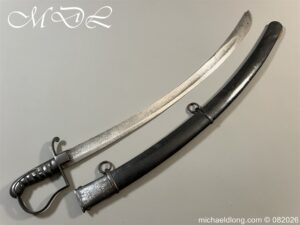
  • Local Price : £1,495.00
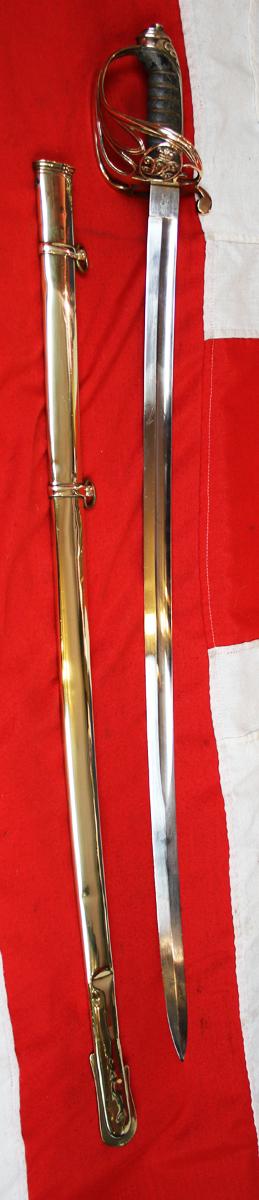
Light Cavalry Officers 1821 Pattern Sword. Ref X3402. A Light Cavalry Officers 1821 Pattern Sword, 40" overall, 34 1/2&157; straight blade with broad fuller & spear point, etched with trailing foliage & crowned VR on one side, the other with 16th Lancers Regimental badge & motto, & the regiment´s 13 Battle Honours from Talavera in 1809 to Sobraon in 1846. Etched on the forte&194;&160;’Henry Wilkinson Pall Mall London´, numbered on the spine 23731. Three bar steel hilt, chequered pommel, fish skin grip, with its original bullion acorn sword knot. In its original plated steel scabbard with 2 suspension rings. Number 23731 for 1880. Sword in very good condition, very good blade. Lieutenant Matthew Herbert Woods.&194;&160; Commissioned 22.3.1879 Lieutenant 1.12.1880, retired by 1886.&194;&160; &194;&160; &194;&160; &194;&160; &194;&160; &194;&160; &194;&160; &194;&160; &194;&160; &194;&160; &194;&160; &194;&160; &194;&160; &194;&160; &194;&160; &194;&160; &194;&160; &194;&160; &194;&160; &194;&160; &194;&160; &194;&160; &194;&160; &194;&160; &194;&160; &194;&160; &194;&160; &194;&160; &194;&160; &194;&160; &194;&160; &194;&160; &194;&160; &194;&160; &194;&160; &194;&160; &194;&160; &194;&160; &194;&160; &194;&160; &194;&160; &194;&160; &194;&160; &194;&160; &194;&160; &194;&160; &194;&160; &194;&160; &194;&160;&194;&160; Images courtesy of West Street Antiques (https://antiquearmsandarmour.com/)
  • Nation : Chinese
  • Local Price : £1495
Click and use the code >26100 to search for this item on the dealer website Most Scarce Antique Ching Dynasty Chinese ShuÄ
  • Nation : British
  • Local Price : £1,495.00
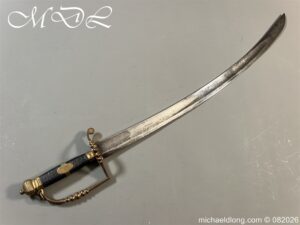
British 1788 Pattern Light Cavalry Troopers Sabre. Thomas Gill Circa 1788-1792. #2412004. The scarce British 1788 pattern light cavalry sabre was the first regulation pattern sword adopted by the British cavalry and was closely based on examples already in use both in Britain and in Europe. This troopers’ sabre was made in Birmingham by Thomas Gill Snr., between 1788 and 1792.The 900mm curved blade has a thick, flat spine above a broad fuller running almost into the spear point. The blade has an upper false-edge, the last 100mm of which was service sharpened.The forte of the blade is engraved with the maker’s logo, “Gill’s Warranted.” The blade is in very good condition for its age and service, with a pale speckled patina and a small nick to the forward edge.The iron stirrup hilt with double languets is in good condition with shallow pitting and some tarnish. The shagreen wrapped wooden grip is in fair condition with wear and small losses to the shagreen. The grip remains strong and the blade is firm in the hilt.The sabre is complete with its iron scabbard with twin suspension rings. The scabbard retains its wooden core. The iron is pitted and cleaned and remains strong with no perforations. The leather panel between the suspension bands looks to have been replaced. The sword sheathes and draws smoothly and is held firmly within the scabbard.This is a good example of a scarce 1788 pattern British light cavalry sabre by one of Georgian England’s top makers. Was: £1,495.00Now:
  • Nation : Turkish
  • Local Price : £1495
Click and use the code >24262 to search for this item on the dealer website Beautiful Mughul High Ranking Warrior´s Sword Talwar 17th-18th Century, Likely Wootz or Damascus Kilij Form Blade
  • Nation : British
  • Local Price : £1495
Click and use the code >25457 to search for this item on the dealer website Fabulous Knight&#acute;s Seal Ring, From Agincourt to the Wars of the Roses Period. A 15th Century Ring with an Intaglio Stylized Engraving of An Armoured Knight on Horseback Holding Aloft His Knightly Sword, a Fabulous and Beautiful Piece.
  • Nation : Iberian
  • Local Price : £1495
Click and use the code >25041 to search for this item on the dealer website Most Fine 18th to Early 19th Century Ottoman Empire Jannisaries YataÄ&159;an Sword, Carved Horn ´Eared´ Hilt & Original Hide Covered Wooden Combat Scabbard
  • Nation : American
  • Local Price : 2,100.00 USD
AMERICAN REVOLUTIONARY WAR HANGER C.1770-80. Provincially made example. Brass hilt comprising stirrup form guard with loop side guard, lighter throughout than commercially produced examples. Raised edge pommel with integral mounded button. Wood grip, perhaps walnut, expanding awkwardly toward the pommel and originally mounted with four brass capped bosses each side. The brass dark with aged patina. The wood dry with age crack and small loss at the guard terminal.  24 ¼” curved blade, very slightly concave each side and blacksmith made.
  • Nation : British
  • Local Price : £1480
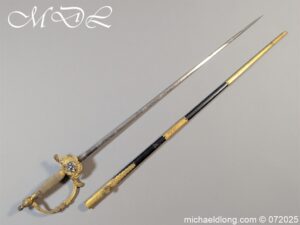
English Silver Hilted Small Sword by Joseph Clare (II) Hallmarked for 1769 / 1770. An English silver hilted small sword by Joseph Clare (II) of London with hallmarks for 1769 / 1770.  The hilt is mounted with an oval shaped dish guard which is exquisitely pierced and engraved with  bold star shaped florets surrounded by  scrolls  and sprays which form the main design theme.  This design pattern is common to the pommel,  ricasso and knucklebow, which attests to the originality and homogeneity of the parts. The sword is well-balanced and mounted with a hollow ground triangular section blade which retains its original decorative engraving on its three sides near the hilt. The baluster shaped grip is covered with spirally wrapped silver crimped strip, the strip separated by triple length twisted wire. Silver cap terminals are present top and bottom of the grip engraved with scallops. The cross guard is mounted with forward and rear drooping tear drop shaped quillons and shallow pas d’ane rings. Joseph Clare was a talented silversmith and silver-hilted sword maker. From 1732 he was apprenticed to Jeremiah Marlow of the Goldsmiths’ Company. After being made free he practiced at a few addresses within the City of London and died in 1771. Clare registered at least four marks with Goldsmiths’ Hall, most being simple representations of his initials in panels which was most usual for silversmiths at the time. The mark on this sword is distinctive in its complexity in that it contains the four letters of his name “C L A R E” inside a panel (see Grimwade Number 358), the first two letters above and the following three below. This mark was registered on 1st  October 1767 and replaced an earlier simpler mark, but was in turn replaced by his last registered mark 16th September 1768. This distinctive mark, therefore, was used for less than a year and is a rare survivor. For examples of Clare’s work see “London Silver-Hilted Swords”, their makers, suppliers and allied traders, with directory, by Leslie Southwick, 2001, Royal Armouries, plates 5, 53 and 61 (the latter two are in the Royal Armouries collection references: ix.798 and ix.1861) respectively, and for Clare’s biography page 72 The hilt is an example of the high standards of design and execution required of the 18th century London silversmith as well as an example of one of the most effective weapons of the 17th and 18th centuries. The hilt retains its original pleasing contours and the blade is in fine clean condition. The engraved designs on the dish guard are clear and exhibit delicate working life repairs in two small areas on each side of the hilt either side of the blade. It appears that an opponent’s blade may have punctured the delicate guard in these places which has led to the repair. The grip maintains its pleasing profile but the wire wrapping is distressed. The blade is discoloured with age related blemishes but is in fair condition. For a further reference see Arthur G Grimwade, 1990, “London Goldsmiths 1697 – 1837 Their Marks and Lives” for a precis of the known records for Clare,  and a summary of his marks. The blade is just over 32 inches (81.5 cm) long and the overall the sword is 38.5 inches (97.75 cm) long.
Page 43 of 156