
Show

Forgot your password?

Error message here!

Error message here!

Error message here!

Error message here!

Show Error message here!

Show Error message here!

Lost your password? Please enter your email address. You will receive a link to create a new password.

Error message here!

Back to log-in

Close

For Sale

The following items are listed by for sale by users of the site and dealers. They are in no way endorsed or guaranteed by www.antiquearmsresearch.com

Add a Classified Item
to

Clicking on the sword will take you through to the relevant classified item or dealer site.
Don't miss out! - Do you want to be kept informed weekly of new aditions? Just join our weekly update list.

You can also receive regular email notifcations when items match your keywords. To recieve them just register or logon at the top right of this page.
Page 5 of 119
  • Nation : -
  • Local Price : $5,995.00
Exquisite Chiseled North European Rapier, ca. 1650. Unique and superbly chiseled iron hilt with separate lower guard featuring down-turned acorn-shaped knob on the obverse side and an upturned hollow heart on the reverse. Partial pas d’ane with long chiseled quillon block and single chiseled acorn-shaped quillon. Single side ring curving upward to join the knuckle bow, which in turn joins the acorn- shaped pommel with large button. Decorated ensuite with chiseled acanthus design in relief. Original grip wrapped with two sizes of twisted copper wire and finished with turks heads top and bottom. Cleaned hollow-ground single-edged 35 3/8″ blade with ridge on the spine and double-edged for the last 8 1/4″; remains of engraved design at the forte. Overall length 42″. Beautiful and unique sword of extraordinary quality, much better in person than photos.
  • Nation : British
  • Local Price : £5995.00
A Wonderful 18th Century French Small-Sword of Parcel Gilt and Blued Steel A Simply Stunning Museum Grade Piece. A Stunning Example of This French Master Craftsman’s Artistry and Skill in Service in The Royal Court of King Louis XVth. A sword that is certainly worthy of a finest collection of all forms of object d'art, antiquities, antiques and militaria. Likely made at Versailles, at the royal workshops, by a royal swordsmith of King Louis XVIth, such as the master swordsmiths of the king, Lecourt, Liger or Guilman. A very finest grade sword of the form as was made for the king to present to favoured nobles and friends. He presented a similar sword to John Paul Jones see painting in the gallery now in the US Naval Academy Museum. Three near identical swords to this now reside in the Metropolitan A simply superb small-sword, with stunningly engraved chiselled steel hilt, overlaid with pure gold over a fish-roe background, decorated with hand chiselled scenes in the rococo Italianate renaissance style depicting various hunting scenes, of hunting hounds and game birds. The multi wire spiral bound grip is finest silver, in with Turks head finials. The blade is in the typical trefoil form, ideal for the gentleman's art of duelling. The degree of craftsmanship of this spectacular sword is simply astounding, worthy of significant admiration, it reveals an incredible attention to detail and the skill of it's execution is second to none. Other similar swords are in also in the British Royal Collection and in Les Invalides in Paris. Trefoil bladed swords had a special popularity with the officers of the French and Indian War period. Even George Washington had a very fine one just as this example. For example of the workmanship in creating this sword for such as the King and Marie Antoinette we show the keys for the Louis XVI Secretary Desk (Circa 1783) made for Marie-Antoinette by Jean Henri Riesener, one of the worlds finest cabinetmakers, and whose works of furniture are the most valuable in the world. The steel and gold metalwork key for Marie Antoinette's desk, is attributed to Pierre Gouthoire (1732-1813), the most famous Parisian bronzeworker of the late eighteenth century who became gilder to the king in 1767. This sword bears identical workmanship and style to that magnificent key. This is the quality of sword one might have expected find inscribed upon the blade 'Ex Dono Regis' given by the King. Very good condition overall, with natural aged patination throughout. The painting in the gallery is titled John Paul Jones and Louis XVI, by the American artist Jean Leon Gerome Ferris depicts John Paul Jones and Benjamin Franklin at the court of Louis XVIth and being presented a similar sword now in US Naval Academy Museum. 39.1/4 inches long overall.
  • Nation : British
  • Local Price : £5900.00
A Sublime Napoleonic Ist Empire French Superior Officer’s Blue & Gilt Officer’s Sword in the Mameluke Style, With Finest Deluxe Grade Chiselled Decor. We Always Try Our Utmost To Offer The Finest or Most Intriguing Pieces We Can From History. With copper mercurial gilt hilt and chequered polished horn grip original gilt scabbard with helmeted Minerva head mounts, twin ring belt fittings with its original, multi looped hanging belt chains, with spring catches. Finely engraved blue and gilt blade. Napoleon's Egypt Campaign, that ended in 1801, many Napoleonic officer's adopted the so-called oriental mounted swords, modelled on the Mameluke taken by him from Murad Bey, commander of the Mamelukes, which he holds in his Egypt portrait captured from the Egyptian Marmalukes {see gallery} that eventually became part of Napoleons Imperial Garde. These swords, in their turn, were captured by the British and similarly adopted as a form of highly favoured officers sword. In fact the mamaluke sabre became the British General's pattern sword that is still in use today. Several of these specific swords were part of a Sotheby's Napoleonic Wars auction in Monaco in 1990, titled "Belles Armes Anciennes Casques et Objects Militaires". The last photo in the gallery is of Joachim Napoleon Murat, King of Naples, brother of Napoleon's Mameluke sword, somewhat similar to our sword, and all based on the sword of Napoleon from Murad Bey. In May of 1804 Napoleon established the French Empire and with it he brought back the title of Marshal of France, also known as Marshal of the Empire at this time. Abolished by the National Convention in 1793, the title of Marshal of France was officially a civilian appointment but reserved for experienced generals. It was an honor to become a marshal and the marshals received higher pay and privileges. Napoleon wished to gain legitimacy in the eyes of Europe since other nations had the rank of field marshal, and he wished to reward and ensure the loyalty of the generals to his empire and thus they wore such swords of this quality and beauty. One of his greatest marshals to wear such a sword was Marshal Marshal of the Empire Étienne Macdonald duc de Tarente Étienne Jacques-Joseph-Alexandre Macdonald. During the spring of 1810, Marshal Macdonald was sent to Spain to take command of the Army of Catalonia. While there he won at Ververa, but in 1811 he fell ill and returned to Paris again. In 1812 Macdonald was given command of the X Corps of the Grande Armée for the campaign against Russia. Macdonald's corps missed most of the fighting of 1812 due to being ordered to hold the left flank, but also due to his command being primarily composed of Prussian and German soldiers, with only his headquarters staff being French. Macdonald's corps laid siege to Riga in August, but they lifted the siege in December during the retreat, just in time for the majority of his force to defect away from the French side due to Prussian nationalism. Napoleon needed experienced commanders for the campaigns of 1813, and in April of that year Macdonald was given command of the XI Corps. He won at Mersebourg and then commanded the right at the Battle of Lützen. Macdonald continued to lead his men into action, winning at Bischofswerda and then commanding the right at the Battle of Bautzen. That August he was placed in charge of multiple army corps but was then beaten by General Blucher at the Katzbach. Nevertheless, Macdonald continued to serve, and he fought at Leipzig , where after the bridge was blown early he had to swim the Elster River to escape capture. After surviving that escape unlike his fellow marshal Poniatowski, Macdonald resumed his command and then fought at Hanau. Marshal Macdonald served during the defense of France of 1814, initially defending the Rhine but then being forced to fall back to Meaux. That February he fought at Mormant and Ferté-sur-Aube and then in March he fought at Provins and Saint-Dizier. By Napoleon's side, Macdonald along with Marshal Ney convinced Napoleon that he should give up the war and abdicate in favor of his son, Napoleon II. Macdonald, Ney, and Caulaincourt were then sent to negotiate with the Allies, but ultimately they were unable to secure the throne for Napoleon's son. When Macdonald returned to Napoleon to deliver the terms of surrender, Napoleon gave him the sword of Murad Bey, the Mameluke leader that he had defeated in Egypt. Minerva, whose helmeted face is depicted and seen on the scabbard mounts, is the Roman goddess of wisdom, justice, law, victory, and the sponsor of arts, trade, and strategy. Minerva is not a patron of violence such as Mars, but of strategic warfare. The blades scabbard has some inside denting at the base, and the blade has some natural age wear to the blue and gilt. Of course this sword’s original owner is now unknown, as none of its history was recorded or saved, however, once accurately known, a sword such as this could be valued anything from treble, to one hundred times its current price, simply depending on how famed he was then or now, or, how important he was to Napoleon and his campaigns. Marshal Nay’s sword for example could easily be valued from one to several million pounds.
  • Nation : British
  • Local Price : £5795.00
Presented By The Queen of Spain in 1837 To US General John H Eaton, President Jackson’s Aide in the Creek War, & The War of 1812. Worn in The American Civil War By Col. Magruder The Hero of Fredericksburg, And By Him At The Funeral of President Lincoln. After personal presentation from the Queen of Spain to General Eaton this sword became the property, by inheritance, and was worn, during the American Civil War, by of US Civil War hero of Fredericksburg, Colonel James A Magruder Just at the time the war was threatening Colonel Magruder was with General Meigs in erecting fortification in Virginia around the city. When the war came on he was commissioned as Major of the 15th New York Engineers. His regiment was immediately ordered to the front. The pontoon bridge across the Rappahannock River, at Fredericksburg, Virginia, was built under his directions, he at the time remaining in the saddle for sixty straight hours, under a steady fire from the enemy. Soon after going to the front he was promoted to the rank of Lieutenant Colonel and he held that position until the close of the war. He was a personal friend of General Grant. From the repeated cannonading, Colonel Magruder became deaf, This fabulous eagle hilted sword was worn, after its inheritance from General Eaton, by the friend of Ulysses S. Grant, Col. James A. Magruder, during the Cival War and at the funeral of President Lincoln. Since 1967, for several decades, this wonderful and historic sword was on display at Dumbarton House in Washington DC, a federal historic house museum A simply stunning historical Spanish presentation General’s sword, presented, by tradition, to United States General John H Eaton, Envoy Extraordinary & Minister Plenipotentiary for President Andrew Jackson's America, to the Kingdom of Spain, by Her Majesty Maria Christina de Borbon, Queen Consort, and Regent for her daughter Isabella II Queen of Spain, in 1837. This magnificent sword has a fine tapering double-edged blade of flattened-hexagonal section, stamped 'Ano D 1837' and 'Fa Ntl Di Toledo' on the respective faces at the forte, finest mercurial gilt bronze hilt, cast with wonderful classical ornament in relief, including oval shell-guard decorated with the eagle perched astride the lightning bolts, flanked by classical figures, the quillon-block bears the letter 'F' for Ferdinand' enclosed within a laurel wreath, a pair of straight quillons, knuckle-guard and pommel, and integral grip all decorated en suite, in its blued iron scabbard with gilt-bronze suspensions mounts and drag 76.8 cm; 30 1/4 in blade Provenance; By tradition presented to General John H. Eaton US General J.H.Eaton, Envoy Extraordinary for President Andrew Jackson to Spain, who was married to the ward of President Andrew Jackson. It was presented by the Regent of Spain, Her Majesty Queen Maria Christina in 1837, when General Eaton was Envoy Extraordinary and Minister Plenipotentiary to Spain (1836-1840). Maria Christina of Spain (when Regent for her daughter, the future Isabella II) was Maria Cristina de Borbon, Princesa de las Dos Sicilias; 27 April 1806 - 22 August 1878) she was Queen Consort of Spain (1829 to 1833) and Regent of Spain (1833 to 1840). This sword was thence passed after his death to his friend and physician Dr William B. Magruder; thence to his brother Colonel James A. Magruder, a personal friend of General Grant, who wore the sword during the Civil War and on full dress occasions including the funeral of President Lincoln. Thence by descent and inheritance this sword passed to Mrs. Millicent Magruder Nichols, of Massachusetts, who gifted the sword to Dumbarton House in 1967. Dumbarton House, is a Federal period historic house museum in Washington, DC. The house serves as the headquarters for The National Society of Colonial Dames of America, a group of women whose ancestors contributed to America’s founding. Eaton originally became active in the Tennessee militia, and attained the rank of major. He developed a close friendship with Andrew Jackson, and served as an aide to Jackson during the Creek War and the War of 1812. Eaton took part in all Jackson's major campaigns. He supported Jackson's controversial decision in November 1814 to attack Pensacola in Spanish Florida, claiming that Spain had put herself in a belligerent position by allowing its territory to be occupied by British soldiers. Eaton participated in the Battle of New Orleans, and became a major proponent of Jackson's presidential candidacy following the war. He was later appointed governor of Florida by President Jackson The First Carlist War was a civil war in Spain from 1833 to 1840, the first of three Carlist Wars. It was fought between two factions over the succession to the throne and the nature of the Spanish monarchy: the conservative and devolutionist supporters of the late king's brother, Carlos de Borbón (or Carlos V), became known as Carlists (carlistas), while the progressive and centralist supporters of the regent, Maria Christina, acting for Isabella II of Spain, were called Liberals (liberales), cristinos or isabelinos. It is considered by some authors the largest and most deadly civil war of the period. The Carlist forces were split in three geographically distinct armies: Norte ('North'), Maestrazgo and Cataluña ('Catalonia'), which by and large operated independently from each other. Aside from being a war of succession about the question who the rightful successor to king Ferdinand VII of Spain was, the Carlists’ goal was the return to a traditional monarchy, while the Liberals sought to defend the constitutional monarchy. Portugal, France and the United Kingdom supported the regency, and sent volunteer and even regular forces to confront the Carlist army. This sword was previously on display {donated by the Magruder family} at Dumbarton House Historic Museum, a Federal Period house in Washington D.C. operated by The National Society of the Colonial Dames of America As with every item we sell it will be accompanied with a Certificate of Authenticity, our unique lifetime guarantee
  • Nation : Unknown
  • Local Price : £5,750.00
A Superb Pair of Flintlock Queen Anne Pistols by Freeman. A Superb Pair of Flintlock Queen Anne Pistols by Freeman of London
  • Nation : Hungarian
  • Local Price : 7995.00 USD
Ex Rare Mid 18th Century Hungarian Horseman’s Saber With Pistol Grip!. Here is a great rarity in outstanding condition. This great, great massive Hungarian saber dates to circa 1750. It retains its original wood covered with leather scabbard add its pistol grip shaped iron grip with original fish skin covering! MASSIVE BUTCHER CLEAVER BLADE WITH LARGE RELIGIOUS ENGRAVINGS! See photos. Blade is just over 2” wide x 30” long. Blade retains much of its original luster with only some very small areas of pitting and darkening. Grip retains all original fish skin covering and iron mounted scabbard retains all original leather covering! MUSEUM QUALITY! (old description tag and hanging rope included) We bought this rare saber from a Belgium collection over 20 years ago and paid 12k for it at that time! Price is firm. Thanks for looking! Check out our other listings for more great antique blades! Our direct email address is: [email protected]
  • Nation : Indian
  • Local Price : £7,950.00
A Cased Pair of Flintlock Duellers by W. Parker of London.. A Cased Pair of Flintlock Duellers by W. Parker of London. With sighted octagonal barrels, decorated with a geometric band at the muzzles, engraved, ‘W. PARKER LONDON’ along the top-flats and decorated with two gold-lines at the breech, platinum breech plugs, stamped with Indian Arsenal marks, ‘APX-33-FX-73’ profusely engraved tangs cut with deep sighting grooves, fitted with rear-sights, signed border engraved locks, fitted with sliding safety catches and decorated with sprays of foliage, half stocked in walnut (some old repairs to one stock) cut with chequering and what appears to be old sealed holes where lanyard rings would have been, spurred trigger guards, turned ramrod pipes and dark horn tipped ramrods. In their original lined and fitted box, with accessories including powder flask, bullet mould, loading rod etc, with original trade label. W. Parker Gunmaker (Successor to Field & Parker) 233 High Holborn, 1793-1841; 10 Chamber St., 1839-41. Workshops & Stores at 22 Chamber St., 1806; 52 & 31/2 Chamber St., 1808; Glasshouse Yd. & Chamber St. (at John Stinton’s) , 1814. Gunmaker to Duke of Kent, Prince Edward & William IV (trade labels). Contractor to Ordnance, 1804-38; East India Co, 1805-41; Hudson’s Bay Co., 1837-41. Supplied Arms to London Police Officers from 1803, Metropolitan Police from 1829. Died age 68, 1841. Succeeded by Parker, Field & Sons. Howard L. Blackmore (1986) Gunmakers Of London, 1350-1850. George Shumway Publisher. USA. Dimensions: Bore: Barrel Length: Overall Length:
  • Nation : British
  • Local Price : £5,650.00
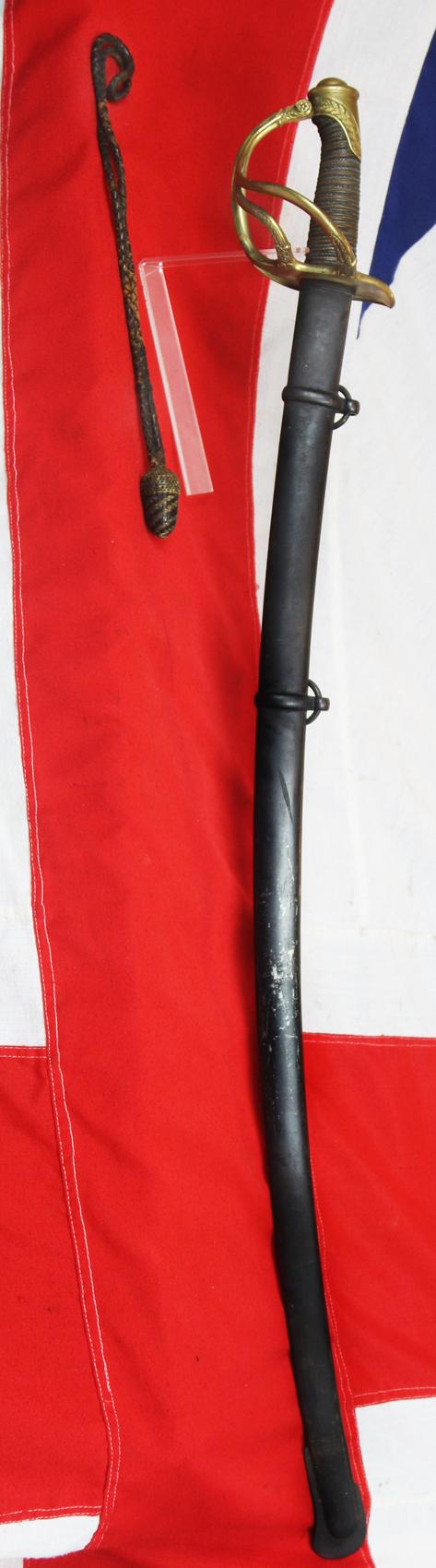
Household Cavalry Officers Officers Sword c 1805. Household Cavalry Officers Officers Sword although referred to as 1814 model this example is slightly different to the regulation pattern. This actual sword is detailed in the book, The British Cavalry Sword 1788 “ 1912 by Richard Dellar page 202 plate 20.12.The description is as follows: A sword with a similar in detail to the Prussian Cuirassier Officers Model 1797 sword but with a central device of the British Royal Crest instead of the Prussian eagle. This type of hilt is thought to date from around 1805. The sword is in very good condition no damage to the basket and the bound leather grip shows slight wear, it is complete with brass scabbard with two narrow slots covered with fish skin note lower ring missing. Overall length 103cm the blade 88.5cm
Page 5 of 119