
Show

Forgot your password?

Error message here!

Error message here!

Error message here!

Error message here!

Show Error message here!

Show Error message here!

Lost your password? Please enter your email address. You will receive a link to create a new password.

Error message here!

Back to log-in

Close

For Sale

The following items are listed by for sale by users of the site and dealers. They are in no way endorsed or guaranteed by www.antiquearmsresearch.com

Add a Classified Item
to

Clicking on the sword will take you through to the relevant classified item or dealer site.
Don't miss out! - Do you want to be kept informed weekly of new aditions? Just join our weekly update list.

You can also receive regular email notifcations when items match your keywords. To recieve them just register or logon at the top right of this page.
Page 6 of 119
  • Nation : British
  • Local Price : £5650
Late 19th century Scottish Dirk for an Officer in the Gordon Highlanders by R&HB Kirkwood of Edinburgh. An exceptional Scottish Military Dirk made for an officer in the Gordon Highlanders in the late 19th century by the goldsmiths R&HB Kirkwood based at 65 & 66 Thistle Street in Edinburgh. The dirk retains its bi-knife and fork which together are housed in the original case with the partner sgian dubh. The mounts are of unhallmarked silver. The grips of the dirk, bi-knife, fork and sgian dubh are fashioned from blackened hardwood carved with a pattern of basketweave with studs mounted at the intersections of the weave. The raised ornate pommels are each mounted with a finely cut Citrine with consistent orange coloured backing inside decorative ferrules featuring bands of thistles and foliage. The pommels are suspended above the grips in typical dirk style for the Gordon Highlanders with an arrangement of silver posts separated by oak leaves. The dirk grip base mount is decorated with thistles and foliage. The cone shaped grip bases of the bi-knife and fork are plain and mounted with blued sprung clips on either side to secure the grips to the scabbard pocket tops. The leaf shaped dirk blade is 11.75 inches (30 cm) long  and has a scalloped back edge under which a deep fuller extends from the grip base towards the tip and terminates just before the scallop line ends, after which the blade becomes double edged to the tip. A wider fuller extends from the hilt along the middle of the blade for the same length. The base to the dirk grip fits snugly over the scabbard mouthpiece. The bi-knife blade is also single-edged and has a scalloped blunt back edge of smaller dimensions compared to the dirk blade. The dirk is housed in a wooden scabbard covered with black leather and with silver mounts. The throat mount to the front is decorated with a Cross of St Andrew onto which at the base is a platform of thistles. A semi-circular arch above is applied with the name of the regiment and beneath this a figure of the Sphynx with “EGYPT” beneath, and below, a Tiger with “INDIA” beneath. The back of the throat mount has a carrying strap bar with the name of the maker in raised relief inside a rectangular shield beneath. Further along the scabbard the pocket throat mounts for the by-knife and by-fork, plus the chape, are decorated to the front with a thistle motif and at the back each mount is stamped individually with a thistle stamp. The overall length is 17.25 inches (just under 44 cm) overall. The double-hinged black leather covered wooden storage box is in fine condition. The lid opens and closes effectively to be secured with hinged clips. The box is fitted with a padded blue silken liner fixed into the into the base of the compartment and into the lid which also has the embossed name of the maker. The sgian dubh is similarly stamped with the maker’s details at the back of the throat mount. The Gordon Highlanders was one of the most famous regiments in the British Army. It was formed in 1881 as the county regiment of Aberdeen, Banffshire and Shetland. In the 1880s the regiment fought in the Anglo-Egyptian War then in India in the 1890s. In 1899 the regiment was sent to fight in the Boer War. Thereafter the regiment fought with distinction in all major conflicts where the British Army was involved. The dirk was first presented to the open market by the descendants of the officer that owned the dirk. This was Stewart Gregor Murray. His military biography is detailed on a old note written in black ink stored inside the case (see the last photo below).  He joined the Second Battalion in 1884 and thereafter was posted to Malta (3 years), Ceylon (3 years) and India (4 years). In India Murray was involved in the storming of the Malakand Pass and in the Relief of Chitral. He returned to the UK in 1895 and was appointed to the role of Adjutant for the 2nd Volunteer Battalion. He was promoted to Captain in 1895 then Major in 1903. Murray resigned his commission in 1904 after 20 years service. Condition: The condition of the dirk is very fine with minor wear as can in be seen in the photos. The pommel stones are in excellent original condition with no cracks, chips or interference to the mount housings. One stud is missing from the front of the main dirk haunch base and two from the upper part of the grip of the fork. The sgian dubh is in fine condition with some mottling to the blade. The storage box is in a fine state of preservation. The steel dirk blade retains its polished finished with minor light stains in a few places.
  • Nation : Italian
  • Local Price : 7,800.00 USD
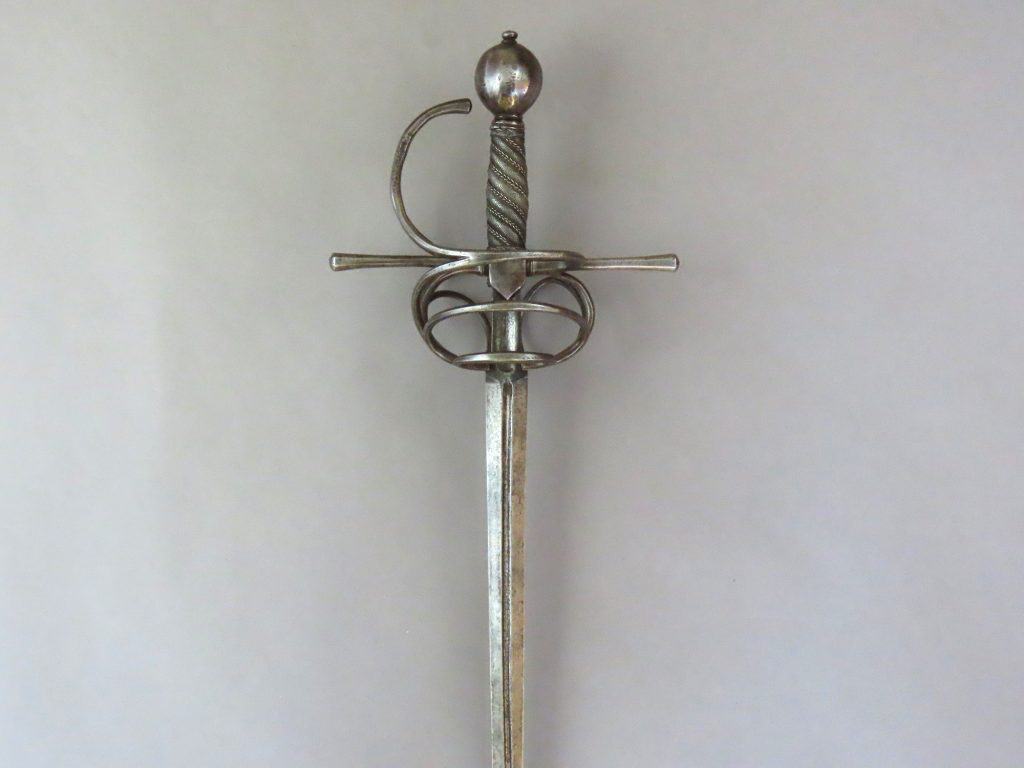
FINE ITALIAN BROADSWORD C.1650. This sword draws upon two closely related groups for form. Its finely embossed and chiseled guard with its central medallion of a classical figure is a variation of the sail form guards used on Maine gauches, Italian rapiers and broad swords. Those swords, are generally from a larger group of crab claw hilted swords which includes examples with and without the sail form guard. The form of its quillons places this sword in that group. The vast majority in the group are plain or modestly embellished for use by foot or mounted troops. This example, distinguished by the quality, and theme of its decoration, was made for an officer or member of an elite guard group. It is closely related to an example in the Royal Armouries, Leeds, #XV-178. 32 1/4" length blade.
  • Nation : Dutch
  • Local Price : 7500.00 USD
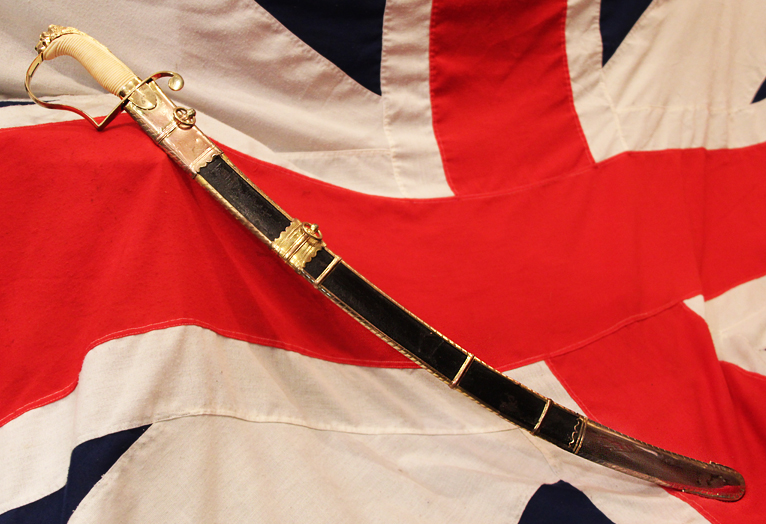
Dutch Voc Silver Hilted Officer's Saber With Scabbard Dated 1771!. A very rare VOC, Dutch East India Company, officers saber with deep blade marks of the VOC, Amsterdam and dated 1771 both sides! Exceptional early saber with full scabbard and silver mounts (scabbard age shrunken and cracked in 2 beneath mid mound, but displays perfectly.) See photos. Blade is about 29” long. The silver hilt has no cracks or repairs, just a little age deformation. It can use a better cleaning. Grip and grip wire is completely intact and grip has some age cracking. This great sword most probably belonged to a VOC captain or admiral. Original silver hilted Dutch VOC swords are very seldom, if ever, encountered! Price is firm. Thanks for looking! Be sure to check out our other listings for more great swords, arms and armor! Our direct email address is: [email protected]
  • Nation : British
  • Local Price : £5375.00
A Fabulous, Historical, And Important Scottish Basket Hilted Broadsword of a Distinguished Hero of the 79th Foot in the Crimean War & Subsequently Elevated, Due to His Gallantry, to a Position Within the Queen’s Bodyguard of H.M Queen Victoria. This was the regimental service combined combat and dress sword of William Cuninghame Cuninghame, Capt. Of the 79th Cameron Highlanders, {son of William Alexander Cuninghame late of the 95th Foot} Capt. Cuninghame landed with his regiment in the Crimea, and he served with distinction in the Battles of Alma, Balaklava and Sebastepol. He was awarded the Crimean medal with three clasps, for his gallant service, and the Turkish medal. After his distinguished service in the Crimean War he became a member of the Corps of Gentleman at Arms, Queen Victoria's personal bodyguard. This was a highly esteemed position to obtain, and only a very few, of the very best, most distinguished, and respected British army officers were ever chosen to serve in such an exalted position. This is his basket hilted combined combat and dress broadsword, that was was commissioned from Wilkinson sword. It was completed by Wilkinsons on the 15th May, and delivered {or colllected} later in May, 1854, serial numbered 5174. The basket is complete with it's traditional red cloth covered stag hide liner, lined with traditional red uniform cloth with its silk tassle. The broadsword blade is etched with Wilkinson's mark and the steel mounted leather scabbard originally bore full engraving of his name, his crest and the regiment number. The Cuninghame name is one of Scotland’s oldest clan names, based on a regional name, and can trace their Scottish ancestry back to Cunninghame which is the northern part of Ayrshire. Traditionally, in 1059, King Malcolm rewarded Malcolm, son of Friskin with the Thanedom of Cunninghame. The name is therefore of territorial origin and it likely derives from cuinneag which means milk pail and the Saxon ham which means village. There is a story that states that Malcolm who was the son of Friskin, obtained the lands from Malcolm III of Scotland after he had sheltered him under hay in a barn The Cunninghams were certainly well settled in the parish of Kilmaurs by the end of the thirteenth century. The son of the Laird of Kilmaurs was Hervy de Cunningham who fought for Alexander III of Scotland at the Battle of Largs in 1263 against the Norse invaders. During the Wars of Scottish Independence the Cunninghams were supporters of the Bruces in their fight for Scottish independence. A detail of the 79th Cameron Highlanders at Alma goes as follows; About half-past one o?clock 20th Sept 1854 the action commenced by the Russians opening fire from the redoubt on the left upon the French, who were attempting to assail their position in that direction. The British forces then formed in line, and proceeded to cross the river about the village of Burliuk. The light and second divisions led the way preceded by the skirmishers of the Rifle Brigade, who advanced through the vineyards beyond the village, and spreading themselves along the margin of the river, engaged the Russian riflemen on the opposite bank. The first division, which formed the left of the allied army, advancing in support, traversed the vineyard and crossed the river, protected by its overhanging banks. On reaching the slope of the hill, the three Highland regiments formed line in Echelon, and, "with the precision of a field-day advanced to the attack, the 42nd Royal Highlanders on the right, and the 79th Cameron Highlanders on the left, the extreme left of the allied army." "The magnificent mile of line," says Captain Jameson, "displayed by the Guards and Highlanders, the prominent bear-skin, the undulating waves of the clan-tartans, the stalwart frames, steady and confident bearing of these young and eager soldiers advancing under fire, can never be forgotten by those who witnessed it, whilst it contributed materially to the discouragement of the enemy, whose columns perceptibly wavered as they approached. His masses of four - and - twenty deep, absolutely reeled and staggered to and fro under the murderous fire of the Scottish line, which was delivered with great effect at a distance of 200 yards." We show in the gallery a painting of the 79th Highlanders charging at Alma, a photo of Capt. W.C.Cuninghame's Crimean War & Queen's Bodyguard Diamond Jubilee medal that were sold some years ago, and a photo of Capt. Cuninghame as part of Queen Victoria's personal bodyguard at the Jubilee service at St Paul's Cathedral 1897 . The basket has a small bar lacking on one side due to hand to hand combat contact damage. As the scabbard is steel mounted, not brass as are his ancestors swords, the family name crest and regiment engraving on the scabbard has all but disappeared due to very light old surface pitting but traces of it can be identified in the right light. It would likely need modern infra red light technology to reveal it fully. 32.25 inch blade. Capt. Cuninghame's Medals and photos in the gallery not included. We acquired three swords direct from the descendant Cuninghame family, one has now been sold and they are all to be sold separately. Every single item from The Lanes Armoury, Britain's famous, favourite, and oldest original Armoury Antique store, is accompanied by our unique Certificate of Authenticity. Part of our continued dedication to maintain the standards forged by us over the past 100 years of our family’s trading, and thus, it is a lifetime guarantee.
  • Nation : British
  • Local Price : £5250
English “Mortuary” hilted sword dating to the middle part of the 17th century. A fine English “Mortuary” hilted sword dating to the middle part of the 17th century and the English Civil War, Commonwealth and Protectorate periods. The hilt of this sword is of typical form consisting of a broad saucer-shaped guard plate from which three main curved flattened guard bars taper upwards ending with flattened angled terminals screwed into the pommel. The sword is notable because of its robust build, fine condition and the higher than average quality of the chiselled decoration. The convex surface of the guard plate is covered with the finely executed busts of eight men, four located either side of the blade. Two, opposite each other, are wigged figures, probably judges. The others have a more grotesque appearance. The remaining spaces are filled with panels of delicate foliage and fine swirling tendrils. The pommel is decorated in the same foliate style. Two downward facing bars emanate from each side of the knuckle bow towards its middle and join the base of each side guard bar to add strength to the structure. The base of each side guard bar is strengthened with a fishtail or merlon terminal which joins the bars to the dish.  The downwardly curled ribbed wrist guard strengthens the rear edge of the plate. The guard bars are decorated with chiselled lines. The pommel is globular in shape and has an integral button on top and a pronounced flared neck beneath. The grip is wrapped with a leather binding which covers the original grip covering of surface mounted wire. The base sits on an iron flanged plug mounted onto the inside of the guard plate from which two langets extend through the tang aperture to flank the blade either side for a short distance below the hilt. The single-edged blade has a pronounced fullered ricasso. A broad shallow fuller runs from the hilt underneath the blunt spine of the blade and terminates a short distance from the tip after which the blade is double edged. A second shorter fuller of similar width opposite the first runs each side for the length of the ricasso after which the main cutting edge of the blade begins. An unknown Blade Maker's stamp is applied on each side within the fuller as is an orb and cross mark a short distance away. The blade was probably made in Solingen in Germany. Huge numbers of blades were imported into Britain during the Civil War period to fulfil demand for swords on both Royalist and Parliamentarian sides.  The blade is 33.75 inches long (86 cm) and overall the sword measures 40 inches (101.5 cm) long. Stuart C Mowbray in “British Military Swords”, Mowbray Publishing, 2013, dedicates a section to Mortuary Swords in pages 178 to 225, as does Cyril Mazansky, in “British Basket Hilted Swords”, Boydell Press 2005, Chapter 11, pages 233 to 280. The similarities between the engraved patterns on the hilts of the swords illustrated in these books and our sword, although they are all somewhat different, shows that the quality of chiselling and engraving present on our sword is of superior quality compared to most other than those known to have been commissioned for nobility of one form or another. This sword is of a style which does not adopt the secondary rear guard bars which appear on some mortuary swords which extend downwards from the  side guard bars to fix on the guard plate nearer to the wrist guard edge.  The robust and broad expanse of the guard of this sword dispenses with the need as can be seen in the examples present in Mowbray and Mazansky.
  • Nation : French
  • Local Price : £5250.00
A Very Fine Napoleonic, Ist Empire, General Staff Officer's Sabre. Three Bar Hilt with Deluxe Imperial General Staff Officer's Scabbard. Another Museum Grade Historical Piece We Are Privileged To Offer. A fabulous Ist Empire deluxe quality Light Cavalry pattern staff officer's sabre with three bar guard hilt, called in France the "Hunter-style". Overall in excellent plus condition for its age, with original wire bound leather grip. During the Revolutionary and Napoleonic Wars the French armies had approximately 2,000,000 plus serving soldiers, of those there were around 2000 generals commanding them in the armies of France, directly under their commander-in-chief, the Emperor Napoleon. However, for example, at the Battle of Borodino, Napoleon lost 1928 of his officer's including 49 Generals, in just one day! This sword would have been used and carried in combat by one of those officer's on Napoleon's general staff. Napoleon was, and remains, famous for his battlefield victories, and historians have spent enormous attention in analysing them. Napoleon had numerous general staff officer's. However, a general in the field would have a relatively smaller cadre of officers supporting them.. Whether they were on Napoleon's staff or the staff of a general, their function was the same, to gather reports from field officers, précis them and ensure Napoleon and the generals have the right information. Then take Napoleon's or the general’s high level orders and ensure they get to the correct field officers, which may mean encoding them by hand. Manage all the logistics, ensure that all the units are supplied with food, equipment and munitions. In 2008, Donald Sutherland wrote: The ideal Napoleonic battle was to manipulate the enemy into an unfavourable position through manoeuvre and deception, force him to commit his main forces and reserve to the main battle and then undertake an enveloping attack with uncommitted or reserve troops on the flank or rear. Such a surprise attack would either produce a devastating effect on morale, or force him to weaken his main battle line. Either way, the enemy's own impulsiveness began the process by which even a smaller French army could defeat the enemy's forces one by one. After 1807, Napoleon's creation of a highly mobile, well-armed artillery force gave artillery usage increased tactical importance. Napoleon, rather than relying on infantry to wear away the enemy's defences, could now use massed artillery as a spearhead to pound a break in the enemy's line. Once that was achieved he sent in infantry and cavalry. The Napoleonic Wars brought radical changes to Europe, but the reactionary forces returned to power and tried to reverse some of them by restoring the Bourbon house on the French throne. Napoleon had succeeded in bringing most of Western Europe under one rule. In most European countries, subjugation in the French Empire brought with it many liberal features of the French Revolution including democracy, due process in courts, abolition of serfdom, reduction of the power of the Catholic Church, and a demand for constitutional limits on monarchs. The increasing voice of the middle classes with rising commerce and industry meant that restored European monarchs found it difficult to restore pre-revolutionary absolutism and had to retain many of the reforms enacted during Napoleon's rule. Institutional legacies remain to this day in the form of civil law, with clearly defined codes of law an enduring legacy of the Napoleonic Code. While Napoleon is best known as a master strategist and charismatic presence on the battlefield, he was also a tactical innovator. He combined classic formations and tactics that had been used for thousands of years with more recent ones, such as Frederick the Great's "Oblique Order" (best illustrated at the Battle of Leuthen) and the "mob tactics" of the early Levée en masse armies of the Revolution. Napoleonic tactics and formations were highly fluid and flexible. In contrast, many of the Grande Armée's opponents were still wedded to a rigid system of "Linear" (or Line) tactics and formations, in which masses of infantry would simply line up and exchange vollies of fire, in an attempt to either blow the enemy from the field or outflank them. Due to the vulnerabilities of the line formations to flanking attacks, it was considered the highest form of military manoeuvre to outflank one's adversary. Armies would often retreat or even surrender if this was accomplished. Consequently, commanders who adhered to this system would place a great emphasis on flank security, often at the expense of a strong centre or reserve. Napoleon would frequently take full advantage of this linear mentality by feigning flank attacks or offering the enemy his own flank as "bait" (best illustrated at the Battle of Austerlitz and also later at Lützen), then throw his main effort against their centre, split their lines, and roll up their flanks. He always kept a strong reserve as well, mainly in the form of his Imperial Guard, which could deliver a "knockout blow" if the battle was going well or turn the tide if it was not. Overall the condition is stunning . The scabbard's inner and outer side has just a very few surface contact bruises. In the 20th century generals plotted campaigns and were not often in the thick of combat. In the Napoleonic wars era general staff officers fought, more often than not alongside their men in hand to hand combat, hence, Napoleon lost so many of his general staff officers. Every single item from The Lanes Armoury, Britain's most famous, favourite, and oldest original Armoury Antique store, is accompanied by our unique Certificate of Authenticity. Part of our continued dedication to maintain the standards forged by us over the past 100 years of our family’s trading, and thus, it is a lifetime guarantee.
  • Nation : British
  • Local Price : £5250
Scottish Basket Hilted Sword dating to circa 1725 to1740 mounted with an “ANDRIA FERARA” marked blade. A fine and robust Scottish basket hilted sword dating to the period preceding the last Jacobite Rebellion of 1745. The sword is a fine example of the Scottish armourers’ craft, the hilt being forged from finely rounded structural bars and pierced plates. The aperture of the basket guard is wider on one side showing that the guard was deliberately forged for a right handed user. The single edged thickly forged blade is a fine Solingen made example with a single fuller running underneath the spine. The fully developed basket guard is finely forged into an elegantly contoured profile. The two main frontal guard panels are decorated in traditional style, with vertical and horizontal border lines incised into the exterior surfaces towards the panel edges to form squares. Inside these squares a circle is pierced into the centre, The panels are further decorated with four pierced triangular arrowhead shapes which surround the centre circles supported by two pierced circles at the base of each. Further circles are pierced into each corner of the squares. The smaller, secondary guard plates to the sides, and the knuckle bow at the front, are finished in similar style. The edges of all the guard plates are skillfully symmetrically fretted with cusps, merlons and triangles. The cone-shaped pommel has a waisted button on top and is decorated with three sets of incised triple grooves, equally spaced apart, which radiate from the button, the middle groove being wider and more pronounced than those on its flanks in each case. The upper guard arm terminals of the basket fit into a chiselled groove which extends for the full circumference of the pommel just below its middle to secure the structure. The blade shoulders are secured in a chiselled groove in the cross guard bar underneath the hilt which retains its scrolled wrist guard. The spirally grooved wooden baluster shaped grip retains its original shagreen cover and iron ferrule at the top. Originally the grip was bound with a wire wrap inside the groove which is now missing.  The hilt also retains its thick leather liner at the base of the grip. The tapering single edged blade is 32.75 inches (83.5 cm) long and of fine quality. A bold fuller runs underneath the spine from the hilt and terminates 8 inches (20 cm) from the rounded tip after which the blade is double edged. The armourers’ mark “ANDRIA FERARA” is stamped into the fuller near the hilt embellished with cross marks and an incised floret beneath the fuller on one side. The blade was most likely made in Solingen. For similar styles of hilt see “Poetry in Steel The Earliest Swords of Walter Allan of Stirling”, by the Baron of Earlshall, London Park Lane Arms Fair, page 129 to 138, Spring 2018, Apollo Publishing. There are strong resemblances between this hilt and those produced in Stirling by both John and Walter Allan during this period, and particularly that shown on page 137 made by John Allan, figs 9 and 10, See also Cyril Mazansky, “British Basket-Hilted Swords”, The Boydell Press, 2005, page 102, fig F5c, for a sword in Blair Castle in Perthshire, and page 113, fig F15c for a sword in the Marischal College in Aberdeen, although the pommel has been replaced on this sword, and page 115, fig F15i, for a sword in a private American collection. The overall length of the sword is 38.5 inches (98 cm) long. The sword is in fine structural shape without repairs or damage apart from slight damage to the wrist guard. There are evenly spread light patches of blackened aging overall.
  • Nation : British
  • Local Price : £5000
Scottish Basket Hilted Sword dating to circa 1730-1740. A fine robust Scottish basket hilted sword dating to the period preceding the  Jacobite Rebellion of 1745. The sword is a fine example of the Scottish armourers’ craft, the hilt being forged from thick structural rounded bars and plates. The aesthetic appeal of the hilt is apparent when viewed from the front revealing the symmetry of the panels and deliberate nature of the construction.  The single edged blade is a finely forged example with a double fuller most likely of Solingen manufacture The fully developed basket guard is finely forged into an elegantly contoured profile. The two main frontal guard panels are decorated in traditional style, with vertical and horizontal parallel border lines incised into the exterior surfaces towards the panel edges to form squares. Inside these squares a circle is pierced into the centre, filed on the outside to create saltire shapes. The panels are further decorated with four pierced triangular arrowhead shapes which surround the saltires supported by two pierced circles at the base of each. Further circles are pierced into each corner of the squares. The smaller, secondary guard plates to the sides, are finished in similar style. The knucklebow plate is decorated with lines but not pierced in the middle leaving a solid panel. This blank space was normally reserved for an inscription or crest but in this instance has been left blank. The dome-shaped pommel has a waisted button on top and is decorated with four pairs of incised double lines, equally spaced apart, which radiate from the button. The upper guard arm terminals of the basket fit into a chiselled groove which extends for the full circumference of the pommel just below its middle to secure the structure. The blade shoulders are secured in a chiselled groove in the cross guard bar underneath the hilt which retains its scrolled wrist guard. The spirally grooved wooden baluster shaped grip retains its original shagreen cover together with its brass wire binding. The hilt also retains its full leather liner covered with red cloth on the outside and stitched with a blue silken hem, much of which remains. The tapering single edged blade is of fine quality. It has a  ricasso which extends 1.5 inches (4.0 cm) from the hilt. A bold fuller runs underneath the spine from the hilt and terminates 7 inches (18 cm) from the rounded tip after which the blade is double edged. A second fuller commences 7.5 from the hilt and runs underneath the first almost to the tip. The blade is 32 inches (81.5 cm) long. For similar styles of hilt see “Poetry in Steel The Earliest Swords of Walter Allan of Stirling”, by the Baron of Earlshall, London Park Lane Arms Fair, page 129 to 138, Spring 2018, Apollo Publishing. There are strong resemblances between this hilt and those produced in Stirling by both John and Walter Allan during this period, particularly that shown on page 137, figs 11 and 12, which is a robust hilt of similar profile lacking fretted edges to the guard panels. See also Cyril Mazansky, “British Basket-Hilted Swords”, The Boydell Press, 2005, page 106, fig F12, for a sword in a private American collection and pages 115, fig F15h, and page 116, fig F16, for swords in the Marischal College in Aberdeen, all of which have plain edges to the guard panels. The overall length of the sword is 37.75 inches (96 cm) long. The sword is in fine structural shape without repairs or damage and in blackened russet condition overall.
Page 6 of 119