
Show

Forgot your password?

Error message here!

Error message here!

Error message here!

Error message here!

Show Error message here!

Show Error message here!

Lost your password? Please enter your email address. You will receive a link to create a new password.

Error message here!

Back to log-in

Close

For Sale

The following items are listed by for sale by users of the site and dealers. They are in no way endorsed or guaranteed by www.antiquearmsresearch.com

Add a Classified Item
to

Clicking on the sword will take you through to the relevant classified item or dealer site.
Don't miss out! - Do you want to be kept informed weekly of new aditions? Just join our weekly update list.

You can also receive regular email notifcations when items match your keywords. To recieve them just register or logon at the top right of this page.

Page 51 of 118
  • Nation : British
  • Local Price : £975.00
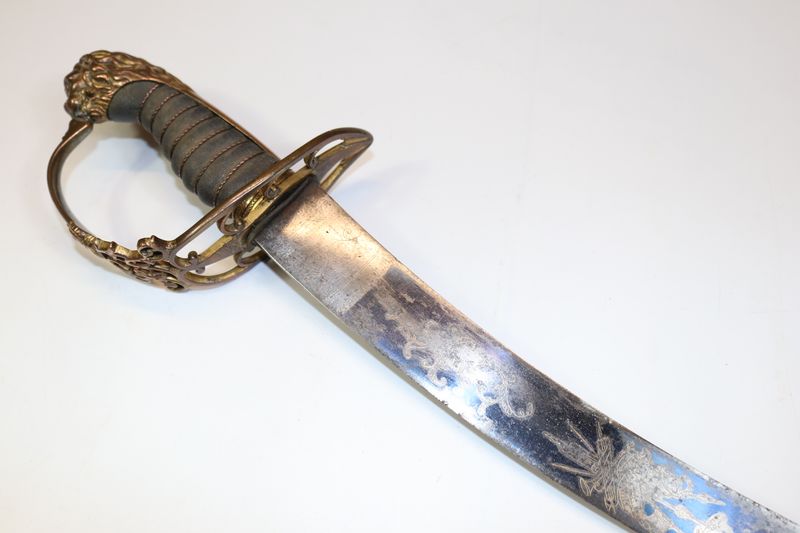
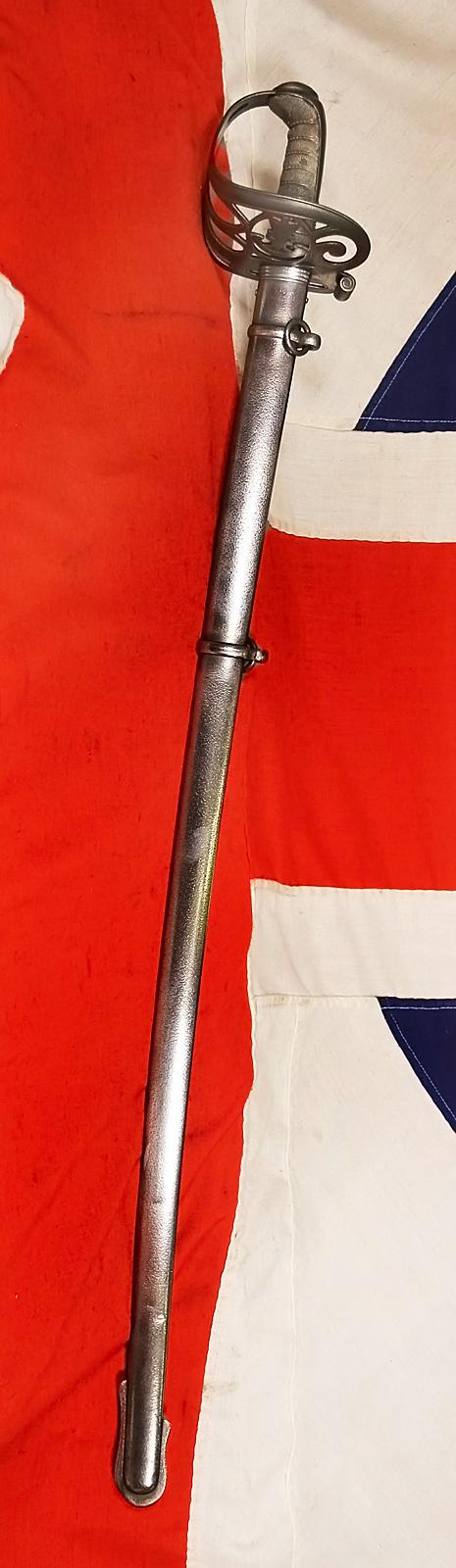
Post 1845 Victorian British Stockport Rifle Volunteers (Cheshire) 1822 Pattern Infantry Officer’s Sword With Etched Blade, Brass Gothic Style Pierced Basket Hilt & Scabbard. Sn 22426:60 -. The Cheshire Regiment was a line infantry regiment of the British Army, part of the Prince of Wales’ Division. The 22nd Regiment of Foot was raised by the Duke of Norfolk in 1689 and was able to boast an independent existence of over 300 years. The 4th Volunteer Battalion was formed in 1860. The regiment was expanded in 1881 as part of the Childers Reforms by the linking of the 22nd (Cheshire) Regiment of Foot and the militia and rifle volunteers of Cheshire. The title 22nd (Cheshire) Regiment continued to be used within the regiment. On 1 September 2007, the Cheshire Regiment was merged with the Worcestershire and Sherwood Foresters Regiment (29th/45th Foot) and the Staffordshire Regiment (Prince of Wales’s) to form a new large regiment, the Mercian Regiment, becoming the 1st Battalion, Mercian Regiment. The Stockport Armoury building (Armoury Street, Stockport) was the Headquarters of the Stockport Rifle Volunteers (Cheshire Volunteer Rifles) in 1862. The 1822 pattern sword was a radical departure from previous designs, having a ‘gothic’ style pierced basket hilt so named after its resemblance to window shapes in gothic architecture and folding langet on one side. Pre 1845 these swords had pipe back blades. Post 1845 they were made with slightly curved fullered blades (see page 159 of Robson’s Swords of the British Army). This original Stockport Volunteer Rifles infantry Officer’s Pattern 1822 sword has a post 1845, 32 ¾” single edged fullered curved blade (38 ½” overall). The blade has faint etched decoration on both sides. One side of the blade has foliate etched panels, the etched Rifle Brigade ‘hung Bugle’ badge and ‘Stockport Rifle Volunteers’ together with etched proof star with inlaid brass roundel. The reverse has foliate etched panels, Queen’s crown Royal Cypher ‘VR’ (Victoria Regina) and etched maker / retailer name and address ‘J&W Wood, Cutlers, Manchester. The blade has areas of staining consistent with age. The gothic style voided brass guard has stylised Royal Cypher VR & Queen’s Crown in the centre. The bar guard is fully intact. It has the correct folding langet on one side. Its fish skin grip with finger grooves & wire binding is excellent. The sword is complete with its brass mounted leather scabbard which has an ornate frog locket on the throat mount and it has 2 brass hanging rings. All leather and stitching are intact. The leather has areas of surface scuffing consistent with age & service use. The price includes UK delivery. Sn 22426:60
  • Nation : British
  • Local Price : £975.00
**RARE**NAPOLEONIC WARS ERA**British 1804 Pattern Royal Navy Seaman’s Boarding Cutlass With Correct ‘Figure Of 8’ Guard Hilt, Rope Lanyard With WD Brass Boatswain’s Call / Bosun’s Pipe Attached. Sn 23174:31 -. The British Royal Navy due to its global presence and command of the sea was by far the most organised and trained of all the World major sea services and it’s edged weapons used for boarding and repelling boarders reflected this. The Royal Navy was one of the first Navies in the 18th Century to begin standardising the personal edged weapons used by ordinary seaman. The 1804 Pattern Naval Seaman’s Boarding cutlass was the first regulation Naval cutlass issued to British Seamen (see page 241 of World Swords by Withers where a cutlass with 1804 pattern hilt the same as ours is illustrated). British Naval Boarding Cutlasses were made by a number of Government contracted manufacturers. In the Napoleonic-era Royal Navy, a Boatswain’s call (or Bosun’s pipe) was a specialised, high-pitched whistle used to communicate orders across a vessel. As a Command Tool, Its shrill, high-pitched tone was designed to be heard over the roar of gale-force winds, the crashing of waves, and the thunder of cannon fire during battle. In the Napoleonic era, the pipe was a badge of rank for Boatswains / Bosuns. This is a very good, rare to find, original British RN 1804 patten boarding Cutlass. It has the correct 1804 pattern hilt consisting of a black painted flat metal figure of 8 shaped guard and ribbed / segmented iron handle. The 28 ¾” long cutlass blade has staining and old stable pitting consistent with age and sea service carry. The cutting edge has some nicks to the cutting edge consistent with age and service use (34” overall). There is no rust. There are no manufacturer or date marks on the blade or hilt but the may be present under the black finish. As is common the cutlass is without scabbard as they were predominantly stored in ship deck racks. The cutlass was found with a rope lanyard attached to it which is mounted with a brass Boatswain’s Call / Bosun’s Pipe). The Gun: A narrow tube that directs air is straight and The Buoy (or Bowl): A hollow metal sphere with a hole that resonates to create the sound work correctly. The Keel: A flat piece of metal beneath the gun that provides structural support is present with no damage & The Shackle: A ring at the end used to attach a lanyard is present and attached to the lanyard. The Call is 4 ½” length and the Buoy has ‘WD Broad Arrow’ mark. The Call has no date or other maker marks. The price for this piece of British Naval history includes UK delivery. Sn 23174:31 (in bucket armoury)
  • Nation : Japanese
  • Local Price : £975.00
C1700 – 1800 Japanese Late Edo Period Mino School Work Very Small Ko Wakizashi Possible Period Boy’s Coming Of Age Festival Sword With Ko-Gatana Side Knife, Scabbard, Carry Bag / Cover & Expert Assessment. Sn 23063 -. An original Japanese small Sword and scabbard. The sword has been assessed by UK Japanese sword expert Bill Tagg. A copy of his hand written notes and illustrations accompany the sword. In extracts from his notes he states “Ko-wakizashi ? Very small sword possibly made for boy’s festival coming of age ceremony, a scaled down katana unsigned looks mid to late Edo period 1700 to 1800. Looks like Mino influenced work shape of tang & what looks like gunome midare hamon (temperline) vaguely showing through the old finger rust & old buff marks needs a professional polish to see work. Fittings (mounts). Saya (scabbard) black lacquer with bright green speckled cloud decoration some old damage and end cap missing. Has ko-gatana (side knife) fitted in pocket blade is signed but unreadable with old rust. Kodjuka (hilt) shows chidori (small birds) flying under large waves signed ‘teru hide’ & kaikihan (seal) omori school style work (undercut waves) bit of wear to it. Tsuba is oval (brass) been gilt showing man with stick pointing at a rabbit with copper rim & one copper plug Hitso Ana nicely engraved circa 1800. Couple nice castellated seppas. Tsuka has old worn black ito over dirty fish skin wrap. Fuchi / Kashira (end caps) are copper been some gilding. Depicts Fish & Waves possibly same workshop as Kodjuka, worn. Menuki difficult to see looks like Motei with his sack in Shakudo & gilt nice quality. When new this would have looked a special sword. Worthy of restoration”. In his illustrations Bill describes the cutting edge as 31 cms & total length as 43 cms. He also describes & measures other blade characteristics which can be seen in the images. The price includes UK delivery. Sn 23059 (in Tanto box armoury)
  • Nation : British
  • Local Price : £975.00
British Indian Army 1896 Pattern Mountain Artillery Sword. A scarce India pattern Mountain Battery sword, made by Robert Mole of Birmingham. The brass stirrup guard is stamped R B. 1. 18 and with blackened ribbed iron grip. The curved blade is 76cm in length and stamped with broad arrow issue marks and dated 1915 The spine is maker marked MOLE Birm and is complete with brown leather scabbard with brass mounts, overall length 89cm
  • Nation : -
  • Local Price : £975.00
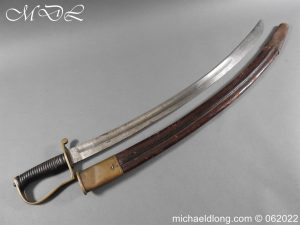
Napoleonic Blue and Gilt 1803 Pattern Infantry Sabre. EL7269 - A good quality 1803 infantry officer's sabre, featuring a blue and gilt decorated 'scimitar' blade. The blade, of 27.5 inches measured in a straight line, has quite good preservation of the blue and gilt decoration on one side, and mediocre on the other side. The highly curved blade is in generally good condition and firm in the hilt, though the guard itself has some movement, probably
  • Nation : Spanish
  • Local Price : 1,350.00 USD
SPANISH RAPIER C.1700-1750. Brass hilt, originally gilt, with large ring guards and olive form pommel. Thickened edge guard formed as two shells joined with a web. The right shell with flower maker's mark and 3. Twisted brass wire wrapped grip with banded ferrules. Fine 29 ½” diamond section blade. The forte, with deep groove marked EN TOLEDO each side. The Spanish take on what developed as the smallsword in northern Europe. Owing to fencing techniques and custom, the rapier remained in use in Spain at the time. 
  • Nation : Austrian
  • Local Price : 1,350.00 USD
AUSTRIAN 1765 PATTERN FUSILIER’S SWORD. Seven Years War period, and likely saw service in the American Revolution. Brass mounted hilt with recurved cross guard marked with an I, and scalloped beaked pommel and backstrap. Ribbed leather covered grip. 20” curved wedge section blade (gray patina with black oxidation toward the tip). The root marked 42. Very rare original leather covered scabbard with brass mounts including heart shaped frog stud. Untouched example from a Revolutionary War exhibition which traveled in the 1960's.
  • Nation : British
  • Local Price : £950.00
A Fine Regimental Victorian 60th Rifles Officer's Sword of the Rifle Brigade Signed Blade by Kemp, Leddell & Co. Armourers, 41 London Wall, London, Used In The Zulu War and in The Boer War As The Later Regiments Name The Kings Royal Rifle Corps. Etched with foliate scrolls, crowned VR cypher, regimental title device of the strung bugle blade in superb bright polish. Regulation grey steel gothic hilt, also incorporating a slung bugle horn, wire bound fish skin covered grip, in its good steel combat weight scabbard with two suspension rings. Sword bespoke commisioned from Kemp, Leddell & Co in London, circa 1870 3rd Battalion, 60th or The King’s Royal Rifle Corps (1755-1958) The 60th Rifles in 1879 were part of No. 1 Column (the Main Force) under Colonel Glyn and Lord Chelmsford. Fought in key engagements, including the decisive Battle of Ulundi on July 4, 1879, which effectively broke Zulu military power. After the Zulu war the regiments name was changed to the KRRC, the Kings Royal Rifle Corps. The 60th Rifles (The King's Royal Rifle Corps) served actively during the Anglo-Zulu War of 1879, (with individual officers like Major Charles Walter Robinson served on staff). The 3rd Battalion arrived in South Africa as part of the vital wave of British reinforcements sent after the initial disaster at Isandlwana. Before reaching Ulundi, they took heavy part in relieving the siege of Eshowe and fought at the Battle of Gingindlovu on April 2, 1879. The British fought in their traditional square formation at the battle of Gingindlovu, with the 60th Rifles taking position on the northern face of the square. According to Castle and Knight, “the main Zulu body split into columns, then crossed the Nyezane (River) at two drifts a mile apart; and, as it advanced up the slopes towards the laager, it fanned out into the traditional chest and horns attack formation. The order to hold fire until the enemy were within 300 yards condemned the troops at the front of the square to the nerve wracking spectacle of the Zulus deploying to attack without a shot being fired to stop them. It was a sight that was to strain the nerves of the untried men of the 60th. The British fought in their traditional square formation at the battle of Gingindlovu, with the 60th Rifles taking position on the northern face of the square. According to Castle and Knight, “the main Zulu body split into columns, then crossed the Nyezane (River) at two drifts a mile apart; and, as it advanced up the slopes towards the laager, it fanned out into the traditional chest and horns attack formation. The order to hold fire until the enemy were within 300 yards condemned the troops at the front of the square to the nerve wracking spectacle of the Zulus deploying to attack without a shot being fired to stop them. It was a sight that was to strain the nerves of the untried men of the 60th. At Ulundi: The battalion marched into the heart of Zululand with Chelmsford's advancing field force. At the decisive Battle of Ulundi, the British formed a massive, mobile hollow square (or rectangle) out on the Mahlabatini plain to repel an estimated 20,000 Zulu warriors. During the Second Anglo-Boer War (1899–1902), the King's Royal Rifle Corps (KRRC)—originally the 60th Regiment of Foot—served with distinction in South Africa. Their actions inspired several notable historical paintings, commemorative prints, and portrait commissions. The Battle of Talana Hill (20 October 1899): The 1st Battalion KRRC played a pivotal role in this early clash, successfully storming the heights alongside the Royal Dublin Fusiliers. Famous period illustrations and paintings capture the intense infantry assault up the boulder-strewn slopes where the KRRC's commanding officer, Lieutenant Colonel Gunning, was killed. The Battle of Colenso (15 December 1899): The 3rd Battalion KRRC was deployed just 700 yards behind Colonel Long's exposed artillery batteries to prevent the Boers from capturing the guns. This chaotic scene is immortalised in multiple famous paintings depicting the desperate struggle to rescue the artillery pieces under heavy fire.
Page 51 of 118