
Show

Forgot your password?

Error message here!

Error message here!

Error message here!

Error message here!

Show Error message here!

Show Error message here!

Lost your password? Please enter your email address. You will receive a link to create a new password.

Error message here!

Back to log-in

Close

For Sale

The following items are listed by for sale by users of the site and dealers. They are in no way endorsed or guaranteed by www.antiquearmsresearch.com

Add a Classified Item
to

Clicking on the sword will take you through to the relevant classified item or dealer site.
Don't miss out! - Do you want to be kept informed weekly of new aditions? Just join our weekly update list.

You can also receive regular email notifcations when items match your keywords. To recieve them just register or logon at the top right of this page.
Page 63 of 118
  • Nation : British
  • Local Price : £685.00
Victorian 27th LRV Officers Sword. Victorian 27th LRV Officers Sword. Levee weight sword with brass gilt hilt with folding side guard, fish skin grip, leather liner and sword knot both showing age wear. The blade slightly curved engraved with 27 LRV, Victorian crown and initials J R B the reverse with V R and crown plus regimental badge and motto, Tutus in undis. Complete with two scabbards, parade and field both in poor condition please see images Overall length 37.5 inch the blade 32.5 inch maker marked Joel Edwards and Sons Hanover Street London
  • Nation : British
  • Local Price : £950.00
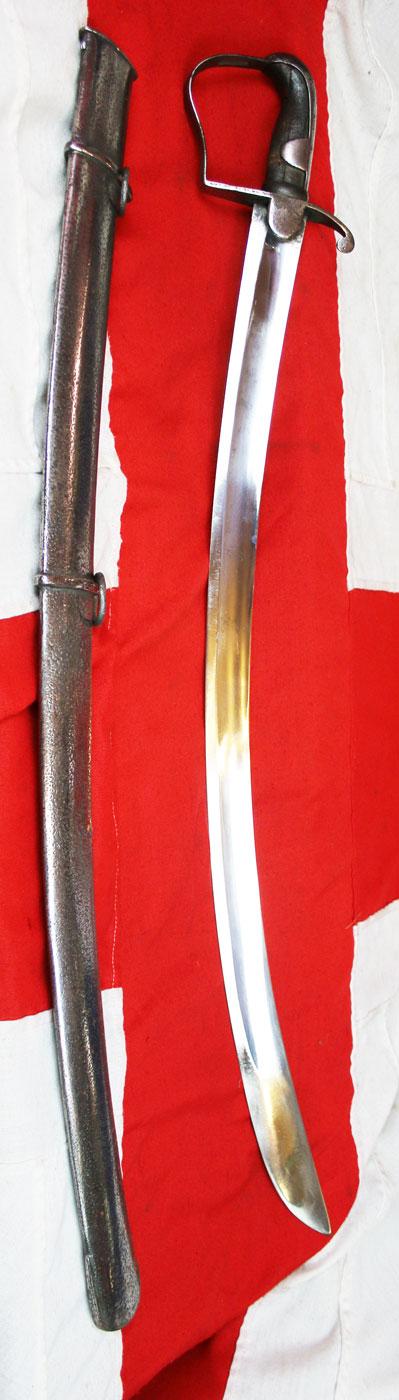
An Original & Historical 1796 Pattern Napoleonic Wars British Light Dragoon Trooper's Sword. A Regiment of the Line Issue Combat Sabre, For An NCO Or Other Rank Trooper Used In The Peninsular War and Battle of Waterloo era.. All steel scabbard, with steel P hilt and wooden grip. The blade is in excellent plus condition, and superbly bright overall, made circa 1802 to 1803. Average condition for age, obviously seen combat service . Maker stamped by Osborne, ordnance contract maker of 1796 pattern light and heavy dragoon trooper's swords, a maker in Birmingham, 1797 to 1803, & ordnance inspector stamped on the blade face, Crown over 1. This sword would have been used by a Light Dragoon trooper in any of the light cavalry regiments of the line, of the Napoleonic Wars, such as one who served, just for example, in the 11th Light Dragoons. The 11th Light Dragoons later became the 11th Hussars. The 11th fought at both the Peninsular War and at the Battle of Waterloo, and were awarded almost 500 medals for Waterloo. After a spell in Ireland the 11th were sent to Spain and Portugal to reinforce Wellington's army. Their strength, normally around 300 in peacetime was raised to 725. They arrived in June 1811 and, as in Egypt, they had a bad start. A dawn attack by the French in woods between Elvas and the Guadiana forced the 11th to retire on to what they thought were friendly Portugese lines. When they realised they were French, their commander Capt Lutyens ordered the charge. The shock tactic worked and they were able to drive their way through, but a second line of enemy troops was able to resist them. They lost 8 killed, 22 wounded and 77 taken prisoner. The regiment had more success at El Bodon near Cuidad Rodrigo on 25th September. By this time they were commanded by Lt Col Cumming, a brave and efficient cavalry officer. A large force of French cavalry was threatening Allied infantry and artillery on the plain in front of the 11th and a squadron of the King's German Legion who were well placed on high ground. Although they were vastly outnumbered the 11th and KGL charged at the enemy again and again, 20 times in all. The 11th were part of Wellington's great victory over Marmont at Salamanca on 22nd July 1812 but by 3rd April 1813 they had to give up their horses and embark for England much to the regret of Sir Stapleton Cotton who was in command of the cavalry in the Peninsula. It had been a hard two years for them having lost 417 men and 555 horses. During their time in the Peninsula many changes had been made to the uniforms of the British Army. The Prince Regent had a keen eye for dress and with his newly acquired position of supreme power was determined to push through his ideas based on continental military trends. The 11th exchanged it's light dragoon Tarleton helmet for a shako. The new jacket was still dark blue but had a buff plastron covering the chest, and white epaulettes, silver for officers. With the return of Napoleon in March 1815 the war with France resumed and the 11th arrived at Ostend on 2nd April. They were in Vandeleur's brigade with the 12th and 16th and had an unprecedented strength of 947 men. They came under heavy attack at Quatre Bras but did not suffer badly. On the 18th June 1815 the Battle of Waterloo began after a terrible night of torrential rain. It was a frustrating morning for the British cavalry who had to stand and watch an infantry battle. Against Wellington's wishes, the heavy cavalry made a brilliant charge that was spoiled by it's failure to re-form. The 11th under the command of Lt Col Money were sent into action when it looked as if the enemy were breaking up. They broke a French infantry square and carried on with the pursuit of Napoleon’s fleeing soldiers. Wellington entered Paris in triumph on 7th July escorted by the 11th and others. The regiment bivouacked on the Champs Elysees and became part of the army of occupation in France and Belgium. On 20th November they eventually arrived home after 3 years on the continent The mounted swordsmanship training of the British emphasised the cut, at the face for maiming or killing, or at the arms to disable. This left masses of mutilated or disabled troops; the French, in contrast, favoured the thrust, which gave cleaner kills. A cut with the 1796 LC sabre was, however, perfectly capable of killing outright, as was recorded by George Farmer of the 11th Regiment of Light Dragoons, who was involved in a skirmish on the Guadiana River in 1811, during the Peninsular War: "Just then a French officer stooping over the body of one of his countrymen, who dropped the instant on his horse's neck, delivered a thrust at poor Harry Wilson's body; and delivered it effectually. I firmly believe that Wilson died on the instant yet, though he felt the sword in its progress, he, with characteristic self-command, kept his eye on the enemy in his front; and, raising himself in his stirrups, let fall upon the Frenchman's head such a blow, that brass and skull parted before it, and the man's head was cloven asunder to the chin. It was the most tremendous blow I ever beheld struck; and both he who gave, and his opponent who received it, dropped dead together. The brass helmet was afterwards examined by order of a French officer, who, as well as myself, was astonished at the exploit; and the cut was found to be as clean as if the sword had gone through a turnip, not so much as a dint being left on either side of it" The blade is remembered today as one of the best of its time and has been described as the finest cutting sword ever manufactured in quantity. The steel hilt and scabbard has overall ols russetting, bright polished and with no denting. Every single item from The Lanes Armoury is accompanied by our unique Certificate of Authenticity. Part of our continued dedication to maintain the standards forged by us over the past 100 years of trading
  • Nation : British
  • Local Price : £950.00
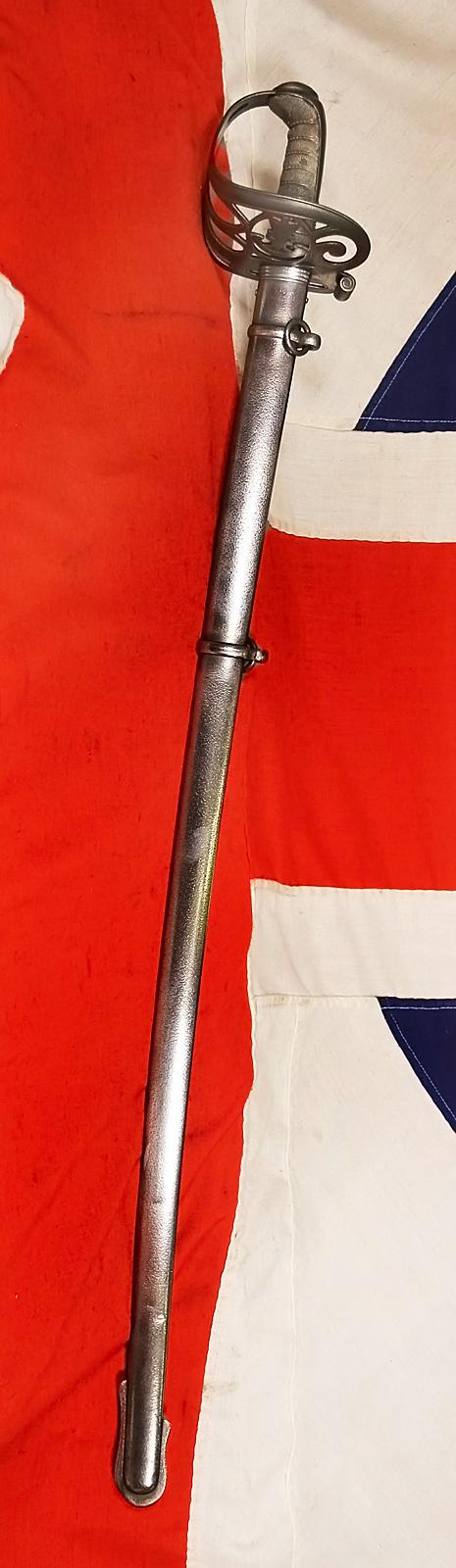
A Fine Regimental Victorian 60th Rifles Officer's Sword of the Rifle Brigade Signed Blade by Kemp, Leddell & Co. Armourers, 41 London Wall, London, Used In The Zulu War and in The Boer War As The Later Regiments Name The Kings Royal Rifle Corps. Etched with foliate scrolls, crowned VR cypher, regimental title device of the strung bugle blade in superb bright polish. Regulation grey steel gothic hilt, also incorporating a slung bugle horn, wire bound fish skin covered grip, in its good steel combat weight scabbard with two suspension rings. Sword bespoke commisioned from Kemp, Leddell & Co in London, circa 1870 3rd Battalion, 60th or The King’s Royal Rifle Corps (1755-1958) The 60th Rifles in 1879 were part of No. 1 Column (the Main Force) under Colonel Glyn and Lord Chelmsford. Fought in key engagements, including the decisive Battle of Ulundi on July 4, 1879, which effectively broke Zulu military power. After the Zulu war the regiments name was changed to the KRRC, the Kings Royal Rifle Corps. The 60th Rifles (The King's Royal Rifle Corps) served actively during the Anglo-Zulu War of 1879, (with individual officers like Major Charles Walter Robinson served on staff). The 3rd Battalion arrived in South Africa as part of the vital wave of British reinforcements sent after the initial disaster at Isandlwana. Before reaching Ulundi, they took heavy part in relieving the siege of Eshowe and fought at the Battle of Gingindlovu on April 2, 1879. The British fought in their traditional square formation at the battle of Gingindlovu, with the 60th Rifles taking position on the northern face of the square. According to Castle and Knight, “the main Zulu body split into columns, then crossed the Nyezane (River) at two drifts a mile apart; and, as it advanced up the slopes towards the laager, it fanned out into the traditional chest and horns attack formation. The order to hold fire until the enemy were within 300 yards condemned the troops at the front of the square to the nerve wracking spectacle of the Zulus deploying to attack without a shot being fired to stop them. It was a sight that was to strain the nerves of the untried men of the 60th. The British fought in their traditional square formation at the battle of Gingindlovu, with the 60th Rifles taking position on the northern face of the square. According to Castle and Knight, “the main Zulu body split into columns, then crossed the Nyezane (River) at two drifts a mile apart; and, as it advanced up the slopes towards the laager, it fanned out into the traditional chest and horns attack formation. The order to hold fire until the enemy were within 300 yards condemned the troops at the front of the square to the nerve wracking spectacle of the Zulus deploying to attack without a shot being fired to stop them. It was a sight that was to strain the nerves of the untried men of the 60th. At Ulundi: The battalion marched into the heart of Zululand with Chelmsford's advancing field force. At the decisive Battle of Ulundi, the British formed a massive, mobile hollow square (or rectangle) out on the Mahlabatini plain to repel an estimated 20,000 Zulu warriors. During the Second Anglo-Boer War (1899–1902), the King's Royal Rifle Corps (KRRC)—originally the 60th Regiment of Foot—served with distinction in South Africa. Their actions inspired several notable historical paintings, commemorative prints, and portrait commissions. The Battle of Talana Hill (20 October 1899): The 1st Battalion KRRC played a pivotal role in this early clash, successfully storming the heights alongside the Royal Dublin Fusiliers. Famous period illustrations and paintings capture the intense infantry assault up the boulder-strewn slopes where the KRRC's commanding officer, Lieutenant Colonel Gunning, was killed. The Battle of Colenso (15 December 1899): The 3rd Battalion KRRC was deployed just 700 yards behind Colonel Long's exposed artillery batteries to prevent the Boers from capturing the guns. This chaotic scene is immortalised in multiple famous paintings depicting the desperate struggle to rescue the artillery pieces under heavy fire.
  • Nation : British
  • Local Price : £950.00
Sword of a Page of Honour to King George V (1910-1936). Straight narrow spear-pointed blade with lenticular cross-section. Blade 58cm in length including washer, the sword 70.8cm overall. Gilt brass recurved crossbar hilt with finials in the form of dog’s heads, smooth ivory grip, gilt brass pommel in the form of a horse’s head. Bullion sword knot. Scabbard of white painted leather with brass throat and chape pieces. The throat and chape pieces of the scabbard are engraved with foliate motifs. The blade is etched on both sides with the crown and cypher of King George V, flowers and foliate motifs. The ricasso of the blade is etched on one side with the retailer’s name ‘WILKINSON & SON 57 AND 58. JERMYN ST. ST. JAMES’S. LONDON.’ It is etched on the other side with a six-pointed star inside which is a stylised ‘W’ indicating the manufacturer, the Wilkinson Sword Company. The Pages of Honour are boys appointed to serve the British monarch at state occasions, most notably carrying the long train of his various robes that would otherwise drag behind him. They should not be confused with the Pages of the Royal Household, who are paid adult servants, although both roles date back to the practice of young noblemen serving other lords in return for education and training in the medieval period. Since 1689 there have been four Pages of Honour at any one time – for some events only two are required, allowing the two not holding the monarch’s train to carry that of the consort, but the Robe of Estate worn at a Coronation requires all four. A second group of four is therefore required for the train of a royal consort at the Coronation. Becoming a page to the monarch was a prestigious honour given at that time to sons of courtiers and prominent noble families. Given their origins these young men often went on to become notable figures in their own right: among George V’s pages were Sir John ‘Jock’ Colville, who was private secretary to Prime Ministers Chamberlain, Churchill and Attlee, Major-General Lloyd-Verney, who commanded the 7 th Armoured Division in WW2, and Lieutenant-Colonel Rowland Baring, Earl of Cromer, who became Governor of the Bank of England and later Ambassador to the United States. Today pages of honour are almost exclusively close friends and family of the monarch. The specifications as of 1921 for the sword to be carried by a Page as part of his official dress were as follows: Sword. — Short, with cross guard and horsehead pommel, ivory grip, white leather scabbard with gilt mounts. Sword Knot. — Gold lace strap and bullion tassel. This model of sword was used for no other function and would almost certainly have been bought along with the page’s uniform. As shown on this example the firm Wilkinson & Son was the retailer – probably the sole retailer. Wilkinson & Son was a tailor specialising in court & diplomatic dress at the highest levels, including tailoring the coronation robes worn by Knights of the various orders, the ermine robes and coronets of the Peers, and even the robes of the monarchs themselves from William IV to George VI. Based on Jermyn Street, which is to this day a centre of British tailoring excellence, it would make perfect sense for them to have produced the dress for royal pages. However, they were not sword cutlers and should not be confused with the Wilkinson Sword Company. This other Wilkinson was founded in 1772 as the business of the noted gunmaker Henry Nock of London, later inherited and renamed by his partner and son-in-law James Wilkinson. It enjoyed great success and was from the late 19 th century the premier swordmaking company in Britain, employing around 300 people in its factory on Oakley Street, Chelsea and with a showroom on Pall Mall. It absorbed many rival firms including Reeves, Mole, Pillin and Thurkle and took an active role in the design process for British military swords like the 1908 Pattern for Cavalry. Despite its near monopoly its business in razor blades and other items eclipsed the declining sword trade and Wilkinson stopped producing swords in 2005, some of its machinery being sold on to Pooley Sword which continues to supply the British Army. It is worth considering how many of these swords could still exist: George V only had 31 pages of honour over his reign, and that number includes the first group of four that carried the train at his coronation, who had served his late father and therefore would already have had swords with the cypher of Edward VII. Queen Mary’s four Coronation pages may not have carried swords at all and she probably needed no other pages after that date: archived pictures of non-Coronation state occasions appear to confirm that two pages carried the King’s train and two carried the Queen’s. This example is complete with its knot and is in excellent condition. The blade is immaculately bright and clean, all of its etching crisp. The ivory grip has no cracking or discolouration due to age, only one tiny black spot near the pommel on one side (>0.5mm). Some surface level latitudinal cracking and one small chip to the white paint of the scabbard. Some rubbing and very minor denting to the scabbard fittings. Due to the ivory used in the grip, this sword cannot be exported from the UK . It has been declared and registered as antique ivory under the provisions of the UK Ivory Act and therefore can be sold within the UK. Please note that this is a one-time non-transferable registration: if you purchase this sword and wish to resell it you must register it again.
  • Nation : British
  • Local Price : £675.00
British Ordnance Marked Victorian 1845 Pattern Royal Navy Boarding Cutlass. Sn 22266 -. The British Royal Navy due to its global presence and command of the sea was by far the most organised and trained of all the World major sea services and it’s edged weapons used for boarding and repelling boarders reflected this. The Royal Navy was one of the first Navies in the 18th Century to begin standardising the personal edged weapons used by ordinary seaman. Experiments during the early 1840s for a new naval cutlass design to replace the venerable 1804 Pattern resulted in a design by George Lovell, the Inspector of Small Arms, being accepted in 1842. A fire at the Tower of London destroyed early stocks and the design did not enter service in bulk until three years later, hence being termed the 1845 Pattern. It was considered very successful, handling well compared to its bulky predecessor the 1804 Pattern and being simpler to manufacture. This is a very good original Victorian 1845 Pattern boarding Cutlass (see page 248 of World Swords by Withers). Our example has the classic broad single edged 29 ½” blade (34 ½” overall). The blade is just under 1 ½” broad at its widest and the spine is 7mm width at its widest. It has the correct full steel bowl knuckle guard and ribbed steel hilt all blackened. The guard is slotted for wrist strap. The blade has some staining consistent with age & service use and has its original leather hilt washer. Near to the hilt one side of the blade has a ‘crown 13’ British ordnance inspection mark. The spine has faint indistinct partial maker’s name ‘***INGTON’ . These weapons were stored in locked racks on board ships and issued only for training or combat so are often found without scabbards. Only a small number were furnished with scabbards so that with a baldrick they could be worn for land-bound duties. Our example is without scabbard. The price for this piece of British Naval history includes UK delivery. Sn 22266 (tub armoury)
  • Nation : British
  • Local Price : £675.00
British Board Of Ordnance 1845 Pattern Royal Navy Boarding Cutlass Weapon Number ‘172’ Regulation Converted Slender Blade C1887 / 1888. Sn 22296 -. The British Royal Navy due to its global presence and command of the sea was by far the most organised and trained of all the World major sea services and it’s edged weapons used for boarding and repelling boarders reflected this. The Royal Navy was one of the first Navies in the 18th Century to begin standardising the personal edged weapons used by ordinary seaman. Experiments during the early 1840s for a new naval cutlass design to replace the venerable 1804 Pattern resulted in a design by George Lovell, the Inspector of Small Arms, being accepted in 1842. A fire at the Tower of London destroyed early stocks and the design did not enter service in bulk until three years later, hence being termed the 1845 Pattern. It was considered very successful, handling well compared to its bulky predecessor the 1804 Pattern and being simpler to manufacture. Many of the 1845 pattern cutlasses were converted in 1887 and 1888 to the new specifications. They had their blades made more slender (see page 248 of World Swords by Withers). Our example is one of the regulation converted blades which would have been performed circa 1887- 1888. It has the classic single edged 28 ½” (34” overall). The blade is 1 ½” broad at its widest and the spine is 5mm width at its widest. The blade has some staining consistent with age & service use. It has the correct full steel bowl knuckle guard and ribbed steel hilt all blackened. The guard is slotted for wrist strap and has an additional period pierced hole. The guard has 2 brass rivets (these would most likely have supported a brass lozenge riveted to the front with a weapon / rack number. The lozenge is absent (Wither’s book illustrates afore described hilt plates). The guard also has engraved ‘BO WD arrow’ Board of Ordnance mark and weapon number ‘172’. These weapons were stored in locked racks on board ships and issued only for training or combat so are often found without scabbards. Only a small number were furnished with scabbards so that with a baldrick they could be worn for land-bound duties. Our example is without scabbard. The price for this piece of British Naval history includes UK delivery. Sn 22296 (tub armoury)
  • Nation : British
  • Local Price : £675.00
Victorian British Firmin & Sons London 1822 Pattern Infantry Officer’s Sword With Gilt Brass Guard Etched Blade To The 1st Manchester (Volunteer) Rifles & Steel Scabbard. Sn 22090 -. Originally raised as the King’s Royal Rifle Corps in 1755, the Rifle Brigade was officially formed in 1800. The Manchester Volunteer Rifles were raised in 1859/60. Their expansion in WW1 as eighteen battalions of the Manchester Regiment saw the Regiment play a significant role in the Great War. The 1822 pattern sword was a radical departure from previous designs, having a ‘gothic’ style pierced basket hilt so named after its resemblance to window shapes in gothic architecture (see page 173 of World Swords by Withers & Page 159 of Robson). This original infantry Officer’s Pattern 1822 sword has a clean 32 ½” single edged steel blade (38 ½” overall).. The blade is signed by the maker or retailer ‘Firmin & Sons 153 Strand London’ and has ordnance acceptance star and inlaid proof roundel. Both sides of the blade have etched decoration featuring foliate panels Queen’s crown VR Royal Cypher, ‘First Manchester Rifles’ within scrolling banners and heradic arms of Manchester with motto ‘From Acorns Spring Oaks’. The gilded brass gothic style voided guard has stylised Royal Cypher Queen’s crown ‘VR’ (Victoria Regina). Its fish skin grip with finger grooves & wire binding is in excellent condition. The sword is complete with its steel scabbard which has 2 steel hanging rings. The price includes UK delivery. Sn 22090
  • Nation : British
  • Local Price : £675.00
**RARE**C1887 Victorian Greaves & Co Kings Head Police Station, Chingford Kent Weapon Number 9 Police Constabulary Sword Hanger With Etched Blade ‘KHP No.9’ & Scabbard. ED 2562 -. The Metropolitan police was formed in 1829 and although Chingford in Kent was in its jurisdiction, the scattered village fell under the control of Waltham Abbey Police Force and did not warrant its own police station at that time. In the 1870’s there were concerns about the increase in lawlessness in Chingford, in particular, rowdy behaviour by some of the many visitors to the forest. In 1887 land was found to build the station next to the Kings Head public house. Illustrated in image 1 is a period image taken Circa 1887 of a Group of King’s Head Police Station Police Officer’s outside their new Police Station. This is an original Victorian era Police hanger & scabbard to the King’s Head Police manufactured by Greaves & Co. It has a faint etched panel on one side of the 23 ½” swept cutlass form blade ‘KHP No.9’ (Kings Head Police Weapon Number 9). The spine has a faint etched panel ‘Greaves & Co Manufacturer’. The fullered blade has just staining consistent with age and is very sharp. The blade has its original leather hilt washer. The shagreen wrapped handle is in good order with brass hand guard & stepped pommel. The hilt’s locking catch works correctly retaining the hanger securely in its scabbard, The overall length of the sword is 29 ½”. The leather scabbard with brass mounts is in good condition with just small areas of stitching on the spine open & just scuffs & abrasions to leather consistent with age and service use. The brass throat mount has a frog locket. The price for this rare hanger to a small Victorian Police constabulary includes UK delivery. ED 2562
Page 63 of 118