
Show

Forgot your password?

Error message here!

Error message here!

Error message here!

Error message here!

Show Error message here!

Show Error message here!

Lost your password? Please enter your email address. You will receive a link to create a new password.

Error message here!

Back to log-in

Close

For Sale

The following items are listed by for sale by users of the site and dealers. They are in no way endorsed or guaranteed by www.antiquearmsresearch.com

Add a Classified Item
to

Clicking on the sword will take you through to the relevant classified item or dealer site.
Don't miss out! - Do you want to be kept informed weekly of new aditions? Just join our weekly update list.

You can also receive regular email notifcations when items match your keywords. To recieve them just register or logon at the top right of this page.

Page 62 of 152
  • Nation : British
  • Local Price : £825.00
British 1892 Pattern Household Cavalry Trooper’s Sword, Unusual Variant. Description Slightly curved, single fullered blade with spear point, basket guard with pierced foliate &#acute;honeysuckle&#acute; decoration incorporating the cypher &#acute;HC&#acute;, buff leather hilt liner and washer, brass wire-bound shagreen grip, smooth steel backstrap and integral smooth oval pommel. Buff leather sword knot. Steel scabbard with two hanging rings and fixed side loop to the upper band. Blade 32 inches in length (81.3cm), the sword 37¾ inches (95.9cm) overall. The blade is unmarked. The outside of the hilt is stamped with two broad arrows point to point, a mark that was put on War Department equipment that was declared obsolete or to be sold off. The inside of the hilt is stamped near the quillon (under the hilt liner) with &#acute;1 . 08&#acute; above &#acute;4 / 01&#acute; above &#acute;T&#acute; above &#acute;209&#acute;. The first two are most likely issue dates of January 1908 and April 1901, indicating periods this sword was in service. The last number is most likely a serial or rack number. The &#acute;T&#acute; marking is interesting “ see below. Since their inception the regiments of Life Guards and Royal Horse Guards which collectively made up the Household Cavalry carried different swords than the regiments of the regular cavalry. This stemmed from their unique status as bodyguards to the Sovereign, which placed them beyond the effective control of the Army bureaucracy for most of their existence. Until 1882 they designed, ordered and carried swords on their own initiative, not necessarily producing better weapons but enhancing their prestige and elite status. The 1892 Pattern sword for the Household Cavalry was adopted after much discussion of the shortcomings of its predecessor the 1888 Pattern. An intense debate had been ongoing throughout the 1880s of the optimal form for a cavalry sword, which had already resulted in three new models of sword for the regular cavalry in just ten years. It was eventually decided to simply adopt the blade of the then-current 1890 Pattern cavalry trooper&#acute;s sword, paired with essentially the same distinctive Household Cavalry hilt, which had not been particularly criticised. Ironically after all the talk of blade handling and sturdiness, the 1892 Pattern saw no combat. After 1908 the regiments of the Household Cavalry would carry the new 1908 Pattern while in the field, while the 1892 Pattern was retained (in the slightly modified Mk II form introduced in 1902) for parade use only. This was done on the direct request of King Edward VII, who found the 1908 pattern &156;hideous&157;. The use of the 1892 Pattern as their parade sword continues to this day. This example appears to have been modified from a standard 1892 Pattern “ its blade has been reduced in length by 2½ inches from the standard and has also been significantly reduced in breadth by grinding back the edge and the false edge, leaving the fuller roughly central in a blade 2.8cm wide at the shoulder, which rapidly narrows to 2cm along most of the blade&#acute;s length (2.7 on an unmodified example), with a much slenderer point as a result. It has even been reduced in thickness “ the original is 8mm thick along most of its length while this example is 6mm. The removal of material has made the fullers shallower and appears to have removed any previous markings from the blade. Conversion to this extent would have required the sword to be dismantled, and this is shown in its repeened pommel with atypical flat tang button. The changes to the blade allow it to fit into its atypical bespoke scabbard, which is along the lines of the steel parade scabbards used for all infantry officer&#acute;s swords since 1866, but modified with a fixed loop on the top band alongside the two hanging rings, which matches the Household Cavalry&#acute;s hanging configuration. The complex blade conversion has been very well done, and reminds me of very similar conversions done in the early 1900s to make sergeant&#acute;s swords, which also slimmed down 1890 Pattern Cavalry blades in order to fit them into scabbards like those of infantry officers. The parallels are interesting and may suggest some kind of deliberate reuse of old stock across the Army. I can find no reference to an official sword in this configuration, however so why was this sword made? The most logical reason to convert the 1892 Pattern to resemble the infantry sword would be to make it more readily wearable on foot. I think there is a strong possibility therefore that this example is an attempt to create a variant for trumpeters and other bandsmen of the regiments. These men had significantly more dismounted duties than the others, making a shorter sword more practical. At least one example exists of the 1820 Pattern sword for the Life Guards, which is usually more than 37½ inches in the blade and sometimes as much as 38¾, having been shortened to 33 inches, which is thought to have been for these musicians (see p185, The British Cavalry Sword by Dellar). The 1882 Pattern was the first to officially acknowledge this need with two distinct versions of the sword manufactured, one with a 34¾ inch blade for trumpeters and bandsmen, and one with a 38 7/8 inch blade for all other troopers. Notably the short model also had a variant scabbard with two hanging rings, just as this sword does. Officially the scheme of long & short versions was then dropped again in the 1888 Pattern, with a 37½ inch model for all troopers. I doubt that the practical need for a shorter version went away in those few short years, however. Perhaps in practice the bandsmen either used the old short 1882s for their foot duties or, as time passed, produced their own up-to-date short versions by conversion. Might that be the significance of the &#acute;T&#acute; marking on this example “ that it is intended for the regimental Trumpeters? See attached reference of a painting by notable military artist Richard Simkin depicting a trumpeter of the Royal Horse Guards on foot with sword as of 1912. The blade is bright with a high polish overall and only tiny areas of frosting or patination. There is no damage to its edge, which has been sharpened. The hilt including backstrap and pommel is likewise bright and clean. The knot and washer have some small areas of staining, the liner is clean. The buff leather pieces are so good that they may be later replacements, but this is difficult to judge. The wire binding of the grip is all intact and there are no losses or visible handling wear to the shagreen. The scabbard has some light patination and polishing marks.
  • Nation : American
  • Local Price : 1,150.00 USD
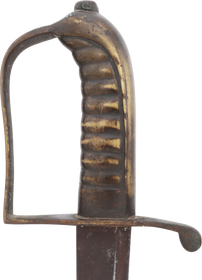
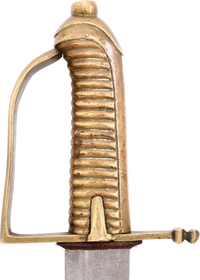
AMERICAN NON COMMISSIONED OFFICER’S SWORD C.1790-1810. This pattern identified in The American Sword (Peterson) as #5 was carried by sergeants immediately after the Revolution and during the War of 1812. The brass hilt has a variation of the “pillow pommel” popular at the time. The grip is reeded American walnut. The blade is 26 ¾” long, broad fullered and retains its original blade seat. The specifications of the General Orders of March 30 and September 22, 1800, set out the specifications for this sword, making it arguably, the first standard pattern US sword.
  • Nation : British
  • Local Price : £795.00
English Silver Hilt Court Sword Hallmark 1786. English Silver Hilted Court Sword Hallmark 1786 London and maker Marked R F “ Robert Foster. Super hilt in the form of the period, hallmarked as is the shell guard with silver wire wrapped grip. The colichemarde blade with good engraving at the ricasso but deteriorates over its length ibn condition please see images. For reference, please see Silver Mounted Swords by Daniek D Harzler page 97. Complete with original leather again with hallmarked fittings, over all length 89cm the blade 72.5cm
  • Nation : British
  • Local Price : £795.00
British Foot Artillery Sword c 1820. British Foot Artillery Sword c 1820 straight blade unfullered flat back with spear point. The guard brass straight knucklebow with brass shield shaped langets, curled quillon and leather-bound leather grip. Only marking is on the hilt which is a stylised S over stamped with a T or F overall length 24.75 inch over all 29.5 inch for reference please see Swords of the British Army Revised Edition page 233
  • Nation : British
  • Local Price : £795.00
British Light Cavalry 1821 Troopers Sword. British 1821 Light Cavalry Troopers Sword steel three bar hilt engraved with domed pommel with tank button and plain back strap with two ears and leather covered grip. The slightly curved blade with single fuller and spear point. Complete with steel scabbard with two loose rings. Overall length 37 inch the blade 32 inches
  • Nation : British
  • Local Price : £795.00
**OLDEST BRITISH ARMY REGIMENT**C1870 British Honourable Artillery (HAC) Officer’s Sword By Warren London With Etched Blade & Scabbard. Sn 22645:5 -. Established in 1537 the HAC is the oldest Regiment in the British army. It was primarily a citizen militia and raised in times of national emergency including the Armada, English Civil war and Napoleonic wars. Until the Victorian era, Officers would have followed regular infantry sword patterns. As this was a volunteer army, they would have to pay for all service equipment including their own swords. This sword highlights the strong influence of French sword design in that era, particularly with regard to the knuckle bow and angled or canted pommel (see page 175 of World Swords by Withers).This is a very good example of the HAC Officer’s Sword. Our example has a 31 ½” long, rapier type steel blade (37” overall). The blade has light staining consistent with age. Both sides have foliate engraved panels, one side has stylised combined ‘HAC’ monogram, the reverse has what looks like ‘WRN’ combined stylised monogram possibly the name of the Officer who commissioned this sword. The ricasso is signed by the maker or retailer ‘Warren 23 Cursitor Street, London’. It has brass guard with canted pommel and pierced upturned clamshell featuring the embossed ignited grenade artillery emblem. The undamaged fish skin covered hilt has its original copper wire binding which is tight and intact. The sword is complete with its original steel scabbard. The scabbard with brass shoe, fixed belt bar and mounts with 2 original brass hanging rings has no dents or damage. The price includes UK delivery. Sn 22645:5
  • Nation : British
  • Local Price : £795.00
British Victorian Officers Court Sword by. British Victorian Officers Court Sword by Mole in super condition, classic form of hilt with full dress knot. The blade in super condition etching bright and clear with VR and crown to both sided surrounded by floral decoration and maker marked Mole Birmingham. It is complete with black leather scabbard with matching gilt mounts.
  • Nation : British
  • Local Price : £795.00
Edwardian Cut Steel Court Sword. Edwardian Cut Steel Court Sword in super condition retaining all original polish to mounts and blade, with facet cut hilt with pierced boat guard and chain and tassel knuckle bow, etched trefoil blade with trophies of arms and floral decoration, complete with original steel mounted black leather scabbard small crease near drag plus both storage bags
Page 62 of 152