
Show

Forgot your password?

Error message here!

Error message here!

Error message here!

Error message here!

Show Error message here!

Show Error message here!

Lost your password? Please enter your email address. You will receive a link to create a new password.

Error message here!

Back to log-in

Close

For Sale

The following items are listed by for sale by users of the site and dealers. They are in no way endorsed or guaranteed by www.antiquearmsresearch.com

Add a Classified Item
to

Clicking on the sword will take you through to the relevant classified item or dealer site.
Don't miss out! - Do you want to be kept informed weekly of new aditions? Just join our weekly update list.

You can also receive regular email notifcations when items match your keywords. To recieve them just register or logon at the top right of this page.

Page 67 of 124
  • Nation : British
  • Local Price : £675.00
**NAMED**WW1 Era British Fenton Brothers Ltd Sheffield George V 1897 Pattern Sword with Presentation Etched Blade ‘Presented To 2nd Lieut Ewart H Philips from Bargoed’ & Field Service Scabbard. ED 2683. -. This is an excellent WW1 era 1897 pattern Infantry Officer’s sword with presentation etched blade. The sword has a clean 32 ½” long blade with partial fullers. The blade is etched on both sides. Both sides have decorative foliate panels. One side has Kings crown Royal Cypher ‘GR V’ (George V Rex), maker detail ‘Fenton Brothers Ltd Sheffield’ together with panel ‘Presented To 2nd Lieut Ewart H Philips from Bargoed (Bargoed is a town and community in the Rhymney Valley, Wales, one of the South Wales Valleys)’. The reverse has King’s crown heraldic arms and has the ordnance acceptance star. It has a full 1897 Pattern knuckle guard with King George V Crown & Royal Cypher. It has a curved stepped pommel with ball top and knurled back strap for grip, fish skin grip with wire binding in superb condition. It is complete with leather covered wood field service scabbard. All leather and stitching are clean and intact. The price for this excellent named sword includes UK delivery. ED 2683.
  • Nation : Dutch
  • Local Price : £675.00
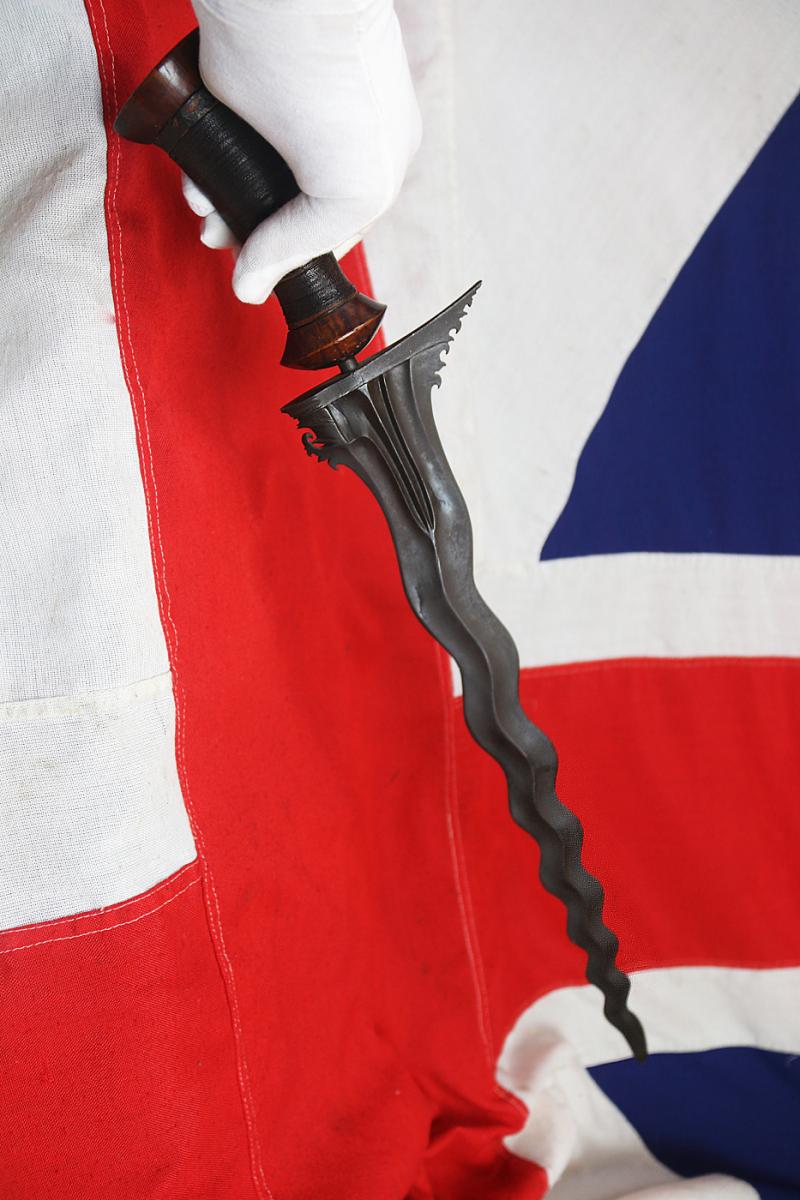
A Scarce Large Antique Bali & Lombok Loncengan Hilt High Born Warriors Kris or Keris. With A Spectacular, Serpentine, 15 Luk {Curves} Blade. From the Bali or Lombok island of Indonesia. The very fine blade being also very finely polished likely leans towards Bali. Most keris or kris from other islands have course blades that are not meant to be highly polished as is this fine sword. The Dutch first visited Lombok in 1674 and settled the eastern part of the island, leaving the western half to be ruled by a Hindu dynasty from Bali. The Sasaks chafed under Balinese rule, and a revolt in 1891 ended in 1894 with the annexation of the entire island to the Netherlands East Indies. This is a beautiful and scarce Kris with bound grip typically indicative of Lombok Keris, Because some kris are considered sacred and believed to possess magical powers, specific rites needed to be completed to avoid calling down evil fates which is the reason warriors often made offerings to their kris at a shrine. There is also the belief that pointing a kris at someone means they will die soon, so silat practitioners precede their demonstrations by touching the points of the blades to the ground so as to neutralise this effect. Reference; a Lanes Armoury *Special Conservation* Item, restored and conserved in our workshop, see info page for details on our conservation principles. Painting in the Royal Collection by Frans Francken the Younger in the gallery, photo 10, painted in 1617, titled 'Cabinet of a Collector', clearly shows, top left, a 16th century Kris dagger, Even as early as the 16th century, awareness and collectability of the Indonesian kris had reached far into Europe. The kris or keris is a distinctive, asymmetrical dagger from Indonesia. Both weapon and spiritual object, the kris is considered to possess magical powers. The earliest known kris go back to the tenth century and most probably spread from the island of Java throughout South-East Asia. Kris blades are usually narrow with a wide, asymmetrical base. The sheath is often made from wood, though examples from ivory, even gold, abound. A kris’ aesthetic value covers the dhapur (the form and design of the blade, with some 40 variants), the pamor (the pattern of metal alloy decoration on the blade, with approximately 120 variants), and tangguh referring to the age and origin of a kris. A bladesmith, or empu, makes the blade in layers of different iron ores and meteorite nickel. In high quality kris blades, the metal is folded dozens or hundreds of times and handled with the utmost precision. Empus are highly respected craftsmen with additional knowledge in literature, history and occult sciences. Kris were worn everyday and at special ceremonies, and heirloom blades are handed down through successive generations. Both men and women wear them. A rich spirituality and mythology developed around this dagger. Kris are used for display, as talismans with magical powers, weapons, sanctified heirlooms, auxiliary equipment for court soldiers, accessories for ceremonial dress, an indicator of social status, a symbol of heroism, etc. 19.5 inch blade, overall 24.75 inches. No scabbard
  • Nation : British
  • Local Price : £675.00
Victorian, British Ordnance Scarboro Rifles (Scarborough North Yorkshire) Pattern 1827 Volunteer Rifle Brigade Officer’s Sword With Etched Blade By Hart & Hill, Scarboro & Scabbard. Sn 23156 -. The Volunteer movement had its origins in the eighteenth century. Service in the Militia was compulsory at that time for those selected by ballot and who were not wealthy enough to hire a substitute. But specific threats, such as Jacobite risings or the threat of French invasion, induced men to volunteer for home defence. A series of Militia Acts, notably in 1761, 1768 and 1802, had the effect of transforming the Militia from a home defence force into a reserve for the Regular Army, and its former function was increasingly filled by the Volunteers. During the Napoleonic Wars 1793-1815, the risk of invasion by Revolutionary France persuaded the government to authorise the formation of volunteer units that would be subject to military discipline and eligible for pay when called out. Numerous Volunteer units were formed around the country. British Volunteer strength peaked in 1803 at a remarkable total of some 440,000, but with the defeat of Napoleon they were all disbanded. In 1859 after another threat of Invasion Volunteer rifle units throughout Britain were reinstated. The Scarborough Volunteer Rifles were part of the historic Yorkshire Rifle Volunteer Corps. They became part of the North York Militia, then the North York Rifles, and later a battalion of the Green Howards (Alexandra, Princess of Wales’s Own Yorkshire Regiment). The 1827 pattern is defined by gothic bar guard hilt coupled with the usual Royal Cypher with strung bugle cartouche badge of the Rifle Brigade (see page 174 of World Swords by Withers). This is an original 1827 Pattern Scarborough Rifles Officer’s Sword. The sword has a clean 32 ½” blade (38 ½” overall) with fullers and original leather hilt washer. The blade has etched & blued foliate panels together with ‘Scarboro Rifles’, the slung bugle of the Rifle Brigade Queen’s crown and ‘VR’ Royal Cypher (Victoria Regina). The blade also has ordnance proof star and roundel & is signed by the maker or retailer ‘Hart & Hill, Scarboro’. It has the correct steel gothic bar knuckle guard with the Rifle Brigade ’Queen’s Crown with slung bugle’ badge and curved stepped pommel. The fish skin covering on the grip grip is very good, the grip’s copper wire binding is all present and tight. It is complete with its steel scabbard with 2 hanging rings and shoe. The scabbard has areas of staining consistent with age but no dents. The price includes UK delivery. Sn 23156
  • Nation : British
  • Local Price : £675.00
**NAMED**Boer War 1901 Dated Blade & WW1 Era British George V 1897 Pattern Sword Guard Engraved To ‘H.W. Mirehouse II N. Staffs Regt’ (2nd Battalion Prince of Wales’s (North Staffordshire) Regiment) With Field Service Scabbard & Frog. Sn 2. The Prince of Wales’s (North Staffordshire) Regiment served with distinction during the Second Boer War and during two World Wars. In 1920 the Regiment was renamed The North Staffordshire (The Prince of Wales’s) Regiment and amalgamated in 1959 with the South Staffordshire Regiment to form The Staffordshire Regiment (The Prince of Wales’s). In 2005 the Regiments of Cheshire, Worcestershire & Sherwood Foresters, Staffordshire and West Midlands & Kings Cheshire were amalgamated to become the Mercia Regiment. This is an excellent British1897 pattern Infantry Officer’s sword to a named Officer of the 2nd Battalion Prince of Wales’s (North Staffordshire) Regiment. The sword has a 32 ½” long blade with partial fullers. The blade has areas of staining consistent with age and use. One side of the blade has a date mark ’01 (1901) and inspection mark. There is no visible maker name. The spine of the blade is numbered ’1162’. It has a full 1897 Pattern knuckle guard with King George V Crown & Royal Cypher. The guard is engraved ‘H.W. Mirehouse II N. Staffs Regt’. It has a curved stepped pommel with ball top and knurled back strap for grip, fish skin grip with wire binding in very good condition. It is complete with leather covered wood field service scabbard. The scabbard has a German silver throat mount & is fitted with Sam Browne pattern leather frog that has 2 belt loops and buckles. All leather and stitching are clean and intact. The price for this sword worthy of further research regarding the named Officer includes UK delivery. Sn 23484:88
  • Nation : British
  • Local Price : £675.00
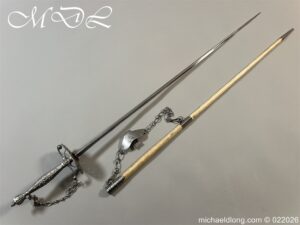
Georgian Cut Steel Court Sword. Georgian Cut Steel Court Sword in super condition with facet cut hilt with pierced boat guard and chain and tassel knuckle bow, trefoil blade, complete with original steel mounted leather scabbard with matching polished hanger and chains.
  • Nation : French
  • Local Price : £935.00
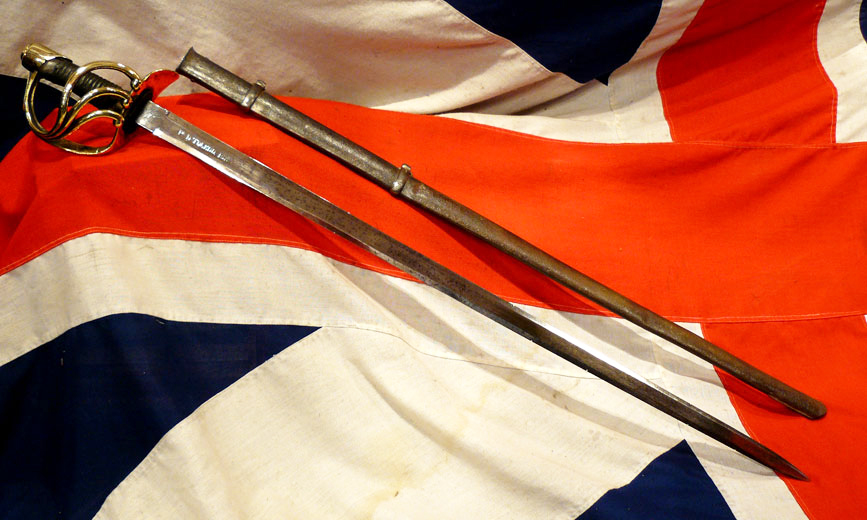
A 19th Century Napoleonic Pattern, Spanish Dragoons, Heavy Cavalry of the Line Sword. In the Napoleonic wars the Spanish heavy line cavalry troopers were equipped with this pattern of sword, based on the French cuirassiers sword, having a hilt of the French heavy cavalry Cuirassiers, An XI pattern, in brass, with knuckle-bow, three curved quillons and pommel. Later this was regularised to create the model 1832 pattern. This sword's blade is maker marked, Toledo 1863. This sword has certainly seen service and evidence of combat use. This is a big, scarce Napoleonic pattern Cuirassier battle sword, and a most impressive and fascinating example, and the first of it's kind we have seen in nearly 10 years, These huge and impressive original 19th century Spanish heavy cavalry swords are very rarely seen to survive and this is a very impressive piece. The Cavalry Regiment El Rey (Spanish: Regimiento de Caballera El Rey is the oldest cavalry regiment in the Spanish Army, distinguishing itself on several occasions during the Peninsular War. They are known bestn for there charge at the Battle of Talavera where they dealt the decissive blow against General Jean Francois Leval's German Division. The Cavalry Regiment El Rey is Spain's oldest cavalry regiment, founded in 1538 under the reign of King Charles I of Spain, and as such bore the title The King's in the Spanish Army. During the Napoleonic era it was considered as one of the best Spanish regiments and it distinguished itself during the Spanish War of Independence, frequently being commented as performing very well in those years. In 1807 the regiment was assigned to Marques de la Romana's Division of the North. In 1808 it joined the fight against France after evacuating from Denmark. Upon arrival in Cantabria the cavalrymen marched to Extremadura where they were to collect horses, thus avoiding the defeat that fell upon Romana's division at Espinosa de los Monteros. In 1809 the regiment would see much action while serving in Gregorio Garcia de la Cuesta y Fernandez de Celis' Army of Extremadura, as part of General Jose de Henestrosa's 1st Cavalry Division. It would fight at the Battle of Talavera, where they captured four French cannons and would be highly praised in Cuesta's report. During the Spanish War of Independence the unit wore a blue coat with scarlet cuffs, collar, lapels, turnbacks, gold piping and buff breeches. Like all regiments at the start of the Peninsular War they wore a red plume on their hat to show their loyalty to the Bourbon monarch, Ferdinand VII of Spain, instead of the "hated foreigner" Joseph Bonaparte. In 1870 the regiment wore a blue coatee with scarlet cuffs, collar and lapels, white turnbacks, and yellow piping and had brass buttons, they also wore blue breeches. The troopers wore a black bi-corn hat with gold lace and a red cockade with a gold cockade loop. In 1898 the regiment had a uniform of a light blue dolman with black Austrian loops and white metal buttons; red collar and cuffs, and red trousers with a light blue stripe. They had also, after the Napoleonic Wars adopted the use of a cuirass and helmet, of steel with brass ornamentation. However, in the colonies of Cuba, Puerto Rico, Guam, the Las Carolinas Islands and the Philippines they wore the Rayadillo colonial uniform with red collar and cuffs and Leopoldina shakos with the Spanish red and yellow cockade 95 cm blade
  • Nation : German
  • Local Price : 925.00 USD
GOTHIC SHORTSWORD, GERMAN C.1450. 19 ¼” length with 13 ¾” blade of heavy wedge section. Excavated with its pommel cap and two of three grip rivets intact. Closely related to the scramseax of centuries earlier, these were swords of peasants, untrained in fencing, but of extraordinary musculature resulting from their backbreaking work. They were kept in the house at the front door for defense and carried when foul play might be encountered as when going to town. That they are weapons and not working knives, is verified by the fact that their original form is preserved, uncompromised by repeated sharpening, as would be the case with a working knife or tool.
  • Nation : American
  • Local Price : 925.00 USD
US 1840 PATTERN FOOT OFFICER’S SWORD. Among the rarest of standard pattern swords, this sword is based on the 1840 NCO sword with distinguishing premium features. The all-brass hilt is decorated with foliage motifs on the pommel and knuckle bow. The left thickened edge side guard folds for wear and opens locked for combat. The underside of the guard is hemispherical to seat the folding guard and is above an oval brass blade seat. The 32 ¼” blade of this example is undecorated and unmarked. It has a chocolate brown patina with some islands of pitting mid-blade, mostly to the right side. Good uniform dark patina. Probably a German import under the pressures of War, this pattern is among the rarest of Civil War swords.
Page 67 of 124