
Show

Forgot your password?

Error message here!

Error message here!

Error message here!

Error message here!

Show Error message here!

Show Error message here!

Lost your password? Please enter your email address. You will receive a link to create a new password.

Error message here!

Back to log-in

Close

For Sale

The following items are listed by for sale by users of the site and dealers. They are in no way endorsed or guaranteed by www.antiquearmsresearch.com

Add a Classified Item
to

Clicking on the sword will take you through to the relevant classified item or dealer site.
Don't miss out! - Do you want to be kept informed weekly of new aditions? Just join our weekly update list.

You can also receive regular email notifcations when items match your keywords. To recieve them just register or logon at the top right of this page.
Page 68 of 157
  • Nation : British
  • Local Price : £795.00
1901-1910 British Edward VII 4th Volunteer Battalion Cheshire Regiment 1897 Pattern Infantry Officer’s Sword With Blued & Etched Blade By Hobson & Sons London & Scabbard. Sn 22426:56 -. The Cheshire Regiment was a line infantry regiment of the British Army, part of the Prince of Wales’ Division. The 22nd Regiment of Foot was raised by the Duke of Norfolk in 1689 and was able to boast an independent existence of over 300 years. The 4th Volunteer Battalion was formed in 1860. The regiment was expanded in 1881 as part of the Childers Reforms by the linking of the 22nd (Cheshire) Regiment of Foot and the militia and rifle volunteers of Cheshire. The title 22nd (Cheshire) Regiment continued to be used within the regiment. On 1 September 2007, the Cheshire Regiment was merged with the Worcestershire and Sherwood Foresters Regiment (29th/45th Foot) and the Staffordshire Regiment (Prince of Wales’s) to form a new large regiment, the Mercian Regiment, becoming the 1st Battalion, Mercian Regiment. The Stockport Armoury building (Armoury Street, Stockport) was the Headquarters of the 4th Battalion, Cheshire Rifle Volunteer Corps in 1862. The 4th Cheshire Rifle Volunteer Corps evolved to become the 4th Volunteer Battalion, The Cheshire Regiment in 1883 and the 6th Battalion, Cheshire Regiment in 1908. The battalion was mobilised at the Stockport Armoury, in August 1914 before being deployed to the Western Front and then being disbanded in 1920. This is an excellent original, King Edward VII (Reigned 1901-1910), 1897 Pattern British Infantry Officer’s Sword to the 4th Volunteer Battalion Cheshire Regiment with Scabbard (see page 179 of World Swords by Withers & pages 165-167 of Swords of the British Army by Robson). The Sword has a 32 ½” single edged blade with fullers (39" overall). The blade is blued & has etched panels to both sides. One side has foliate devices, King’s Crown above scrolling banner ‘4th V.B Cheshire Regt’ & ordnance proof star with inlaid brass roundel. The reverse has foliate devices, King’s Crown above stylised Royal cypher ‘ER VII’ (Edward VII Rex) and heraldic arms above maker / retailer name ‘Hobson & Sons 1-3 & 5 Lexington St London W’. The hilt is fitted with its original leather washer. It has an ornate bowl guard with stylised Royal Cypher and undamaged gilt wire bound fish skin grip together with stepped steel pommel with ball top. It is complete with its nickel plated steel scabbard with 2 hanging rings. The body of the scabbard has lost patches of its original factory nickel finish which can be seen in the images. The price includes UK delivery. Sn 22426:56
  • Nation : British
  • Local Price : £795
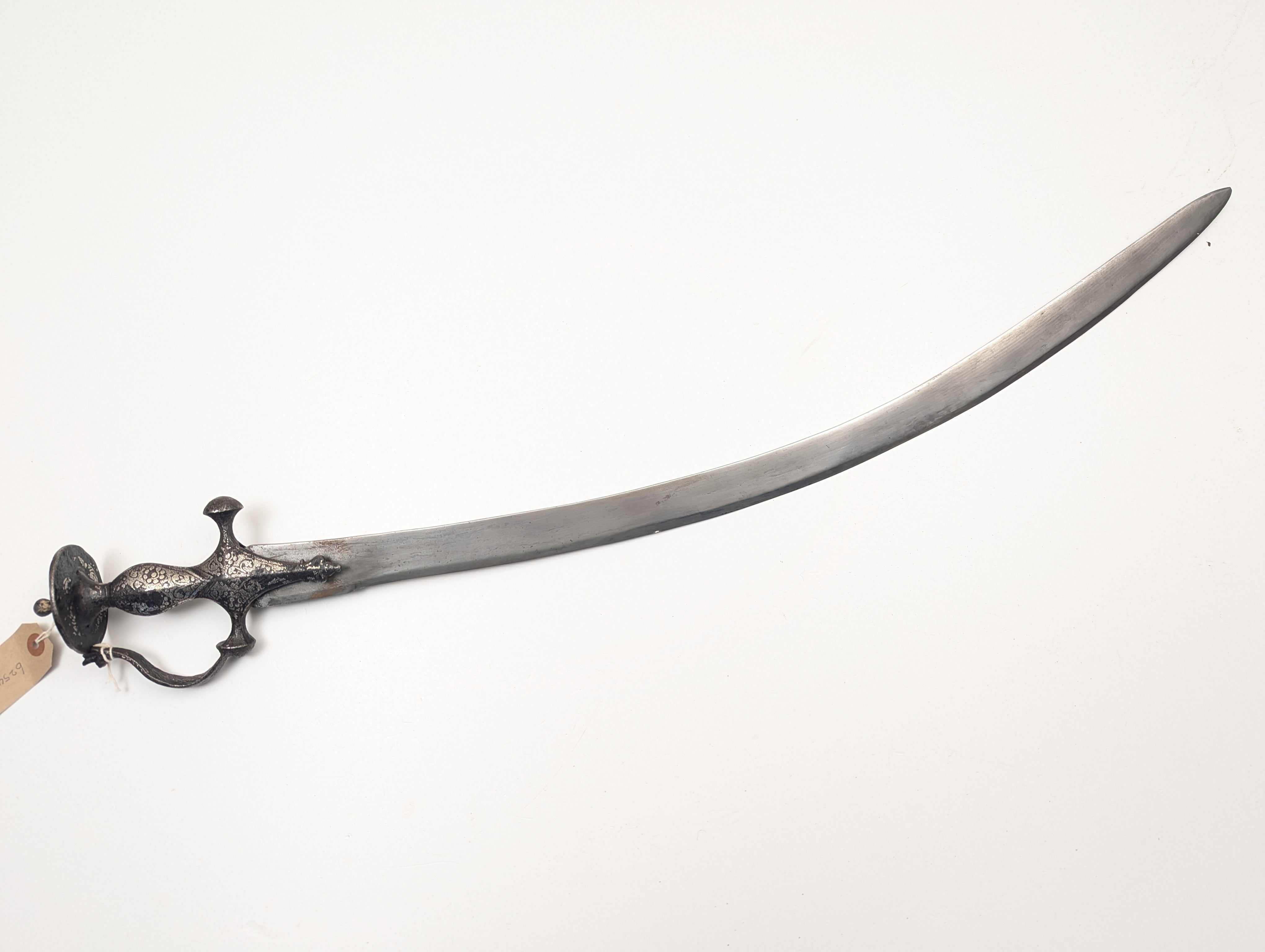
Click and use the code >25924 to search for this item on the dealer website Historical 17th-18th Century Indian Tulwar Sword From the Siege and Relief Of Lucknow. Battle Trophy of Irish Captain Of the 32nd Foot, Capt. H.G.Browne From a Collection Swords From The Battles & Defence. Sword With Dozens Of Hand To Hand Combat Cuts
  • Nation : British
  • Local Price : £795.00
**OSCAR WILDE’S BARRISTER CONNECTIONS**WW1 1916 British 1897 Pattern SJ Pillin London Infantry Officer’s Presentation Sword With King George V Guard & Etched Blade To Sub Commandant Sir Edward Clarke KC PC By Staines (Middlesex) Volunteer Traini. Sir Edward George Clarke, Kings Counsel (KC) (15 February 1841 – 26 April 1931) was a British barrister and politician, considered one of the leading advocates of the late Victorian era and serving as Solicitor-General in the Conservative government of 1886–1892. His legal career included representing Oscar Wilde in his disastrous prosecution of the Marquess of Queensberry for libel, and representing the plaintiff in the "baccarat case", during which Sir Edward cross-examined the Prince of Wales. He was a member of the anti-women’s suffrage movement. During WW1 he was Sub Commandant of Staines (Middlesex) Volunteer Training Corps (a Period pamphlet depicting the famous Sir Edward Clarke KC drilling in civilian clothing with the Staines volunteers in 1915 is illustrated in image 1). This is an original British 1897 pattern Infantry Officer’s sword presented to Sir Edward Clarke by Staines (Middlesex) Volunteer Training Corps with scabbard and frog. The sword has a 33 ½” long blade with partial fullers and measures 39 ¾” overall. The blade has areas of staining consistent with age and use. The blade has foliate etched panels and Kings Crown above heraldic arms. The ricasso has the makers name SJ Pillin 31 Gerrrard St London & the correct engraved ordnance acceptance proof star and inlaid brass roundel & original leather hilt washer. One side of the blade has a crisply engraved presentation panel with wording "PRESENTED TO SUB COMMANDANT THE RIGHT HONOURABLE SIR EDWARD CLARKE PC KC BY SUBSCRIBERS TO AND MEMBERS OF THE STAINES VOLUNTEER TRAINING CORPS AS A MARK OF APPRECIATION OF PATRIOTIC SERVICES EFFICIENCY RENDERED SEPTEMBER 1916". The spine of the blade is numbered 108262. It has a full 1897 Pattern knuckle guard with Crown GR V device. It has a curved stepped pommel with ball top and knurled back strap for grip, fish skin grip with wire binding in very good condition. It is complete with leather covered wood field service scabbard. The scabbard has a German silver throat mount & is fitted with leather frog that has 2 belt loops and buckles. The price includes UK delivery. Sn 21541
  • Nation : German
  • Local Price : £795.00
WW1 Era Imperial German Mounted Field Artillery Officer’s Quality Etched & Blued Panels Blade Dress Sword To ‘3 Lothr Feldartill. Reg. Nr 69’ (3rd Battery Field Artillery 69th Regiment) With Bullion Stitched Cord, Portepee & Scabbard. Sn 22. This is an excellent, original Imperial German Mounted Field Artillery Officer’s dress sword. The sword has nickel plated hilt with langets and knuckle bow. There are some areas of wear to the nickel finish consistent with age and service carry. It has its original wire bound fish skin covered grip in good order. The guard is fitted with original Officers bullion stitched cord and portepee. The sword measures 36” overall and it has a 30 ¾” single edged, curved blade with fullers (we cannot see any maker mark under the langets). The spine of the blade near to the hilt has a faint Imperial German inspection mark. The polished blade has its original leather hilt washer & has deeply tooled panels on both sides and the spine featuring Martial banners and arms & foliate decoration. One blued panel features a horse drawn artillery train with mounted gunnery troops, another blued panel is marked to ‘3 Lothr Feldartill. Reg. Nr 69’ (3rd Battery Field Artillery 69th Regiment) alongside a blued panel with ‘Horse’s Head’. The sword is complete with its original black painted steel scabbard with hanging ring & shoe. The scabbard has a few dents consistent with service carry. The price includes UK delivery. Sn 22871
  • Nation : British
  • Local Price : £795.00
**ATTRIBUTED**Pre 1845 British William IV 1822 Pattern Infantry Officer’s Sword With Etched Blade To ‘Lieutenant-Colonel George William Paty, 96th Regiment Of Foot’ (Later General Sir George William Paty, K.C.B., K.H) & Scabbard. Sn 23109 -. General Sir George William Paty, K.C.B., K.H., was born in 1788 and joined the 32nd Foot as an Ensign in 1804. He served in the Copenhagen Campaign of 1807, and afterwards in the Peninsular. Promoted to Lieutenant Colonel in 1817, on half pay, he served in the 96th Foot as a Major on full pay in 1825. The 1822 pattern sword was a radical departure from previous designs, having a ‘gothic’ style pierced basket hilt so named after its resemblance to window shapes in gothic architecture and folding langet on one side. Pre 1845 these swords had pipe back blades. Post 1845 they were made with slightly curved fullered blades (see page 173 of World Swords by Withers & Page 159 of Robson). This original infantry Officer’s Pattern 1822 sword has a pre 1845, 32 ¼” single edged curved pipe back blade (37 ½” overall). The blade has very faint foliate panels decoration on both sides. There are no maker or date marks on the blade. One side of the blade is faintly etched with King’s Crown and Royal cypher ‘WR IV’ (William IV Rex) together with another faint etched panel ‘LT COL PATY 96th REGT’. The gothic style voided brass guard has stylised Royal Cypher King’s Crown and ‘WR IV’ (William IV Rex). The bar guard is fully intact. It has the correct folding langet on one side. Its fish skin grip with finger grooves & wire binding is in good condition with just light service wear & all wire tight and intact. The sword is complete with its blackened steel scabbard with 2 hanging rings and shoe. The price includes UK delivery. Sn 23109
  • Nation : British
  • Local Price : £795.00
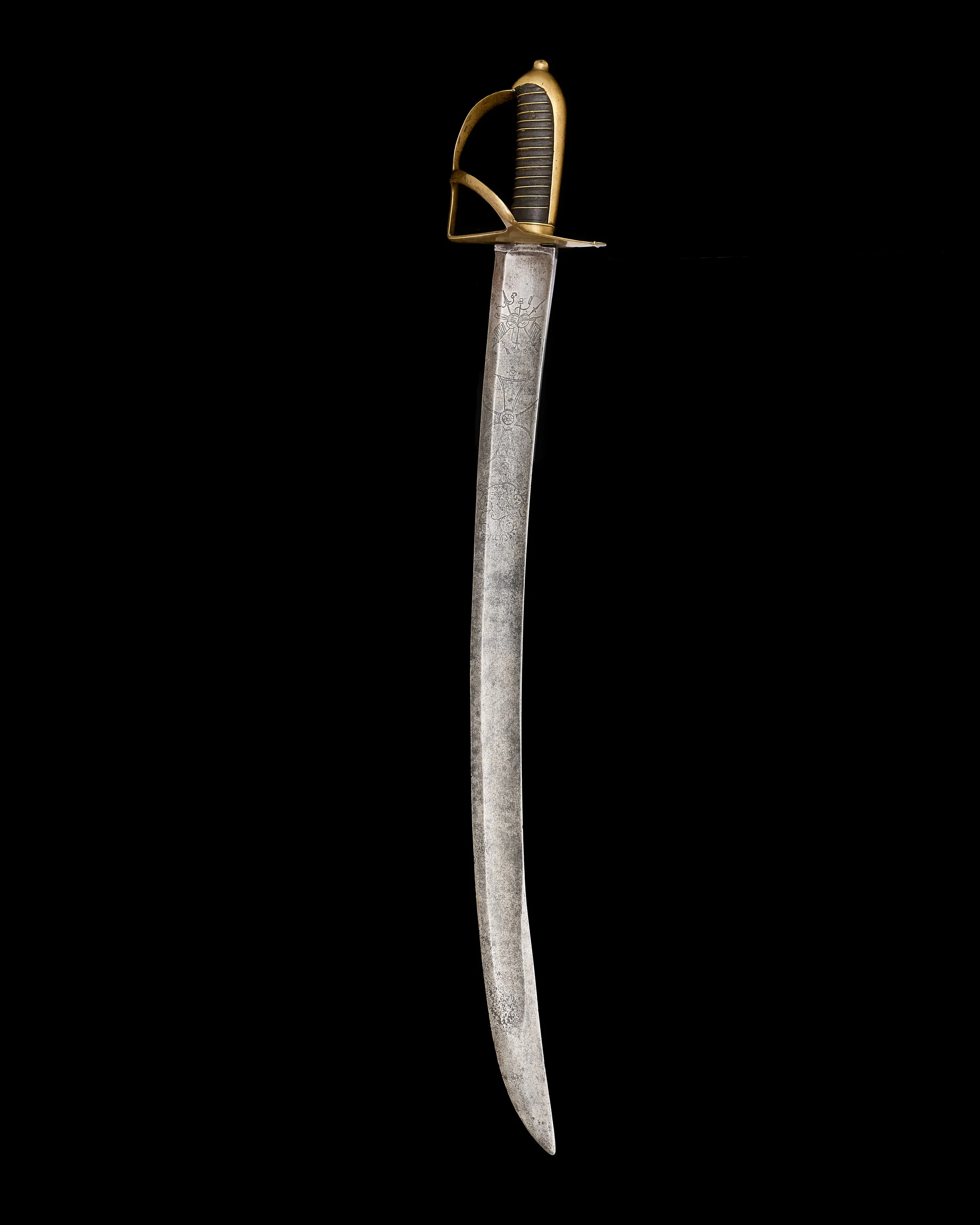
English Hunting Sword Hallmarked 1782. English Hunting Sword Hallmarked 1782 ribbed ebony grip please note cracks but solid. The silver hallmarked fitting indicate a date of 1782 and makers mark W. K Slightly curved blade 23.5 inch in length with narrow and wide fuller overall length 29 inch
  • Nation : British
  • Local Price : £795.00
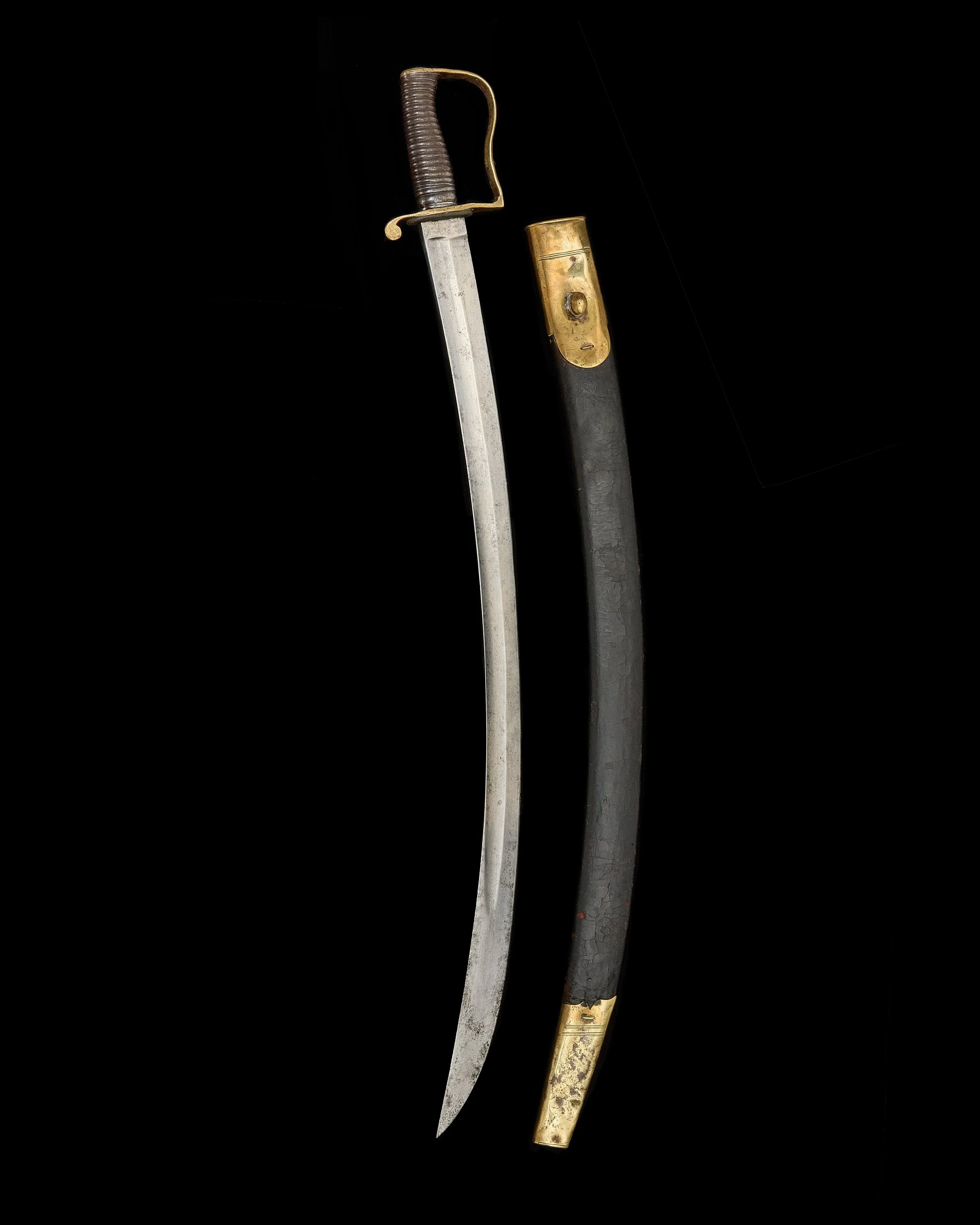
**RARE**PARKHURST PRISON ** Victorian British Parker Field & Sons London Parkhurst Prison (Isle of Wight) Prison Guard’s Hanger Sidearm Short Sword With Etched Blade ‘Parkhurst Prison’ & Scabbard. ED 3026 -. Parkhurst Prison on the Isle of Wight was established in 1838 as a juvenile penitentiary for male offenders sentenced to transportation. The prison aimed to reform young men through a strict regime of discipline, education, and industrial training before they were sent to colonies like Australia. Its harsh system, including wearing leg irons, strictly enforced periods of silence, and basic food, drew significant criticism from reformers and the public. By the mid-1850s, the practice of deporting "Parkhurst Boys" began to end and the prison’s function broadened to include other male offenders sentenced to terms exceeding a year. This is an excellent Victorian Prison Officer’s hanger to Parkhurst Prison & scabbard. It has a fullered 21 ¾” swept blade which has staining to be expected with age (27 ¼” overall). The blade has a fine deeply etched panel on one side ‘Parkhurst Prison’ and the reverse has an etched foliate panel with crisp manufacturer detail ‘Parker Field & Sons 233 Holborn London’ (all illustrated). The fish skin handle with wire binding all present tight and intact is undamaged with just light areas of staining and light service wear. The hilt has the correct steel knuckle guard with stepped pommel. The original leather scabbard has the correct Prison Officer’s steel mounts. The throat mount has a fixed steel belt bar. All leather & stitching of the scabbard are clean & intact. The price for this rare hanger to Parkhurst Prison includes UK delivery. ED 3026
  • Nation : British
  • Local Price : £795.00
1886 Dated British WD 1885 Pattern Cavalry Troopers Sword Regiment Marked ’16 L’ To The 16th Lancers With 1889 Dated Mole Patent Scabbard Regiment Marked To The ‘OX Y’ Oxfordshire Yeomanry Cavalry. ED 3023 -. The 16th The Queen’s Lancers was a cavalry regiment of the British Army, first raised in 1759. It saw service for two centuries, before being amalgamated with the 5th Royal Irish Lancers to form the 16th/5th Lancers in 1922. The regiment saw much action in the Napoleonic Wars, Zulu Wars, the Regiment also fought at the Battle of Sobraon in February 1846 during the First Anglo-Sikh War & served in India in spells between 1865 and 1899, the Boer Wars & WW1. This is a nice original, 1885 Pattern British Cavalry Troopers Sword to the 16th Lancers with Scabbard. These swords were designed during the period when the British army was continuing to argue on the merits of the ‘cut’ versus the ‘thrust’ of British cavalry blades. The hilt design features a Maltese Cross motif cut into the knuckle guard and is a distinctive feature of these swords (see pages 48 – 57 of Swords Of The British army by Robson). The Sword’s fullered 34 ½” blade is clean. It measures 40” overall length. The blade and hilt have WD inspection marks. The blade has date /86 (1886) and inspection marks. There are no visible maker marks even under its original leather hilt washer. The spine of the blade has inspection mark. The knuckle guard has the correct Maltese cross motif. The inside of the guard is Regiment marked ‘16L’ to the 16th Lancer’s and has weapon numbers 71886 struck out and number 52. It has the correct boiled hard leather chequered scales in very good condition secured by the correct 5 rivets. It is complete with its steel scabbard which has 2 fixed hanging rings. The scabbard has even aged patina and no dents. The scabbard has date 7/89 (July 1889) weapon number 133 and regiment mark ‘OX Y’ to the Oxfordshire Yeomanry Cavalry (the Oxfordshire Yeomanry Cavalry was founded in 1798. The OX Y service in the Second Boer War as part of the Imperial Yeomanry, and as a yeomanry regiment during WWI). The scabbard is also signed ‘Mole Patent’. The price includes UK delivery. ED 3023
Page 68 of 157