
Show

Forgot your password?

Error message here!

Error message here!

Error message here!

Error message here!

Show Error message here!

Show Error message here!

Lost your password? Please enter your email address. You will receive a link to create a new password.

Error message here!

Back to log-in

Close

For Sale

The following items are listed by for sale by users of the site and dealers. They are in no way endorsed or guaranteed by www.antiquearmsresearch.com

Add a Classified Item
to

Clicking on the sword will take you through to the relevant classified item or dealer site.
Don't miss out! - Do you want to be kept informed weekly of new aditions? Just join our weekly update list.

You can also receive regular email notifcations when items match your keywords. To recieve them just register or logon at the top right of this page.
Page 78 of 157
  • Nation : British
  • Local Price : $1200.00 CAD
ENGLISH FLINTLOCK HOLSTER PISTO. ENGLISH FLINTLOCK HOLSTER PISTOL: Approximately .62 Cal. Circa 1770. The 9 inch barrel is engraved “N… SON LONDON”. It seems quite crudely done, however, it does have clear British Proof marks with the initials “_ W”. The lock has quite a unique waterproof pan. Again, the cartouche on the lock, which would have had the maker’s name, is not visible. The brass furniture is very nice and quite unique in its style. The walnut stock is also unique in that it was never made to carry a ramrod. It is quite likely it was made for the Eastern market. The stock has a very nicely chequered panel on the back of the grip. This is a very unique and unusual flintlock. $1200.00
  • Nation : American
  • Local Price : $1200.00 CAD
P. 1859 NAVAL CUTLASS 2ND TYPE. P. 1859 NAVAL CUTLASS 2ND TYPE: Maker: A & E HOLLER of Solingen. Holler made 13,000 cutlass bayonets many of which were exported to the U.S. for the Civil War. The grips are EXC+, the blade is bright and also EXC+. The scabbard is VG (BCB-B165 & 167) Also European Bayonets of the American Civil War Pg. 73-75. EXC. $1200.00
  • Nation : British
  • Local Price : £625.00
Unusual 1796 Heavy Cavalry Dress Sword. This unusual sword combines a Scottish broad sword blade with a British 1796 Heavy Cavalry dress sword handle. The brass handle and copper wire are solid with no movement and the blade is in good condition with an overall patinaThe dress sword for the Heavy Calvary was introduced following army reforms in 1786 with full regulations brought in 1796. Normally the sword consists of a boat-shell guard and long double sided blade. These regulations were not strictly enforced, and it is not uncommon to find early swords with non regulation blades as long as the guard and scabbard conformedPossibly this was a family sword, or for a Scottish officer who preferred the shorter, heavier blade over the longer and more delicate regulation
  • Nation : French
  • Local Price : 7,800 kr
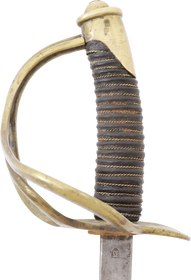
Large cavalry saber dated 1820 possibly French.
  • Nation : American
  • Local Price : 875.00 USD
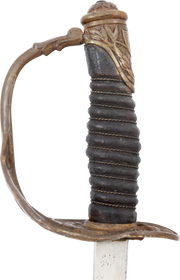
CONFEDERATE NCO SWORD, FROM THE FAMOUS FRANK BARNYAK COLLECTION. Possibly a German import but almost certainly Southern made. Styled as the US M.1840 musicians sword (Peterson #44) which is specified with a 28” blade, this example has a 28 3/8” straight broad fullered blade which is unmarked. The brass or bronze hilt is made in three pieces as opposed to two for the regulation pattern. The pommel base has a flamboyant baluster form compared to the ferrule and neck of the regulation swords. Additionally, the pommel and grip are of a significantly different alloy from the guard, which is substantially similar to the US regulation. The pommel and grip are of copper-rich reddish bronze, not seen on US contract swords. Their very noticeable dissimilarity from the guard virtually precludes manufacture in Germany, leaving Confederate production as the logical conclusion. Frank Barnyak was a professional gun show promoter which gave him unparalleled access to the market. He was known for his ability to ferret out rarities such as this.
  • Nation : ?
  • Local Price : 875.00 USD
FINE EUROPEAN PLUG BAYONET, 19TH CENTURY. German for the Spanish market, first half of the 19th century. 7” d.e. blade with grooved edge ricasso, etched in foliage throughout. The forte with an inscription perhaps RATHBONE.  See Armas Blancas en Espana, color plate 16 for an identical example identified as German monteria knife made in Solingen by A & E Holler. That maker is recorded 1839-69 and almost certainly made this knife during that period. Plug bayonets were popular in Spain for hunting, where a musket could be quickly be converted into a spear for self defense, particularly against boar and bear
  • Nation : Italian
  • Local Price : 875.00 USD
ITALIAN PLUG BAYONET C.1700. Good quality example which was most likely was carried as a sidearm in the form of a bayonet to circumvent local restrictions. 13 3/8” overall. The blade finely formed in the Italian taste with a central fuller and back fuller which transitions to a false edge past the midpoint. Delicate scallops flanking the bolster. Brass base ferrule and one-piece horn grip with silver or white metal cap. The ferrule below worn and incomplete.
  • Nation : British
  • Local Price : £620.00
Canadian 1890 Pattern Cavalry Trooper&#acute;s Sword, Princess Louise Dragoon Guards. Description Curved, single fullered blade, ambidextrous basket hilt with pierced Maltese Cross symbol and turned-over edges, black pressed leather grips secured by five steel rivets, brown leather washer. Steel scabbard with fixed opposed hanging rings. Overall length 39 inches (99.2cm) blade length 33½ inches (85.1cm). Traces of orange-brown paint to the lip of the guard on one side. The spine of the blade is stamped with &#acute;/90&#acute;, indicating that it is an 1890 Pattern, and a crown inspection mark for Enfield. The flat of the blade is stamped at the forte on one side with a broad arrow and &#acute;EFD&#acute;, indicating War Department property made at Enfield, with another Enfield inspection mark. On the other side it is stamped with an issue mark for 1899, and two broad arrows point-to-point, a mark that was put on War Department equipment that was declared obsolete or to be sold off. The inside of the guard is stamped with &#acute;PLDG&#acute;, indicating the Princess Louise Dragoon Guards, and the sword number &#acute;51&#acute;. The scabbard is stamped at the face side of the throat with two broad arrows point-to-point, below what appears to be &#acute;PLDG&#acute; again “ the &#acute;L&#acute; and &#acute;D&#acute; are most clearly visible with the other letters less visible due to shallower stamping and surface wear. The trailing side of the throat piece is stamped with the date &#acute;96, a further crown inspection mark for Enfield and what look like the Roman numerals &#acute;II.&#acute;. The flat spine of the scabbard body is similarly stamped with a broad arrow and &#acute;WD&#acute;, indicating War Department property, another crown inspection mark for Enfield, the same &#acute;II.&#acute; mark and the date &#acute;96. The PLDG originated in 1872 as the independent cavalry troop of the Canadian capital city of Ottawa. It gained the patronage of Princess Louise Caroline Alberta, the fourth daughter of Queen Victoria, during her time residing in the city. Louise&#acute;s husband John Campbell, the Marquess of Lorne, was appointed Governor General of Canada from 1878 to 1883, and she accompanied him as the viceregal consort. Her stay in Canada caused both excitement and uncertainty, Canadians not being accustomed to having royalty reside there, but left an enduring legacy: Lake Louise, Mount Alberta and the province of Alberta as a whole are named after her. The Ottawa Troop of Cavalry therefore took on the much grander name of the Princess Louise Dragoon Guards from 1879, and was expanded to a full squadron. Being a militia regiment, it could not directly serve overseas, but volunteers from the PLDG served within the Imperial Yeomanry during the Boer War, earning the battle honour &#acute;South Africa, 1900&#acute;. The 1899 issue date on the blade of this sword raises the possibility that it may have issued for this deployment. While the brand new 1899 Pattern was in service by the time of the Boer War the PLDG, like many Canadian regiments, never received it and would have continued to carry the 1890 Pattern throughout. The squadron was expanded again in 1903 to a full regiment and renamed the 5th &156;Princess Louise Dragoon Guards&157;. This regiment was once again not mobilised in its own right for the First World War, but contributed men to the 8th Regiment, Canadian Mounted Rifles. The PLDG was still using their 1890 Pattern swords and carried them across the Atlantic, but on arrival in England they were exchanged for the up-to-date 1908 Pattern. The 8th Regiment was broken up after its arrival, the majority of its cavalrymen sent to France to reinforce the 4th Battalion, Canadian Mounted Rifles. Fighting as infantry, enough of the former members of the 8th participated in the Battle of Mount Sorrel in 1916 to qualify for a battle honour, which ultimately passed to the PLDG after the formal disbandment of the 8th Regiment post-war. In 1936 the 5th PLDG was merged with the 4th Hussars of Canada to form the 4th Princess Louise Dragoon Guards, which served as armoured car reconnaissance units within the Royal Canadian Armoured Corps during the Second World War, earning sixteen battle honours. The regiment became infantry in 1944 but retained some cavalry traditions, including having &#acute;squadrons&#acute; and &#acute;troops&#acute; of men rather than &#acute;companies&#acute; and &#acute;platoons&#acute;. It was disbanded in 1965, and moved to the Supplementary Order of Battle as an inactive unit. The blade has some scattered light pitting. It has been shortened by roughly 1 inch and repointed “ this was probably done during service to repair a damaged tip. Some damage to the leather grips, including chipping at the edges and an abrasion on one side. Light handling wear to the chequering. The hilt and scabbard have some patination and pitting, some small dents to the scabbard towards the chape end. The leather washer fits a little loosely and may be a replacement.
Page 78 of 157