
Show

Forgot your password?

Error message here!

Error message here!

Error message here!

Error message here!

Show Error message here!

Show Error message here!

Lost your password? Please enter your email address. You will receive a link to create a new password.

Error message here!

Back to log-in

Close

For Sale

The following items are listed by for sale by users of the site and dealers. They are in no way endorsed or guaranteed by www.antiquearmsresearch.com

Add a Classified Item
to

Clicking on the sword will take you through to the relevant classified item or dealer site.
Don't miss out! - Do you want to be kept informed weekly of new aditions? Just join our weekly update list.

You can also receive regular email notifcations when items match your keywords. To recieve them just register or logon at the top right of this page.

Page 79 of 118
  • Nation : British
  • Local Price : £475.00
1897 Dated British Officers Swagger Sword Stick With White Metal Collar Engraved To ‘H.W. Clare’. Sn 22374 -. This is an original Swagger Sword Stick & Scabbard in the form popular with Victorian British Officers. It has a 14” steel blade which tapers to a sharp point. The blade has just light staining consistent with age. It measures 21 ½” overall in its scabbard. The wood grip & scabbard are undamaged. The throat of the scabbard has a white metal collar in the form of a fastened belt buckle. The collar is engraved to ‘H.W. Clare’ and dated ‘1897’ most likely the name of the Victorian British Officer who owned this swagger stick. The price includes UK delivery. Sn 22374 (armoury on top of gun rack)
  • Nation : British
  • Local Price : £475.00
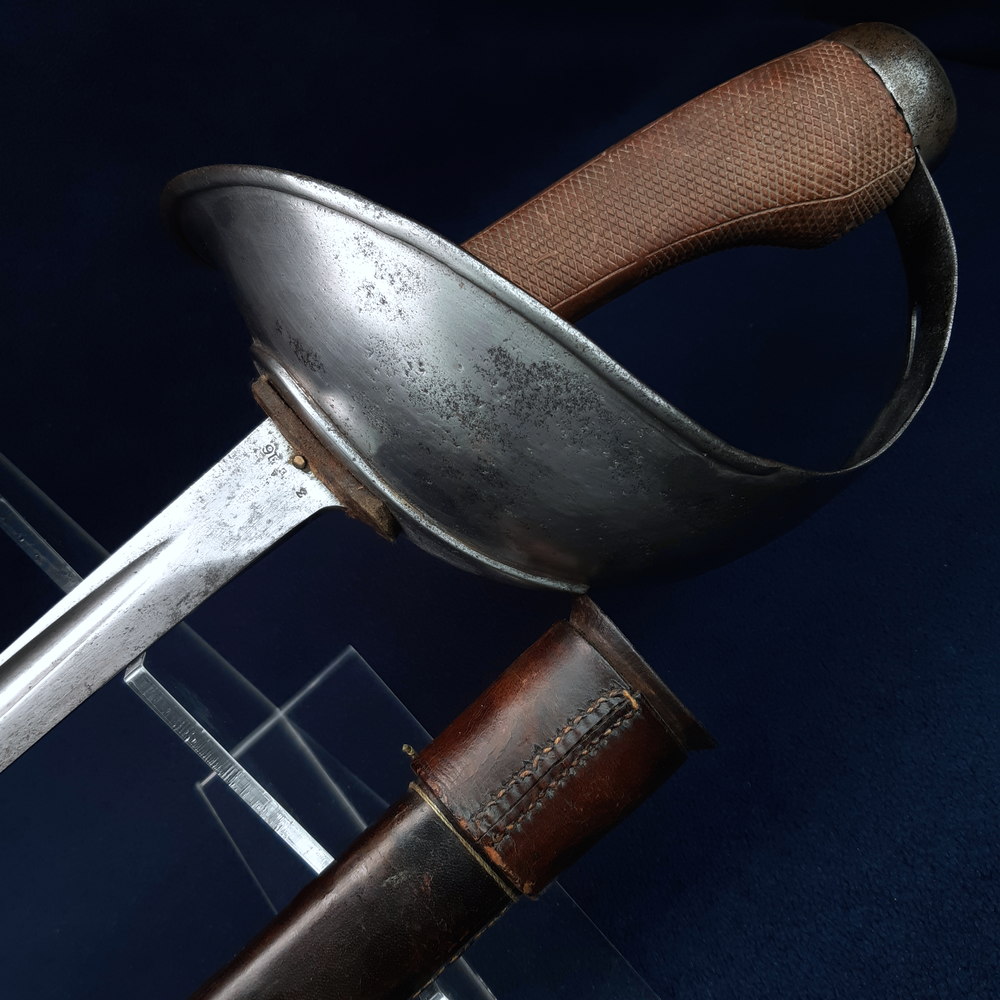
British WW1 1908 Pattern Cavalry Trooper’s Sword by Enfield, 1916 with Unusual Leather-Covered Steel Scabbard. Straight single-fullered blade with spear point, steel bowl hilt with folded rim and sword knot slit near the pommel. Brown leather washer, chequered plastic grip with thumb rest. Smooth oval steel pommel. Steel scabbard covered with leather including leather frog strap and lyre chape piece, leaving only the steel throat piece exposed. Blade 35 inches in length, the sword 42½ inches overall. The blade is stamped at the ricasso on one side with a broad arrow War Department stores mark, ‘EFD’ indicating that it was manufactured by the Royal Small Arms Factory at Enfield, a crown inspection mark with ‘E’ for Enfield and an ‘X’ indicating that the blade passed a manufacturer’s bending test. It is stamped on the other side with the manufacture date 3 ‘16 for March 1916 and two further crown inspection marks with ‘E’. The spine of the blade is stamped P ‘08 indicating the pattern. The inside of the hilt is covered thickly with black paint, obscuring any unit marks that might be stamped in their usual position there. The scabbard leather is unmarked while its steel body, which is often stamped on standard examples, is obscured by the leather. Leather scabbards are unusual on the 1908 Pattern – most examples use an all-steel scabbard with two fixed hanging rings at the throat, designed to be held by a horizontal strap attaching it to their horse’s saddle via a frog. This example is built like the steel scabbard but lacks the fixed rings, and with its vertical frog strap it must have been worn with a Sam Browne belt attached to the rider’s body instead, effectively the same system as seen on field scabbards for the 1912 Pattern cavalry officer’s sword. The scabbard is well made and would seem to combine the strength of a steel scabbard with the lack of rattle and reflection which made leather or leather-over-wood scabbards popular for field use. I have seen all-leather scabbards on 1908 Patterns before which are sometimes referred to as being used by NCOs, but have not seen documentary evidence of this connection, nor have I seen this stronger leather-over-steel model before. A trial run of similarly leather-covered-steel scabbards was produced for the 1899 Pattern trooper’s sword during the Boer War, with the purpose of cutting down reflection, but this was not made universal and they are uncommon today. As mentioned the inside of the hilt has been painted black, as has as the outer rim of the scabbard’s throat piece. These are remnants of a field paint scheme that would most likely have covered all the metal hilt parts. Paint was often applied to cavalry trooper’s swords during the First World War as camouflage, and to reduce reflection off the polished metal which could give away a unit’s position. Between its black paint and leather scabbard cover this particular sword would have been rendered completely non-reflective in the field. Painting does not seem to have been done preemptively or according to a central plan – rather it was done ad hoc by deployed soldiers themselves. The odds of a camouflaged sword having been carried on a campaign are therefore very high. Field paint was often removed after the conflict to return swords to parade condition, and this example appears to have treated that way with the outside of the hilt and pommel stripped and repolished. The finish on the inside of the hilt did not matter so much and it would have been tricky to remove paint in the recesses there, so it has been preserved in that area. The steel pin at the base of the blade (designed to hold the washer in place) has been lost – a short copper rod appears to have been inserted as a replacement, peened on one side of the blade and bent 90 degrees on the other to secure it. This simple repair may be period and there is dark patination to the copper. The washer itself may be a replacement as its edges are more roughly and irregularly cut than standard, although the leather has some age to it. The blade is bright and clean, sharp with no edge damage, only tiny patches of light patination near the tip and at the forte, a few small dents also at the forte. The outside of the hilt has been refinished bright with polishing marks and patches of cleaned moderate pitting, some of which looks to be filiform (worm-shaped, caused by moisture working its way under a protective layer like paint or lacquer). Speckled patination to the pommel. Only a few light dents to the plastic grip, very little handling wear. The sword is firm in the hand with no movement to the hilt or grip. The leather scabbard cover has some dents and small cuts, one notable branching crack to one face in its lower section, perhaps due to shrinkage opening up an existing cut. This has exposed the steel core, and the exposed steel is rusted. The chape end is a high-wear area and the leather chape piece has some denting, cracks from bending, loss of stitching and one area of lost leather exposing the chape end of the steel core on one side (which allows us to see that it is shaped just like the standard steel scabbard). Interestingly there is no active rust on the very small area of exposed steel and what looks like brown paint or lacquer there (the steel may have been given a protective coat of some kind before covering with leather?). Some hard glassy filler material is visible between the leather and steel in one spot at the edge of the break– possibly an adhesive. A previous owner has tied down the leather frog strap with cord – this keeps it nicely in place and helps prevent damage so I have left it be.
  • Nation : British
  • Local Price : £475.00
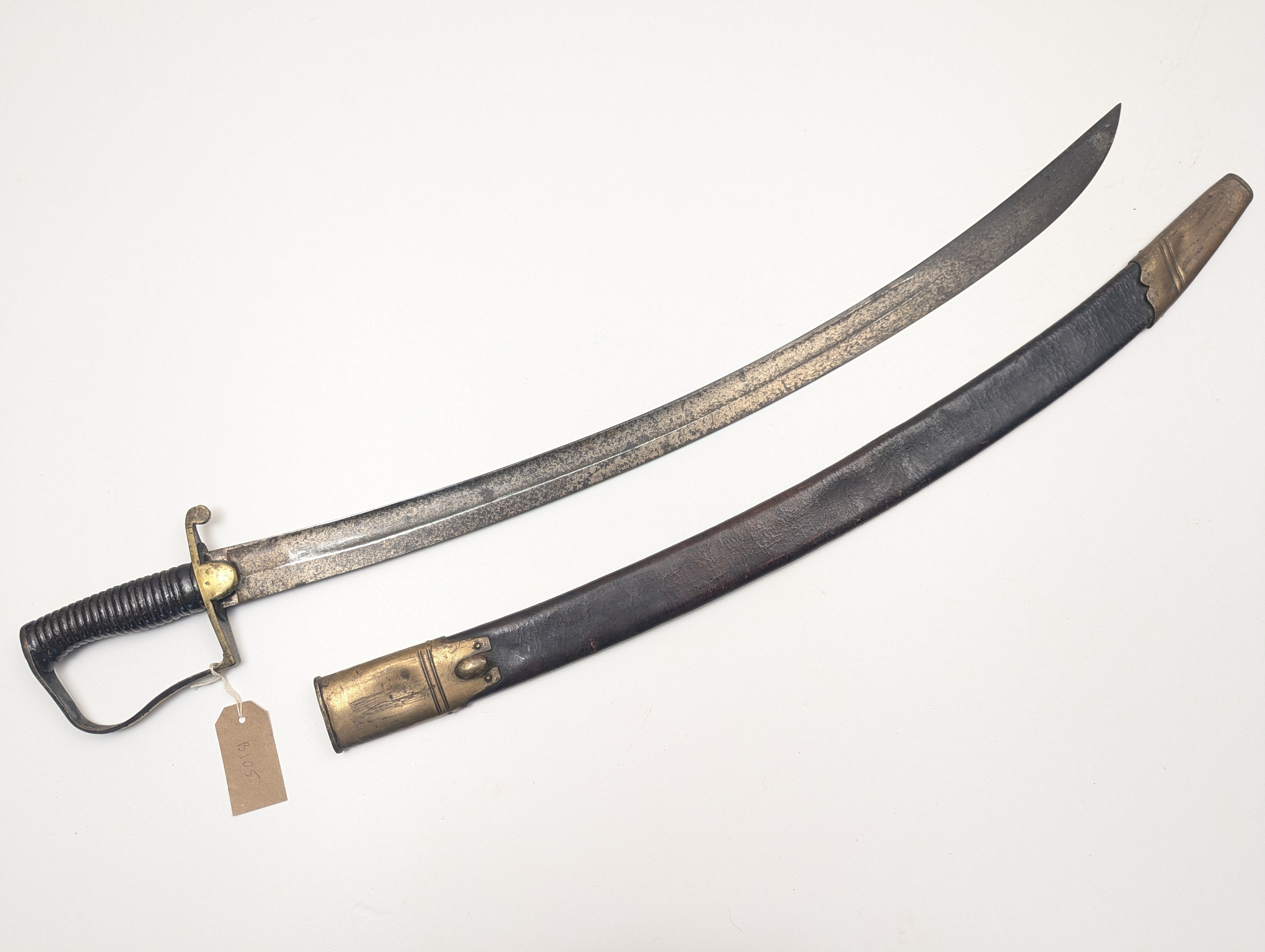
**UNKNOWN SWORD**Circa 19th Century Sword With Curved Sabre Blade & Steel Scabbard. ED 3029 -. After much research via books, the internet & within the trade we have been unable to identify the Model or Nationality of this sword. Most likely made in the 19th Century it has an ebonised wood hilt with well defined finger grooves and curved steel back strap. It has a large steel tapering square section cross guard with ball finials and central langets similar to those found on British Mamaluke & Indian Talwar swords. The wood has knocks bumps and bruises consistent with age & handling but is totally secure. The sword has a 31 ¼” curved sabre blade with fullers. The blade has no visible maker marks & has age related staining. There is no damage to the cutting edge. The sword measures 36 ¾” overall. The sword comes with its original steel scabbard in which it was found. The throat of the scabbard has slots which neatly accommodate the langets of the sword. The scabbard has 2 hanging rings and shoe. The metal has even age related patina and no dents. The price for this sword worthy of further research includes UK delivery. ED 3029
  • Nation : British
  • Local Price : £475.00
**MINT**Post 1952 British Wilkinson Sword Ltd QE II Royal Household Clam Shell Court Sword With Blued & Etched Panels Blade, Gilt Hilt Fitted With Bullion Cord & Portepee & Scabbard. Sn 23573 -. The small sword (also court sword, French: épée de cour or dress sword) is a light one-handed sword designed for thrusting which evolved out of the longer and heavier rapier of the late Renaissance. The height of the small sword’s popularity was between mid 17th and late 18th century. It is thought to have appeared in France and spread quickly across the rest of Europe. The small sword was the immediate predecessor of the French dueling sword from which the épée developed (see page 280 of Wither’s book ‘World Swords’ where British Royal Court Swords are illustrated). This is a mint British Queen Elizabeth II Royal Household Court Small Sword by Wilkinson Sword made post 1952 in the form of mid 17th to Victorian Era examples. It has an ornate cast gilt hilt with cross guard & clam shell. It has a bar knuckle guard & urn type pommel. The guard is fitted with bullion tape cord & portepee. The slim 32 ¼” blade is straight, undamaged and clean. The blade has etched & blued panels on both sides with foliate decoration & Queen’s crown above ‘ER II’ (Elizabeth II Regina). One side has a panel with the maker’s name Wilkinson Sword Ltd & crossed Swords legend below QEII Royal Appointment. The blade has its original red leather hilt washer. The sword measures 38” overall. It is complete with its original equally mint condition leather scabbard which has gilt brass mounts. The throat mount has a shield form frog bar. The price for this mint Royal Household court sword includes UK delivery. Sn 23573
  • Nation : Indian
  • Local Price : £475.00 GBP
Indian Army Mountain Battery Sabre. Indian Army Mountain Battery Sabre"
  • Nation : British
  • Local Price : £475.00
Inter War 1921 British Army In India WD ‘Small Grip’ IP08 (India Pattern 1908) Heavy Cavalry Trooper’s Sword & Scabbard. Sn 23174:30 -. The British Army of India variant of the 1908 sword featured a smaller grip to match the generally smaller hands of cavalry troopers recruited in the sub-continent. As private purchases, officer’s swords sometimes showed some variation from the standard pattern. Occasionally whole Regiments would have their own variation on the theme. This British Indian Army 1908 Pattern Heavy Cavalry Troopers sword & scabbard is in very good condition. The Sword has an undamaged 34 ½” single edged blade with fuller (41 ½” overall). The blade is clean and is dated ‘11 21’ date (November 1921) together with WD ordnance inspection marks. The spine has ‘IP 08’ (India pattern 1908 designation) and it has its original leather hilt washer. The steel bowl guard has no dents & has the typical smaller India issue stippled wood hilt with correct thumb recess to assist grip. It is complete with its original steel scabbard with fixed hanging rings and brass throat mount. The scabbard has no dents. The price includes UK delivery. Sn 23174:30
  • Nation : Austrian
  • Local Price : 650.00 USD
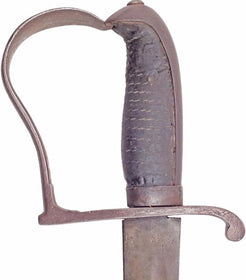
PROBABLE CONFEDERATE USE! AUSTRIAN M.1862 INFANTRY SWORD. Iron hilt with exaggerated P form guard and leather covered grip (wire removed). 26" curved broad fullered blade marked EISENBACH 833 with no ordnance or government marks indicating it was retailed, not government contract. Blade shows about 85% smooth surface, the rest heavily pitted in patches-typical Confederate condition as these were hidden in walls, under floors etc. in the expectation that the South would rekindle the war.
  • Nation : French
  • Local Price : $650.00
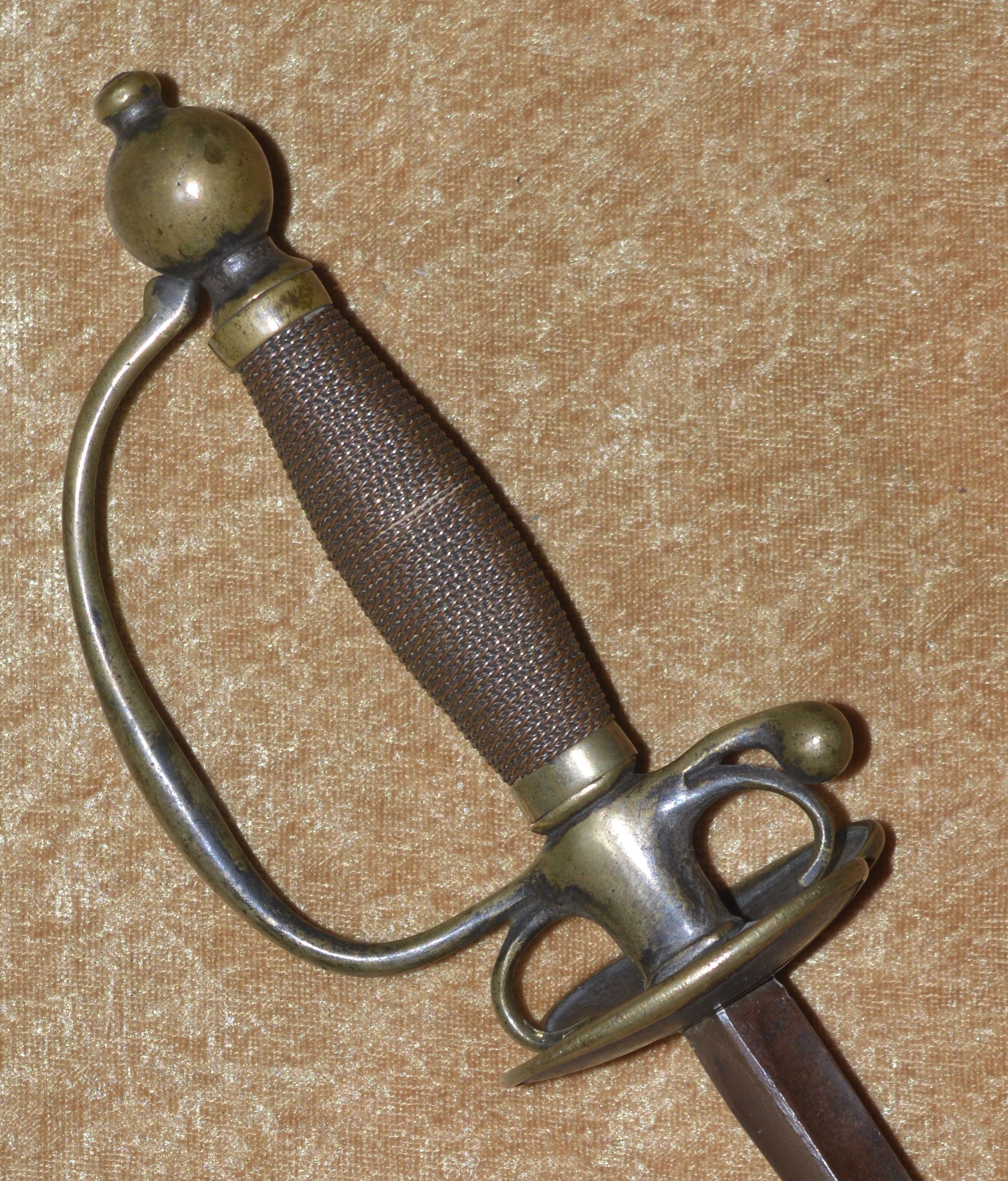
European Smallsword, 2nd Half 18th C, Probably French. Featurng cast brass hilt, consisting of asymmetrical shell guard with raised border, pas d’ane, reverse quillon with ball finial, and integral knuckle bow joining the spherical pommel with button. Wood grip with twisted copper wire wrap and brass ferrules top and bottom. Slender hollow-ground 30 3/4″ (78.1 cm) blade of triangular section, engraved with scrolling foliage and stands of arms over the upper third. Hilt parts somewhat loose, showing mellow mustard-color patina, with darker patina in protected areas. Blade with dark brown patina and several shallow nicks in the edge; engraving difficult to see due to the dark patina. No scabbard. Overall length 36 5/8″ (93 cm). Many swords of this type were carried by gentlemen and officers in the Colonial American forces during the Revolution.
Page 79 of 118