
Show

Forgot your password?

Error message here!

Error message here!

Error message here!

Error message here!

Show Error message here!

Show Error message here!

Lost your password? Please enter your email address. You will receive a link to create a new password.

Error message here!

Back to log-in

Close

For Sale

The following items are listed by for sale by users of the site and dealers. They are in no way endorsed or guaranteed by www.antiquearmsresearch.com

Add a Classified Item
to

Clicking on the sword will take you through to the relevant classified item or dealer site.
Don't miss out! - Do you want to be kept informed weekly of new aditions? Just join our weekly update list.

You can also receive regular email notifcations when items match your keywords. To recieve them just register or logon at the top right of this page.
Page 94 of 119
  • Nation : -
  • Local Price : 475.00 USD
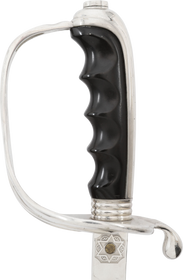
US 1902 PATTERN OFFICER’S SWORD. Pattern specified for all general officers. This example dates about mid 20th century (1950's). Plated hilt, blade and scabbard. The 31" blade decorated 2/3 its length with foliage, military trophies, eagle, US and blank panel for the officer's name. Inset brass proof to the ricasso with N S MEYER retailer's name opposite. A fine vintage example preserved in virtually as new condition.
  • Nation : German
  • Local Price : 475.00 USD
GERMAN GOTHIC SHORT SWORD C.1450. Forged iron, 12 1/4” total length. Thick wedge section blade as found on ballock daggers. Made to penetrate the thick leather doublets worn at the time for protection from attack. Flattened tang, pierced for securing scale grips, probably antler or bone. Made without a guard as was prohibited for peasants, but with the rudimentary scroll side lug which served that purpose. Stable rust growth with minor flaking and very minimal losses. Excavated and professionally preserved. These swords were carried by peasants who were otherwise forbidden to carry weapons. They were justified as agricultural tools, but their use as weapons is verified by the fact that they lack the repeated sharpening and reshaping of the blades which results from agricultural use. A true German Gothic sword.
  • Nation : Spanish
  • Local Price : 465.00 USD
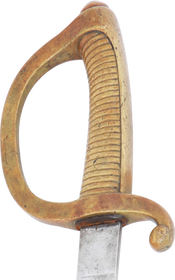
SPANISH ENLISTED MAN’S SWORD. Pattern worn by infantry as well as artillery. Bronze one piece hilt of French styling, with ribbed grip. 27 3/8" slightly curved single edged blade, the right side marked ARTA FABA DE TOLEDO 1902. One piece brass hilt with ribbed grip. Original brass mounted scabbard, complete, the leather sot with near half its original finish remaining. Blade bright with crisp markings. Dating to the immediate post Spanish American War of 1898 and the political turmoil which led to World War I.  
  • Nation : British
  • Local Price : £330.00
British 1899 Pattern Cavalry Trooper’s Sword, 1st King’s Dragoon Guards. Curved single-fullered sabre blade, Steel bowl guard with turned-over inside edge. No washer. Black pressed leather grips secured to the exposed full-width tang with three large rivets, steel pommel. No scabbard. Blade ~33¼ inches (85.6cm) in length, the sword ~40 inches (101.7) overall. The ricasso of the blade is stamped on one side with a broad arrow War Department mark, ‘EFD’ indicating manufactured at the Royal Small Arms Factory at Enfield, a crown inspection stamp with ‘E’ for Enfield and an ‘X’ indicating the blade passed a manufacturer’s bending test. It is stamped on the other side with reissue dates of ’02, ’03 and ’06 and two further Enfield crown inspection stamps. The spine of the blade is stamped with ‘/99’, its pattern, and another Enfield crown inspection mark. The exposed tang is stamped near the hilt with the letters ‘G’ and ‘X’. The outside of the guard is stamped with another broad arrow, ‘EFD’ and crown inspection stamp with ‘E’. The inside of the guard is stamped with the issue date ‘9 06’ for September 1906 above the unit mark ‘1 DG’, indicating the 1 st King’s Dragoon Guards and the serial number ‘413’. The ‘D’ has been double stamped creating an overlap. The 1899 Pattern cavalry trooper’s sword was introduced on the 19 th October 1899, eight days after the Second Boer War broke out. It was intended to be a refinement on the 1890 Pattern, with a slightly shorter blade, greater protection for the hand and a longer grip. Users generally considered it on the heavy side and much more effective in the thrust than the cut: this cemented the growing consensus that cavalry swords should be built entirely for thrusting. The 1899 Pattern was carried during the Boer War, in which the 1 st King’s Dragoon Guards served from January 1901. Immediately upon their arrival they were drafted into a brigade under Colonel Bethune which drove General De Wet’s forces out of the Cape Colony. They then operated in the Orange River Colony until the end of the war in 1902. The dates on this example suggest that it was in use with someone as of 1902, and the brown finish found in places on the hilt might well be field camouflage, but the 1906 date next to the unit mark suggests to me that it was not issued to the KDG until then, so its war service is uncertain. The blade has speckled patination with some patches of light pitting, increasing towards the tip. The edge has previously been sharpened with numerous nicks. The tip is rounded. The outside of the hilt has some denting, a few scratches, cleaned pitting and spots of dark patination. There is a noticeable red-brown finish present on most of the inside of the hilt (except near the lip where the unit mark is placed), parts of the exposed tang, and on small areas of the outside of the hilt, including around the sword knot slit and near the turned-over inner guard – in both cases these are recesses where there would be less friction and polishing would be difficult. This finish may be chemical browning, it does not appear to be paint. Cavalry swords in the Boer War were routinely camouflaged due to the well-known marksmanship of the Boers. The leather grips have light handling wear, a few small dents and abrasions.
  • Nation : Italian
  • Local Price : 455.00 USD
ITALIAN ARTILLERY OFFICER’S SWORD C.1880. Plated iron hilt with segmented bowl guard and radially reeded pommel. Plating worn inside the bowl. One piece ebony grip. 30 1/2” curved broad fullered blade crisply decorated the first half with foliage, arms of Italy, military trophies and the artillery flaming bomb. Plated scabbard freckled with some wear but no dents. This sword dates to the period of Italy's colonial expansion into Africa and the conflicts it brought on including the Italo-Ethiopian War (1895-6) and the ongoing war with the Ottoman Empire which controlled Libya.
  • Nation : American
  • Local Price : £455.00
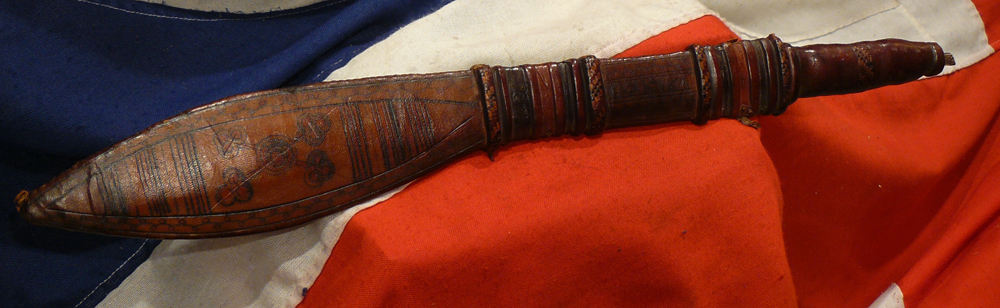
19th Century, Antique, Mandingo Mandinka Chief's Slave and Gold Trader's Sword With Tattooed-Leather Covered Wooden Scabbard. A most scarce and original African slave and gold trader chieftain's sword The Manding (Mandingo) are West African people. Their traditional slaver's sword comprises a sabre like blade, a guardless leather grip and wide expanded scabbard with exquisite tattooed leather work. This example is a fine example of very nice quality and most finely tattooed. It has a 16 inches long curved blade, leather grip and leather scabbard with leaf shaped widening tip, entirely tooled tattooed and decorated. Of special interest is the finely bound and decorated leather work. These weapons are well known for their rare leather-work and the tattooing applied to the leather of the scabbards. The iron work skills are of black-smith quality. Slave raiding, capture and trading in the Mandinka regions existed in significant numbers long before the European colonial era, as is evidenced in the memoirs of the 14th century Moroccan traveller and Islamic historian Ibn Battuta. Slaves were part of the socially stratified Mandinka people, and several Mandinka language words, such as Jong or Jongo refer to slaves. There were fourteen Mandinke kingdoms along the Gambia River in the Senegambia region during the early 19th century, for example, where slaves were a part of the social strata in all these kingdoms. Scholars have offered several theories on the source of the transatlantic slave trade of Mandinka people. According to Boubacar Barry, a professor of History and African Studies, chronic violence between ethnic groups such as Mandinka people and their neighbours, combined with weapons sold by slave traders and lucrative income from slave ships to the slave sellers, fed the practice of captives, raiding, manhunts, and slaves. The victimised ethnic group felt justified in retaliating. Slavery was already an accepted practice before the 15th century. As the demand grew, states Barry, Futa Jallon led by an Islamic military theocracy became one of the centres of this slavery-perpetuating violence, while Farim of Kaabu (the commander of Mandinka people in Kaabu) energetically hunted slaves on a large scale. Martin Klein (a professor of African Studies) states that Kaabu was one of the early suppliers of African slaves to European merchants Many blades were taken by the Mandingo and fitted from European weapons, such as sabres and short cutlasses. . In general, these remain primarily considered Mandingo weapons, and from regions in Mali. These were of course invariably mounted with European sabre blades. Mandingo Tribe (also known as the Mandinka, Mande, or the Malinke Tribes) were the traders of the African West Coast, trading primarily in gold and slaves. In 1324, Mansa Musa who ruled Mali, went on Hajj pilgrimage to Mecca with a caravan carrying gold. Shihab al-Umari, the Arabic historian, described his visit and stated that Musa built mosques in his kingdom, established Islamic prayers and took back Maliki school of Sunni jurists with him. According to Richard Turner – a professor of African American Religious History, Musa was highly influential in attracting North African and Middle Eastern Muslims to West Africa Picture in the gallery of a Mandingo Slave Trader Chieftain, standing next to his boy sword bearer, carrying his very same form of 'tattooed' sword. One, from an original collection of weapons we recently acquired. Overall the leather on this sword in in exceptional condition and beautifully decorated. Early medeavil painting in the gallery of Mansa Musa's visit to Mecca in 1324 CE with large amounts of gold, that not unsurprisingly attracted many Middle Eastern Muslims and Europeans to Mali.
  • Nation : French
  • Local Price : £325.00
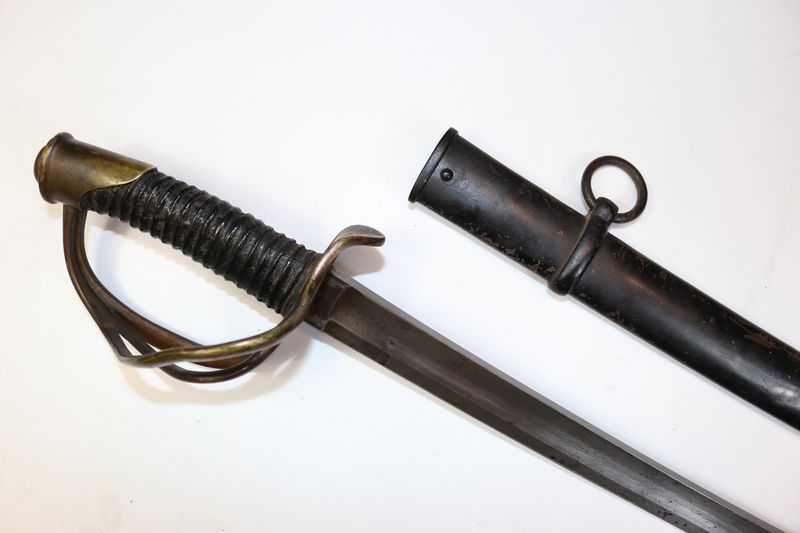
French M1822 Light Cavalry Sabre. EL7299 - A French M1822 light cavalry troopers' sabre. No maker's markings or stamps that I can see. Blade quite bright and in good condition, of 36 inches long. A tiny bit of movement in the guard. Leather grip intact and earlier type of two ring scabbard.
  • Nation : German
  • Local Price : £325.00
Bavarian Circa 1810 Infantry Trooper’s Sword. Single-edged hanger blade with narrow fuller running close to the spine and hatchet point. Brass hilt with round forward quillon and plain knucklebow, smooth brass backstrap with tang button, ribbed grip of black leather over wood. Black leather washer. No scabbard. Blade ~23½ inches in length (59.4cm), the sword 28¼ inches (71.8cm) overall. The blade is engraved on both sides with the crown and cypher of Maximilian I Joseph, first King of Bavaria, who reigned from 1806 to 1825. The blade is sharp with a number of nicks and chips to its edge in the upper portion. Scattered spots of cleaned pitting to the blade, more significant patches at the shoulder and near the tip. Some rounding wear to the tip sharpening marks, also polishing marks to the faces. The leather washer has some losses on one side. The grip is all intact with no losses. The brass hilt and backstrap have a few small dents and an even midtone patina.
Page 94 of 119