
Show

Forgot your password?

Error message here!

Error message here!

Error message here!

Error message here!

Show Error message here!

Show Error message here!

Lost your password? Please enter your email address. You will receive a link to create a new password.

Error message here!

Back to log-in

Close

For Sale

The following items are listed by for sale by users of the site and dealers. They are in no way endorsed or guaranteed by www.antiquearmsresearch.com

Add a Classified Item
to

Clicking on the sword will take you through to the relevant classified item or dealer site.
Don't miss out! - Do you want to be kept informed weekly of new aditions? Just join our weekly update list.

You can also receive regular email notifcations when items match your keywords. To recieve them just register or logon at the top right of this page.

Page 95 of 120
  • Nation : French
  • Local Price : £425.00
Russian M1817 Infantry Sword / Hanger. Curved blade with single broad fuller and spear point. Cast brass one-piece hilt with ribbed grip and oval pommel, knucklebow and forward-curving quillon. No scabbard. Blade 26 7/8 inches in length, the sword 32 1/8 inches overall. The Russian M1817 was based on the French ‘sabre briquet’ line of short sidearms for foot troops, which had been in use in France since the retirement of the infantryman’s epee in 1767 (‘briquet’ being a joking nickname from their supposed use as oversized firelighters). Being simple, strong and cheap to produce the design spread across Europe, particularly during the Napoleonic Wars, and it was either adopted or copied in Germany, the Netherlands, Belgium, Denmark, Switzerland, Italy and Spain. The Russian version, perhaps inspired by examples captured from their enemy during the 1812 invasion of Russia, has a slightly longer blade which is fullered until very close to its spear point, whereas the original was unfullered with a hatchet point. Its quillon has an unusual finial with a smaller ball atop a larger one, the larger having notches in its surface, very different to the smooth single ball finial of the French-derived type. Compared to the somewhat heavy but robust French type the Russian feels a little nimbler in the hand. There is engraved text, the script probably Cyrillic, on the spine of the blade, which is difficult to make out due to wear. There are some stamped letters including ‘I’ within circles on the side of the knucklebow, probably manufacturing or inspection stamps along the lines of the French ‘poincons’. The blade is darkly patinated overall, with some pitting and denting towards the point, which has worn (probably reduced by around 1/8 of an inch). The grip has some handling wear that has rubbed it smooth, with a light patina overall.
  • Nation : American
  • Local Price : 425.00 USD
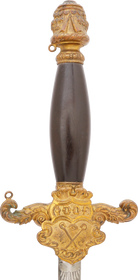
AMERICAN SECRET SOCIETY SWORD LATE 19TH-EARLY 20TH CENTURY. The Odd Fellows, founded in England in the 18th century, was a secret society which promoted brotherhood and good will among its members. It is thought that the name referenced skilled workers in fields outside the organized guilds and thus outsiders to the main workers community. This sword is a good example, beautifully finished and overlaid in gold, much of which remains. The chain knuckle bow is lacking. The 27 1/2” blade, in original preservative, is decorated with gilt foliate panels Kiarsarge Encampment. The scabbard is hand engraved with gilt mounts matching the hilt.
  • Nation : Chinese
  • Local Price : £420.00
Chinese Shuangjian Double Shortswords, Late 19th Century. Two straight, spear-pointed blades with flattened diamond cross-section, each with cast brass hilt and pommel, horn grips, both fitting together into a wooden scabbard covered with smoothed rayskin, with five cast brass fittings, two with fixed hanging rings. A fine brass chain is attached to a loop on the pommel of one of the swords, the other pommel has the same loop but no attached chain. Blade length 16.5 inches, overall length of each sword 22 inches. The hilt of each sword depicts a taotie or ‘greedy glutton’, a Chinese mythological monster which was one of the ‘Four Perils’, lacking a lower jaw to emphasise its insatiable hunger. Like the lion often used on European swords, the taotie symbolized both threat towards enemies and protection of one’s own. The pommel is cast with a foliate pattern, and the scabbard fittings with a dragon motif framed by a Greek key or ‘rolling thunder’ pattern and more foliate designs. Jians were commonly worn in China during the Qing period. Shuangjian (雙劍) literally means "double jian", and described two jians mounted into half hilts that both fit into the single scabbard side-by-side to appear as one. Dual wielding of them was relatively common in the quite flamboyant warrior culture of the period, making shuangjian a more convenient way to carry the pair. They are typically shorter than single jians. Travellers to China found jians to be interesting and portable souvenirs, which led to a growing number of pieces made purely to sell to the tourist trade towards the end of the 19 th century, including miniature versions. Both practical and tourist jian vary greatly in materials and workmanship, making them difficult to tell apart. The blades are clean, with some polishing marks and areas of light patination. Some casting imperfections on the brass fittings. There is some movement to the pommel on one sword (without the chain). The wooden divider in the scabbard sits between the blades - this quite thin and has been chipped slightly at the mouth. One should take care when sheathing the blades not to scrape against the divider.
  • Nation : American
  • Local Price : 415.00 USD
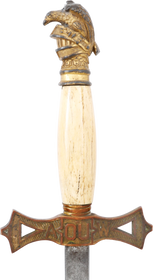
AMERICAN SECRET SOCIETY SWORD. Ancient Order of United Workmen, organized immediately after the Civil War to provide security and death benefits to workmen, originally, on the railroads. As with all such societies of the period, membership was restricted and tenets regarding moral conduct and intoxicants were incorporated in the bylaws. The sword is of excellent quality with pierced cross guard decorated with AOUW. The ivory grip shows age and checks. The eagle on helmet pommel retains most of original gold surface. The 28 ¼” blade is marked with retailer's name, J W VICKERS BUFFALO NY at the forte and decorated with foliage AOUW and owner's name. The brass fitted iron scabbard has a smooth brown patina. 
  • Nation : British
  • Local Price : £295.00
Boer War Era British Officer’s Brown Leather Covered Swagger Sword Stick With German W.R. Kirschbaum & Co (Later WKC) Solingen Triangular Section Blade With Plaited Leather Retaining / Wrist Strap. Sn 23182 -. This is an original Boer War Era British Officer’s brown leather covered wood Swagger Sword Stick & Scabbard. It has a 15 ¼” triangular section blade that tapers to a pin sharp point. It measures 22 ¼” overall in its scabbard. The blade is stamped with the “Knight Helmet” trademark used by W.R. Kirschbaum & Co. of Solingen, later part of Weyersberg, Kirschbaum & Co. (WKC). The wood grip & scabbard are bound in brown leather. The leather has some light scuffing consistent with age and the throat of the scabbard is securely mounted with a plaited leather wrist strap that doubles as a hilt retaining strap. The price includes UK delivery. Sn 23182 (top of gun rack armoury)
  • Nation : Polish
  • Local Price : £295.00
George V 1897 Pattern Infantry Officer's Sword. EL7398 - A George V era infantry officer's sword, 1897 pattern. No retailer or maker marked. The blade in bright polish, with good frost etching, and some blemishes, firm in the hilt and not sharpened. This sword was purchased obviously during George V's reign, but is known to have been owned by an officer with the surname Bell in WW2. The hilt in good condition and complete in good condition
  • Nation : Japanese
  • Local Price : £295.00
**FROM THE PERSONAL COLLECTION OF UK JAPANESE SWORD EXPERT BILL TAGG**C1550’s - 1600 Japanese Late Muromachi Period Large Mokko Shaped Iron Tsuba For Handachi Mounted Swords With Silk Lined Pouch. ED 3055 -. This ancient Japanese Tsuba (hand guard) is from the personal collection of UK Japanese sword expert Bill Tagg. The Tsuba is contained in its silk lined cloth protective storage pouch with Velcro tab fastener. A short descriptive note written by Bill accompanies the Tsuba. The note reads “ Large mokk!3; shape iron tsuba for a handachi mounted sword, with some Yoshihira z!3;gan (brass inlay). Tiny bit of wear, nice black patina. Ancient could date to late Muromachi era 1550’s – 1600”. The price for this attractive and well preserved piece includes UK delivery. ED 3055 (in tsuba drawer office)
  • Nation : German
  • Local Price : £295.00
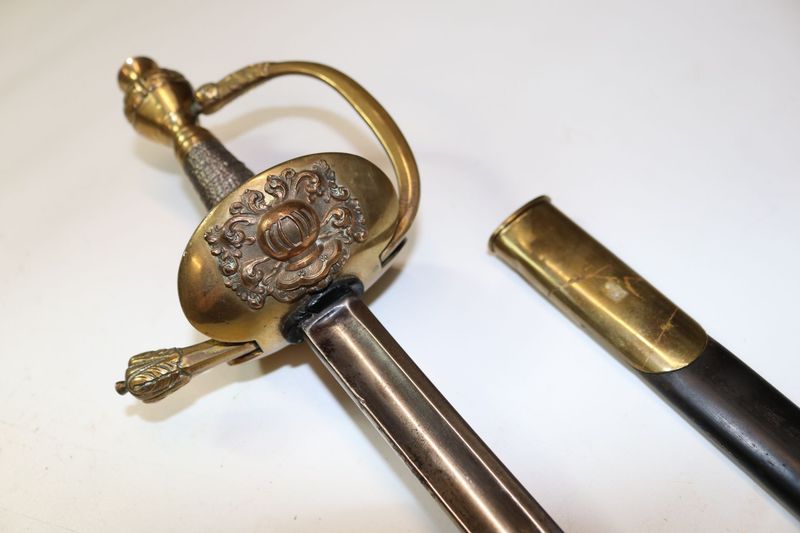
19th Century Continental Spadroon. EL7323 - A 19th century, possibly German, infantry officer's spadroon, with a single edged blade which has been re-tipped and is now 28.5 inches long (probably an inch longer originally). The emblem on the shell guard is that of a knightly plumed helm, but I don't know what this signifies, so research is required. Complete with what appears to be the original leather and brass scabbard.
Page 95 of 120