
Show

Forgot your password?

Error message here!

Error message here!

Error message here!

Error message here!

Show Error message here!

Show Error message here!

Lost your password? Please enter your email address. You will receive a link to create a new password.

Error message here!

Back to log-in

Close

For Sale

The following items are listed by for sale by users of the site and dealers. They are in no way endorsed or guaranteed by www.antiquearmsresearch.com

Add a Classified Item
to

Clicking on the sword will take you through to the relevant classified item or dealer site.
Don't miss out! - Do you want to be kept informed weekly of new aditions? Just join our weekly update list.

You can also receive regular email notifcations when items match your keywords. To recieve them just register or logon at the top right of this page.
Page 96 of 120
  • Nation : Italian
  • Local Price : £295.00
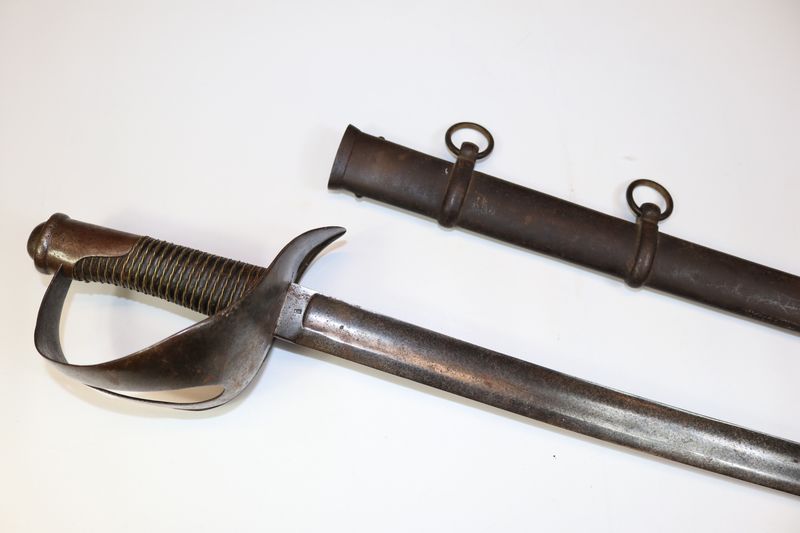
Italian M1860 Cavalry Sabre by Schnitzler & Kirschbaum. EL7295 - Italian M1860 cavalry sabre by Schnitzler & Kirschbaum. Large 35.5 inch blade, firm in the hilt, no movement. Blade with dark patina and some light pitting in blades - it has been service sharpened. Brass wire replaced to the grip. Complete in earlier type of scabbard with two rings.
  • Nation : German
  • Local Price : £295.00
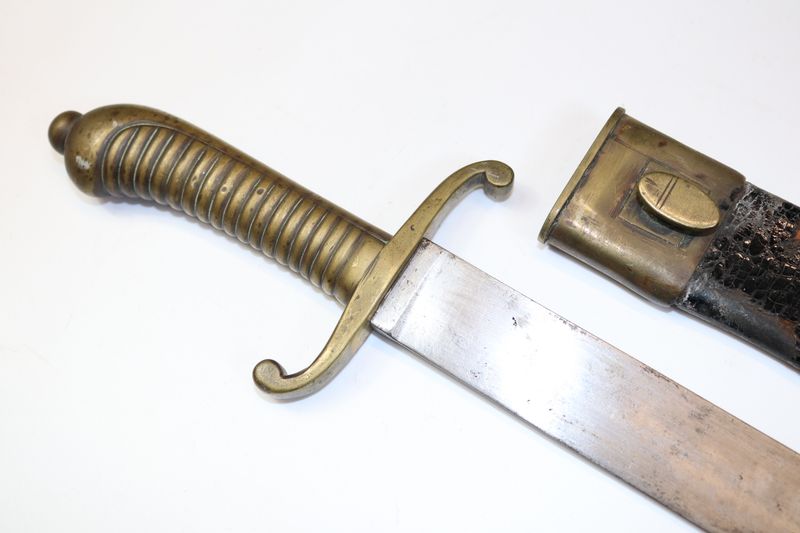
Royal Saxon Hanger M1840 Prussian Army. EL7219 - A 1st Royal Saxon Grenadier Regiment, No. 100 of the Prussian Army, M1840 faschinenmesser hanger. Blade very clean on one side and the other side with more patina, firm in the hilt. Brass hilt in good shape with clear markings. Complete with matching scabbard, though the leather is very dry and with a couple of cracks, but nevertheless it is complete and sheathes well.
  • Nation : American
  • Local Price : £295.00
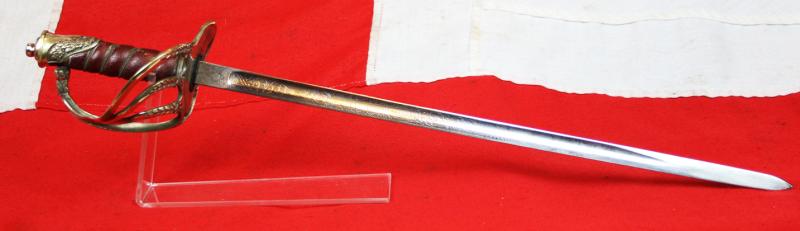
A Most Interesting & Rare, Antique, 19th Century, American Presentation Boy's Sword. Presented to George Mellor in 1890. Made to The Standard Fully Functional Sword Specification Grade and Quality of an Adult's Sword At The Time. Made by Thurkle of Soho London. A most intriguing and interesting original antique curiosity and collector's item. The hilt design is based on an officer's sword of the American Civil war, with a straight blade, but around two thirds the regular size, suitable for a boy of, say, 4 to 8 years of age. We show the very same kind of sword held by a young boy dressed in a uniform in front of a patriotic portrait photograph of president William McKinley, in 1896. Cast brass hilt with wire bound leather grip over wood. Tempered blad fully etched with patterning and presentation name and date, George Mellor 1890 . Maker marked by Thurkle of Soho. Overall in very good condition. Photo of child held in the Library of Congress {copyright free} No scabbard 21 inches long overall, hilt, 5 inches
  • Nation : French
  • Local Price : £295.00 GBP
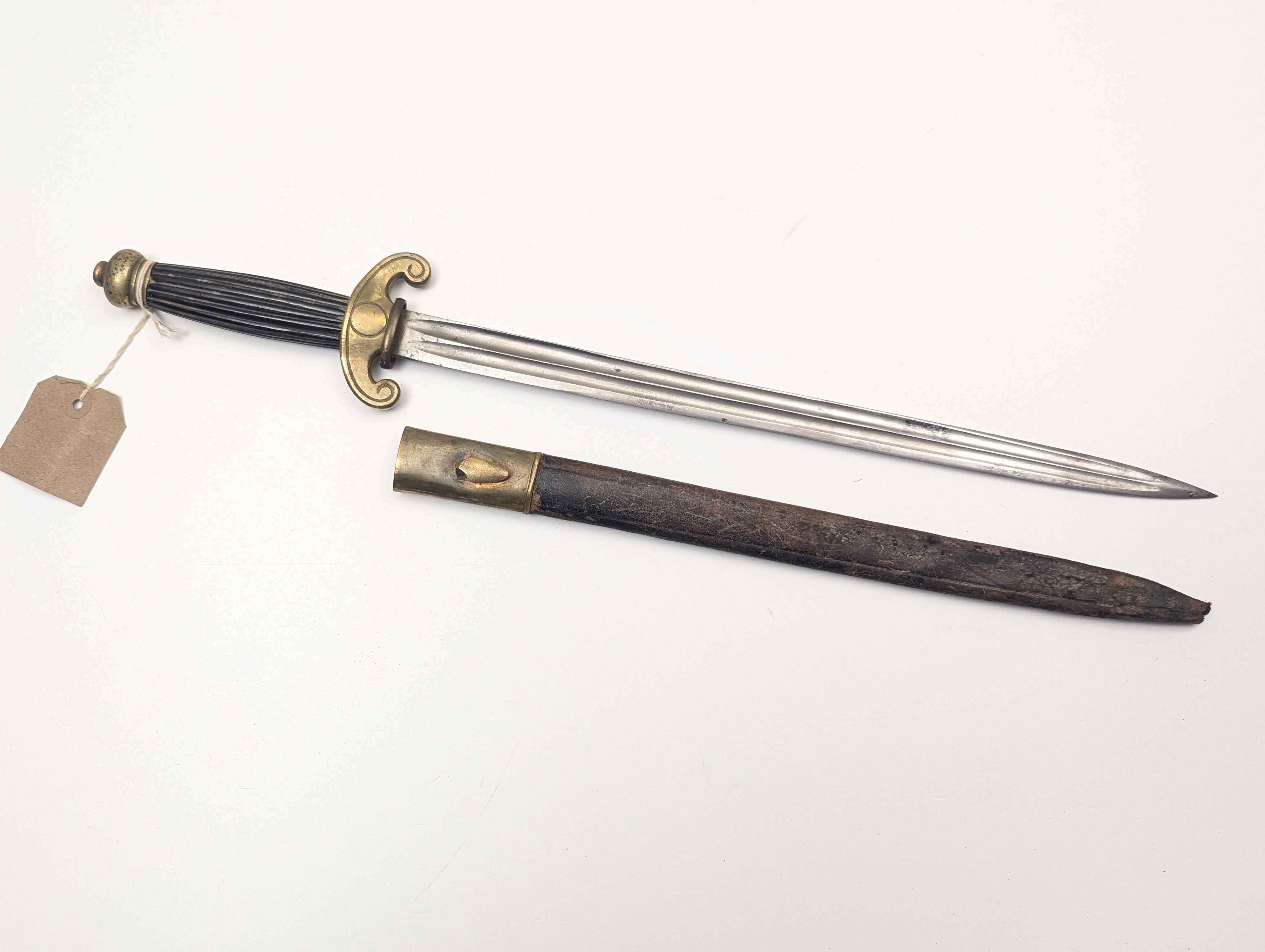
French Naval Administrator's Dagger. An M1860 French Naval Administrator's Dagger. Some sources indicate these were issued to officers stationed in the South China Sea at the time of the Boxer Rebellion."
  • Nation : American
  • Local Price : 405.00 USD
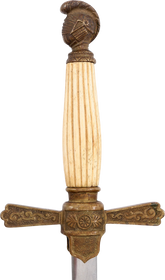
US MILITIA NON COMISSIONED OFFICER’S SWORD, CIVIL WAR OR LATER. One of the many variants (see Peterson #11 and #12) which were purchased by state militias before, during and after the Civil War. Brass hilt with cruciform guard and shield form langets. Plumed helmet pommel and reded bone grip. 27 3/8” rounded face straight double-edged blade struck with a walking bear maker's mark at the forte. That mark is well known, but the subject of some confusion. It is recorded on some Civil War swords, but mostly later examples. It may be the mark of the Weyersberg family of sword makers who were active before the Civil War. Brass mounted leather covered steel scabbard, the screw for the bottom mount lacking. As with most undated swords of types used during the Civil War, dating is speculative. However, it would be perfectly at home in a Civil War collection.
  • Nation : -
  • Local Price : 405.00 USD
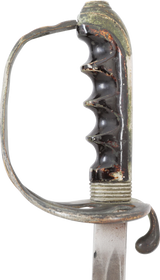
US 1902 SWORD FOR ALL OFFICERS. See The American Sword, Peterson #77. Pattern still in current use. This example among the earliest, probably WWI and before. 27 5/8” curved broad fullered blade, undecorated. The ricasso marked with retailer's name, RIDABOCK & CO, NEW YORK, (established 1847). Finger stall japanned grip integral with the pommel and backstrap. Plated scabbard with a few small nicks and the plating worn along the top edge. Hilt plating worn and oxidized. Early construction and condition indicative of considerable service. Exceptional character for these.
  • Nation : Indian
  • Local Price : £400.00
US M1873 Entrenching Tool. Flat blade with straight edges leading to a round spadelike point. Steel socket with reinforcing side bars crimped onto the blade. Ribbed wood grip. Tin scabbard covered with brown leather, with brass throat piece secured with brass rivets, the throat piece incorporating a square loop, through which runs a circular steel hanging ring. Blade 8 inches in length, the tool 13¼ inches overall. The wood grip is stamped next to the socket with ‘US’. The leather covering of the scabbard is also stamped on one side near the throat with ‘US’. In the 1860s the US Army had no standard issue entrenching tools, earthworks traditionally being considered the domain of engineers, but experience from the Civil and Indian Wars led commanders to the conclusion that the ability to create one’s own cover, even in the form of a shallow pit, was crucial for troops on the battlefield. The Model 1873 tool was manufactured at the Springfield Armory for use by the US Cavalry – note the metal ring at the scabbard throat which allows it to be attached to a saddle rather than to a man’s belt. Simple and robust, the M1873 was a successful design, and Army field tests showed that seemingly small trowels could provide useful pits and mounds in the unforgivingly flat plains of the central United States. The blade has no edge damage. It has polishing marks and some light scratches, some spots of patination, and a few small spots of light pitting near the tip. The brass throat piece of the scabbard has an even patina, with some small areas of verdigris around its rivets. The steel hanging ring is patinated overall. The wood grips are in good condition, retaining rich colour with no significant handling wear or damage. The leather of the scabbard has some spots of staining and surface rubbing, one small hole near the throat on the reverse side, and one short crack along the central rib of the reverse side, exposing some of the tin core. All the scabbard’s stitching is intact.
  • Nation : French
  • Local Price : £400.00
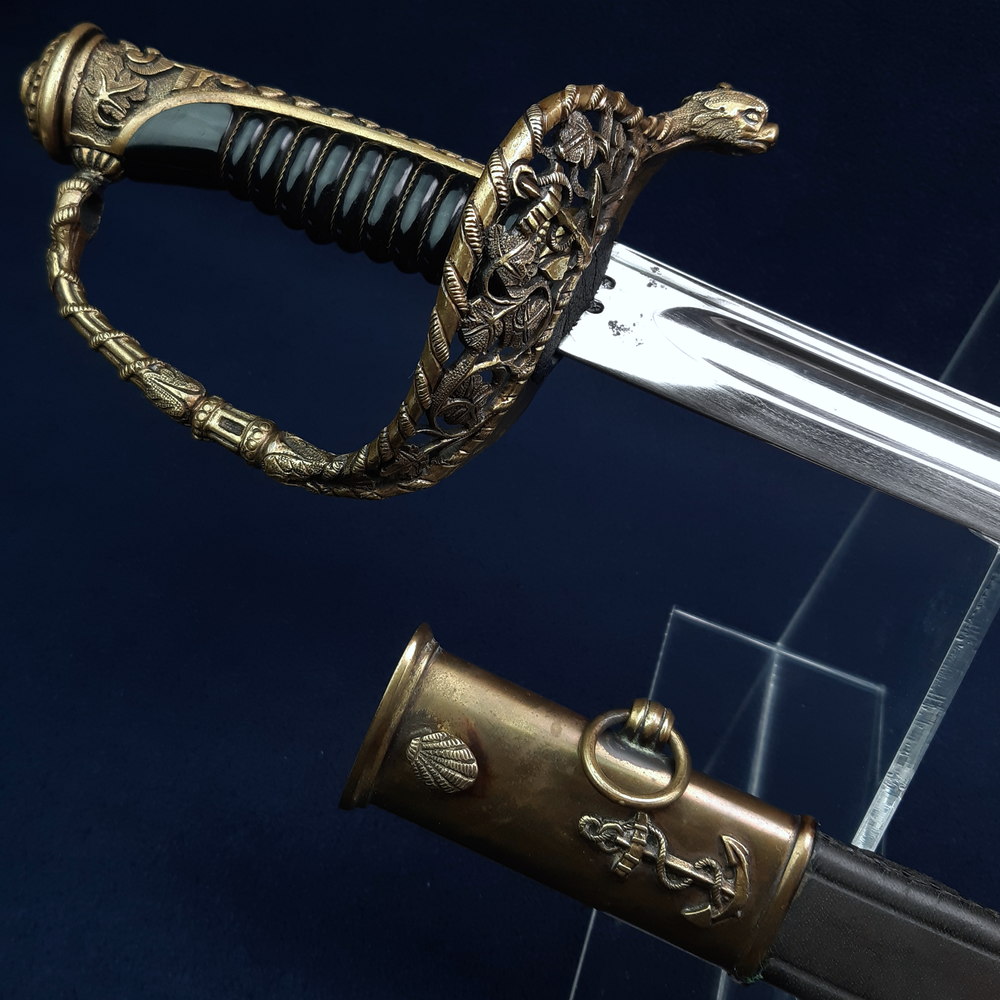
French M1854 Naval Officer's Sword by Coulaux, Klingenthal. Curved blade fullered a la Montmorency (one broad fuller and one narrow fuller running close to the spine) with false edge and spear point. Black leather washer. Ornate brass hilt with forward-curving quillon in the form of a mythical sea creature, usually referred to as a dolphin, cast and pierced panel of decoration to the outer guard in the form of a fouled anchor, leaves and vines, the edges of the panel cast to appear as if wrapped in a rope, this feature continuing down the ornate knucklebow, which has an oval opening for a portepee. Ring also set inside the hilt next to the ferrule for threading a portepee. Grip of ribbed black plastic bound with wire. Brass backstrap cast with seashells, swags and leaves, integral oval pommel cap with radial palmate design. Black leather scabbard with brass fittings at the throat, middle and chape, the throat and middle pieces with hanging rings, the throat piece bearing a frog stud in the form of a seashell on one side, and a fouled anchor on both sides, the chape piece with large shoe cast with a seashell and leaves. The spine of the blade is engraved with the maker’s mark ‘Coulaux & C. Klingenthal’. The ricasso of the blade is stamped on one side with two poinçons (inspector’s punch marks), one of a star and ‘C’, the other a star and ‘B’. Government arms manufacture at Klingenthal began in 1730 with the opening of what was then known as the 'Manufacture Royale d'Armes Blanches d'Alsace', and ended in 1836, the location being considered too close to the German border and vulnerable in case of invasion. Main production shifted to the arsenal at Châtellerault. The Coulaux family had been managing and operating the Klingenthal facility since 1801, and purchased it at auction from the French state in 1838. It was run by the family thereafter as the private enterprise ‘Coulaux & Cie’ (Coulaux & Co.), continuing to produce sword & bayonet blades, as well as fencing swords and agricultural blades, until its closure in 1962. The Model 1854 naval officer’s sword remains in use by the French navy to this day, France’s longest serving regulation model of sword. This example is probably from the early 20 th century as it uses plastic for the grip rather than horn: the material was updated when Bakelite became available. The combination of poincons seen on the blade’s suggest a date range starting from 1900, although I cannot find an end date for these. Given its manufacturer the sword cannot postdate 1962. The blade has a high polish with only small spots of light frosting and a few tiny spots of patination – it may well be nickel-plated and if so the plating is in excellent condition with no flaking. The brass hilt has an even light patina and a few tiny dents. The wire binding of the grip is all present and tight, the wood itself in undamaged. The scabbard has a few shallow dents to the upper end which do not interfere with sheathing and drawing, it retains its gloss black paint with a few tiny spots of flaking revealing steel and some areas of abrasion.
Page 96 of 120