
Show

Forgot your password?

Error message here!

Error message here!

Error message here!

Error message here!

Show Error message here!

Show Error message here!

Lost your password? Please enter your email address. You will receive a link to create a new password.

Error message here!

Back to log-in

Close

For Sale

The following items are listed by for sale by users of the site and dealers. They are in no way endorsed or guaranteed by www.antiquearmsresearch.com

Add a Classified Item
to

Clicking on the sword will take you through to the relevant classified item or dealer site.
Don't miss out! - Do you want to be kept informed weekly of new aditions? Just join our weekly update list.

You can also receive regular email notifcations when items match your keywords. To recieve them just register or logon at the top right of this page.
Page 103 of 119
  • Nation : British
  • Local Price : £310.00
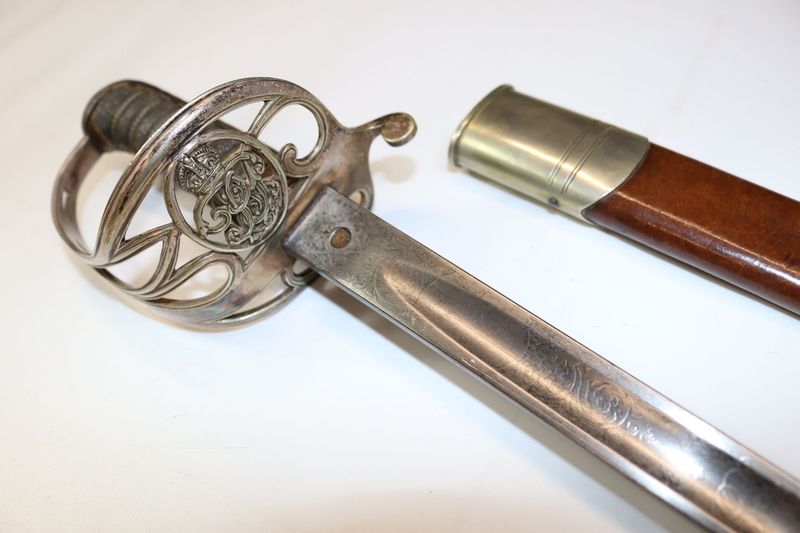
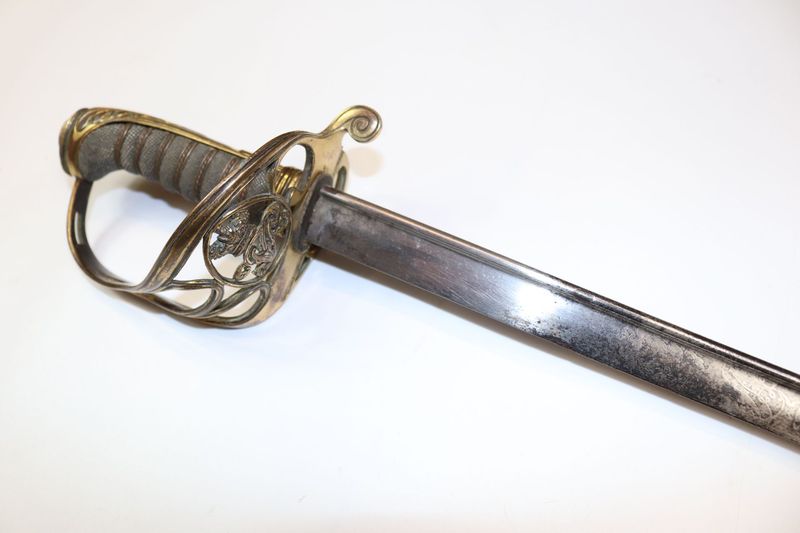
Early Victorian 1822 Pattern Infantry Officer's Sword. EL7203-2 - A Victorian 1822 pattern infantry officer's sword (dating to 1837-1845). Bright blade with early Victorian style etched panel to each side, with plain ricasso and no sign of a maker or retailer. The hilt in good condition, with much gilt remaining and good shagreen and wire. The folding drop of the guard works well. There is a little bit of movement in the hilt on the tang. A very light
  • Nation : Indian
  • Local Price : £310.00
Late-Victorian Bengal Police Officer's Sword by Pillin. EL7334 - A late-Victorian (circa 1895) Bengal Police officer's sword, by Pillin. In rather worn condition, with quite faint etching to the 32 inch 1892 pattern blade, and the shagreen of the grip very worn from use. The brass Gothic hilt furniture was plated and most of this remains. Complete in Indian field service scabbard. A relatively scarce sword.
  • Nation : British
  • Local Price : £310.00
Prussian M1816 Infantry Hanger / Sabre. Curved hanger blade with hatchet point, single fuller. Cast brass heart-shaped hilt with short quillon and knucklebow, brass grip with diagonal grooves on one side and smooth on the other, round brass pommel. No scabbard. Blade 25½ inches (65cm) in length, the sword 31½ inches (80cm) overall. The M1816 was a near-copy of its predecessor the M1715 infantry sword. The Napoleonic Wars having finally concluded, the Prussian army chose in 1815 to adopt the French infantry saber as standard for their infantry – the Guards regiments however preferred the old Prussian model and so new stocks were produced. The blade is of the form the English called a ‘hanger’ although German sources consider it a sabre. Sturdy and simple to produce, these swords had a long service life, remaining in use longest as a parade weapon with the Schloßgarde-Kompanie (guards of the royal palaces) until they units were disbanded with the end of the Prussian monarchy in 1918. This example is very slightly non-standard, having simpler ferrules and a blade about 3/8 of an inch longer. It bears no official markings so might be a privately purchased version. The blade has a bright polished finish. There are a few small nicks to the blade around its midsection and some very small patches of pitting in the same area. The brass of the hilt has an even patina, with the usual minor dents and some brown spotting. It has one small crack near where the knucklebow meets the hilt, but remains solid with no movement. The quillon is bent slightly to one side.
  • Nation : British
  • Local Price : £310.00
British Mark I 1856 Pattern Drummer's Sword, Royal Fusiliers, Circa 1886 by Mole. Straight unfullered double-edged spear-pointed blade with diamond cross-section, brass hilt with central VR cypher of Queen Victoria, triangular langets and trefoil finials. Longitudinally ribbed brass grip, flared pommel with tang button. Black leather scabbard with brass fittings at throat and chape, the throat piece with teardrop-shaped frog stud. The brass grip is stamped on one of the narrow, smooth sides with ‘R F. L.COY.’, indicating that this sword was issued to L Company of the Royal Fusiliers, as well as a broad arrow over ‘WD’ which is a War Department stores mark, and a crown inspection stamp. The other smooth side of the grip is marked with what are probably rack numbers including ‘33’. All the grip markings are somewhat faint due to rubbing which has somewhat smoothed the features of the hilt overall – this is probably attributable to repeated polishing of the brass, probably during its service life. The edge of the ricasso is stamped on one side with an illegible mark that may be two overlaid stamps. The throat piece of the scabbard is stamped on one edge with the maker’s mark ‘MOLE’, and next to the throat with the date ‘2 . 1886’ indicating February 1886, probably the manufacture date. These short swords were issued to drummers of infantry regiments. While the pattern was ordered to be adopted in 1856, there is evidence that similar-looking swords were being carried by musicians in some units as early as 1843, and some units did not actually adopt the new pattern until years after its introduction. Wholly ornamental, an identical version with a cast iron hilt was issued for buglers. The blade has some light patination in places. The brass hilt and grip has a few tiny spots of patination in recesses, raised areas with overpolishing as previously mentioned. A few small nicks to the unsharpened edge on one side near the midpoint. The leather of the scabbard remains flexible – take care to support it when withdrawing the blade. Some surface-level flaking and cracking to the leather. All its stitching is intact. The brass pieces of the scabbard have a darker patina. Some dents to the edges of the throat piece. Some light dents and scratches to the chape piece, these creating a few tiny spots of brighter brass. None of these interfere with sheathing and drawing the blade.
  • Nation : US
  • Local Price : £300.00
US Navy Model 1870 Yataghan Bayonet. Yataghan blade, brass hilt with partial muzzle ring and lobe quillon, brass grip with ‘feathered’ or ‘fishscale’ texture, beaked pommel with motif of crossed cannon barrels over an anchor. Unusual hilt design with high leaf spring locking catch and lower hole to accommodate the cleaning rod of the 1870 rifle. Black leather scabbard with brass locket and chape, with frog stud. Blade is unmarked. Hilt is marked with ‘S’. The back of the grip is stamped with ‘GGS’ and the pommel end with ‘J.G.B’. The US 1870 Navy rifle was a Springfield made rolling block type – the bayonets for it are thought to have all been made by the Ames Manufacturing Company of Chicopee, Massachusetts. Two versions are known to exist, this version with the yataghan blade and a straight-bladed version. Blade has some pitting, brass hilt has some very small dings and patina as expected for age. Scabbard is very good, only minor rubbing to the leather, no structural damage. Some small dents to the chape piece.
  • Nation : British
  • Local Price : £300.00
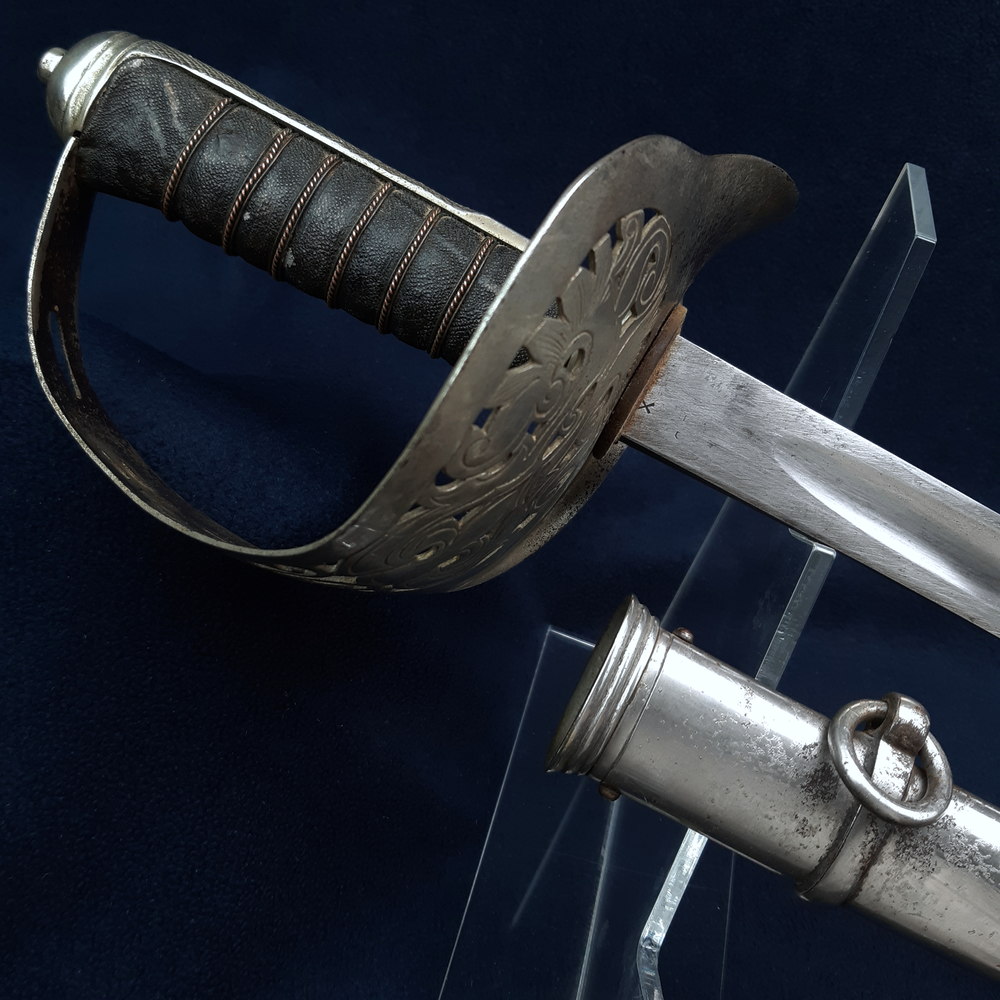
British 1905 Pattern Infantry Staff Sergeant’s Sword, 1912 Rehilt and Conversion for George V. Straight single-fullered spear-pointed blade. Nickel-plated steel hilt of the 1897 Pattern infantry design, with pierced decoration including the crown and cypher of King George V. Ribbed ferrule and fully chequered steel backstrap, integral oval pommel with tang button, these parts non-ferrous and probably German silver (copper-nickel-zinc alloy). Wire-bound black shagreen grip, brown leather washer. Blade 32½ inches in length, the sword 38½ inches overall. Nickel-plated steel infantry parade scabbard with two hanging rings. The blade is stamped at the forte on one side with the manufacture date ’00, an issue stamp ’03, and two crown inspection stamps with ‘E’ for Enfield. The other side is stamped with an ‘X’ indicating that the blade passed a manufacturer’s bending test, and another mark, mostly erased by grinding – by comparison with other examples this is probably the remnant of the maker’s mark EFD, indicating the Royal Small Arms Factory at Enfield. The spine of the blade is stamped with /99, indicating the pattern, and another Enfield crown inspection stamp. Unlike officers who privately purchased and owned their own swords, staff sergeants were issued their swords from regimental stores like a musket or bayonet, and the swords remained government property. The 1905 Pattern staff sergeant’s sword was unusual in that it was manufactured using surplus 1899 Pattern cavalry trooper’s sword blades, which is thought to have been done to replace swords lost in the Boer War without too much expenditure. As originally produced the 1905 comprised of an unmodified 1899 Pattern blade fitted with new slab grips secured with rivets and an 1897 type infantry hilt bearing the cypher of Edward VII. In 1912 both the 1898 and 1905 Pattern staff sergeant’s swords were officially rehilted to replace the old royal cypher with that of King George V. Having encountered and stocked multiple examples like this one, it is clear to me that other modifications were carried out to many of the 1905 Pattern swords beyond simply replacing the hilt, these modifications tending to bring them closer in form to the infantry officer’s sword (much like the 1898 Pattern sergeant’s sword, which was already a doppelganger of the officer’s model). This example is typical. Its blade has been reduced in length by trimming the tip, and narrowed in both width and thickness by grinding the faces, belly and false edge such that it now fits in an infantry scabbard, a significant change compared to the cavalry type. For comparison: Original 1899 Pattern cavalry blade: Curved, 33½ inches in length, 1.45 inches wide at the shoulder (due to a flare at the base designed to add strength there specifically), 1.05 inches wide at the midpoint (16.75 inches from shoulder), 0.36 inches thick at the shoulder, 0.275 inches thick at the midpoint This sword’s blade: Straight, 32½ inches in length, 1.03 inches wide at the shoulder, 0.76 inches wide at the midpoint (16.75 inches from shoulder, ignoring shortening for a more direct comparison), 0.3 inches thick at the shoulder, 0.18 inches thick at the midpoint After this reshaping, which would have required complete reprofiling of the tip, the blade has been sharpened and mounted with its new hilt plus a new infantry-style shagreen grip and a standard infantry backstrap. The grip is very distinctive on these swords as it is quite crude compared to contemporary equivalents, lacking for instance grooves for the wire. Possibly the tang is wider than standard requiring something bespoke yet easily fabricated. Even with a few manufacturing shortcuts, why the military went to such effort to convert these is an interesting question. My thought is that the 1912 sword would have stood out less on parade than the 1905 Pattern, which needed a larger scabbard and distinctive riveted grip to fit its cavalry blade. Rehilting swords for a new monarch may have become an opportunity for the Army to ‘fix’ the odd-looking and cumbersome 1905 Pattern into something that looked less makeshift, at minimal cost. This rehilt & conversion type is not found in lists of official patterns, but the change is extensive enough that perhaps we ought to consider the 1912 Sergeant’s sword worth noting as a distinct model for collecting purposes. Its features are consistent and it helps explain why the 1905 Pattern staff sergeant’s sword is quite rare today. The blade has visible grinding and sharpening marks to its faces from its conversion, with no apparent effort to put on a polish. Some examples have plated blades but not this one. The edge is, as mentioned, sharp along about 4.5 inches of the false edge and 13 inches of the true edge, with no edge damage and an intact tip. Some spots of moderate patination and a few tiny areas of light cleaned pitting on one side. The hilt and scabbard are all nickel-plated, with some wear and flaking to the plating exposing dark patinated steel, quite extensive in high-friction areas like the inside of the guard and around the sword knot slit. The alloy backstrap and ferrule are bright and clean with only a tiny patch of verdigris on the pommel. The backstrap does not completely fit into the ferrule, and the ferrule itself is slightly misaligned, but despite these the sword is well peened, completely solid in the hand with no movement to any part, and the blade rings when struck. The shagreen of the grip is all intact with light handling wear, its wire binding is all present with slight movement to all loops. The blade sheaths and draws fully and smoothly, its scabbard is free of dents.
  • Nation : British
  • Local Price : £300.00
British Mark I 1856 Pattern Drummer’s Sword, East Kent Regiment. Straight unfullered double-edged spear-pointed blade with diamond cross-section, brass hilt with central VR cypher of Queen Victoria, triangular langets and trefoil finials. Longitudinally ribbed brass grip, flared pommel with tang button. Black leather scabbard with brass fittings at throat and chape, the throat piece with teardrop-shaped frog stud. The brass grip is stamped on one of the narrow, smooth sides with ‘E.K.’, indicating that this sword was issued to the East Kent Regiment. The throat piece of the scabbard is stamped on the rear face next to the staple with ‘RENOVATED POTTER ALDERSHOT’. These short swords were issued to drummers of infantry regiments. While the pattern was ordered to be adopted in 1856, there is evidence that similar-looking swords were being carried by musicians in some units as early as 1843, and some units did not actually adopt the new pattern until years after its introduction. Wholly ornamental, an identical version with a cast iron hilt was issued for buglers. Henry Potter & Co is a musical instrument maker founded in 1810 by Samuel Potter, a Drum Major of the Coldstream Guards, supplying musical instruments such as drums, fifes and bugles to the military. Initially based in London, William’s son George created a branch at Aldershot, which was the site of the Army's first permanent training camp established in 1853. Over time Aldershot grew into a major military town and garrison seen to this day as the home of the British Army, providing continuing business for the highly specialized craftsmen at Potter & Co. It is interesting to see that they did renovation work on bandsmen’s swords – while not swordsmiths they would most likely have had all the skills needed to repair or spruce up brass and leather parts, and regiments would have been used to doing business with them. The company is still in operation at Aldershot to this day. The blade has some spots of light patination and some old polishing marks. The brass hilt & grip and the brass fittings of the scabbard have an even patina, with a brighter area on the scabbard throat piece where it is covered by the langet when the sword is sheathed. The leather of the scabbard remains flexible – take care to support it when withdrawing the blade. Some surface-level flaking and cracking to the leather. All its stitching is intact.
  • Nation : British
  • Local Price : £300.00
British George V 1897 Pattern Infantry Officer’s Sword, Probably WW1. Straight single-fullered spear-pointed blade. Steel hilt with pierced and imprinted decoration including the crown and cypher of King George V (reigned 1910-1936). Steel ferrule, fully chequered steel backstrap, integral oval pommel with tang button. Wire-bound black shagreen grip, brown leather washer. Steel nickel-plated parade scabbard, with two hanging rings. Blade 32 5/8 inches in length past the washer, 1 inch wide at the shoulder, the sword 38½ inches overall. The blade is stamped on one side at the ricasso with a proof mark that is simply ‘PROVED’ with the letters arranged in a circle. This is a more economical form of the traditional proof, which would usually take the form of an inset brass proof slug surrounded by etching. There is no maker’s mark or other markings on the blade. I have seen this simplified proof mark before on swords produced during WW1, by the manufacturers Fenton Brothers and Hawksworth, both in Sheffield. These firms did not typically manufacture swords and only began to do so due to the war. I have also seen examples stamped with this proof mark but no maker’s mark, just the text ‘MADE IN SHEFFIELD’. Lacking all of the equipment and skilled labour that would be available at a firm of sword cutlers, these wartime manufacturers at times had to improvise, such as making hilts out of materials other than steel (to avoid the need to bend a steel ‘flat’ into shape which required specialised tooling) or swapping the shagreen grip for leather. Skipping the traditional but non-essential slugs for a simple stamp on the steel may have been another such measure and does not seem to have been done by any established firms. Wartime swords did typically have decorative etching, so this example is a little unusual in having a completely plain blade. There might have once been shallow etching that has been completely polished off subsequently. The blade is bright with a mirror polish, with some light frosting in places, a few small spots of patination, small patches of heavy patination at the very shoulder abutting the washer, and polishing marks. The blade’s edge is unsharpened and undamaged. The shagreen of the grip has a few small spots of wear and one lost scale which show up brown, its wire binding is all present with some movement to all the loops. The hilt, ferrule, backstrap and pommel have all been nickel-plated and this plating is in very good condition with little wear even on high-wear areas like the edges and inside of the hilt. No movement to the hilt, the sword is solid in the hand. The scabbard’s plating has a few spots of wear revealing patinated steel, the scabbard as a whole is straight and free of dents allowing smooth sheathing and drawing.
Page 103 of 119