
Show

Forgot your password?

Error message here!

Error message here!

Error message here!

Error message here!

Show Error message here!

Show Error message here!

Lost your password? Please enter your email address. You will receive a link to create a new password.

Error message here!

Back to log-in

Close

For Sale

The following items are listed by for sale by users of the site and dealers. They are in no way endorsed or guaranteed by www.antiquearmsresearch.com

Add a Classified Item
to

Clicking on the sword will take you through to the relevant classified item or dealer site.
Don't miss out! - Do you want to be kept informed weekly of new aditions? Just join our weekly update list.

You can also receive regular email notifcations when items match your keywords. To recieve them just register or logon at the top right of this page.
Page 21 of 154
  • Nation : British
  • Local Price : £3,450.00
British Generals Scimitar – General Sir Robert Mansergh. British Generals Scimitar – General Sir Robert Mansergh GCB, KBE, MC by Wilkinson Sword London number 82917 which was sold to Hobson 8th May 1961 however it was obtained directly from the family with two further very interesting sword. Regulation ER 2 sword in great condition just contact marks please see images. Commander-in-Chief of the United Kingdom Land Forces from 1956 to 1959 In that capacity he headed a Committee which looked at the Administration of the British Army. Mansergh also served as Colonel Commandant of the Royal Artillery and the Royal Horse Artillery Regiments. The grips are Ivorine which is Synthetic ivory, made from cellulose nitrate. However this could still cause issues with shipping “ customs to certain countries due to the similarities to Ivory.
  • Nation : British
  • Local Price : £3,450.00
British Officers Royal Artillery Sword – General Sir Robert Mansergh. British Officers Royal Artillery Sword General Sir Eric Carden Robert Mansergh, GCB, KBE, MC Robert Mansergh was born in Cape Colony and educated at the Rondebosch Boys High School in Cape Town and the Royal Military Academy, Woolwich. He was commissioned into the Royal Field Artillery in 1920 He served with the British Military Mission to Iraq between 1931 and 1935, being awarded the Military Cross in 1932 The sword is George 5th regulation pattern by Wilkinson Sword London number 58559 and although the Wilkinson Sword register is blank it was obtained directly from the family with two further very interesting sword which will be listed shortly. The blade with pitting towards the tip and one small area of staining please see images. Complete with field service scabbard and frog
  • Nation : Japanese
  • Local Price : £3450
Click and use the code >23511 to search for this item on the dealer website Stunning & Beautifu, Edo Period Tachi-kake, The Traditional Japanese Samurai Tachi Sword Stand. Used by Such As The Okuyama Clan´s Daimyo lord. A Clan That Were Descendants of The Famous Genji Clan
  • Nation : British
  • Local Price : £3400
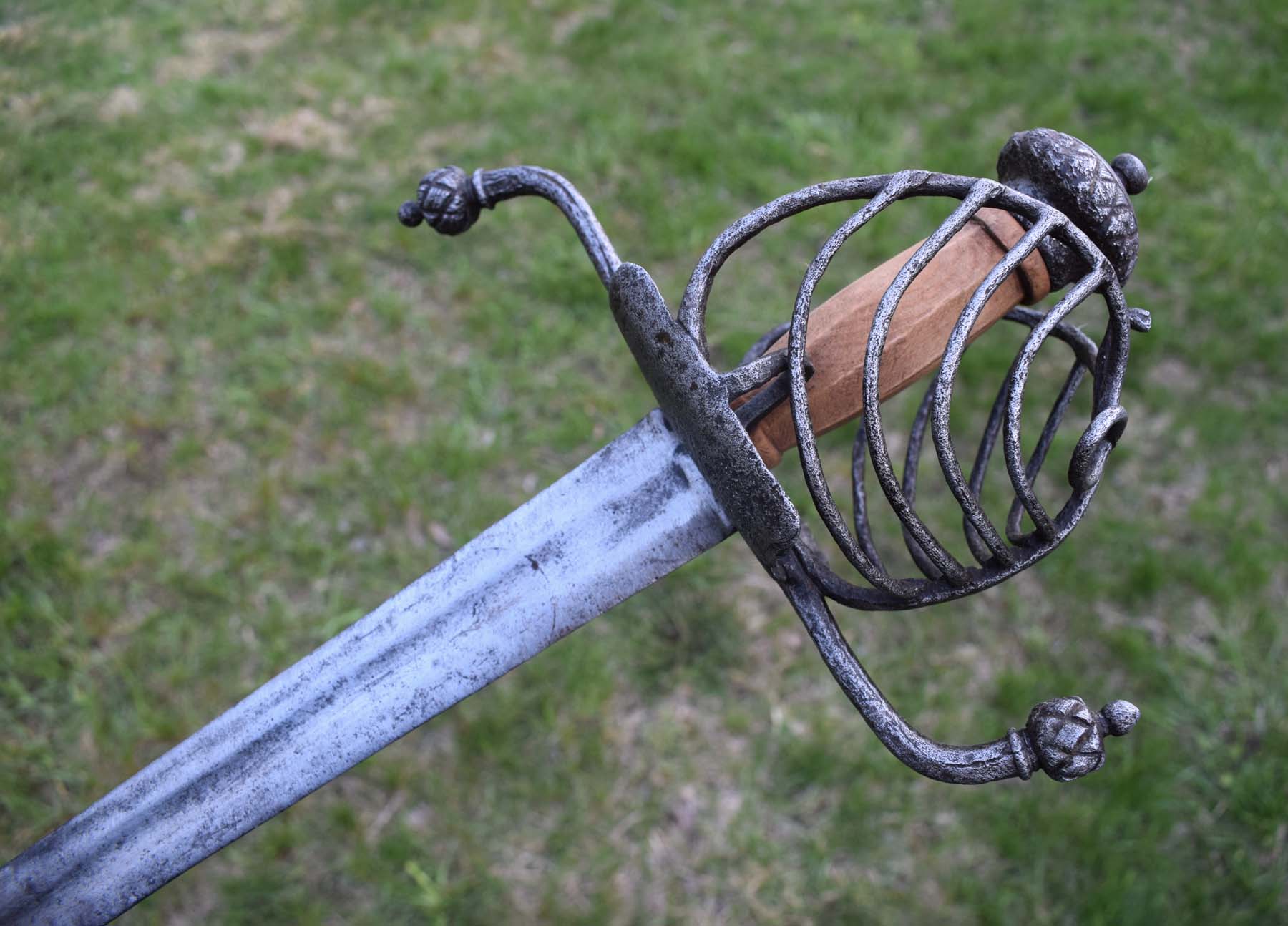
Scottish Basket Hilted Sword dating to the second quarter of the 17th century. The original scabbard is of scarce early form made from hollowed slats of wood covered with leather stitched along the middle on one side. It lacks its iron furniture apart from the crimped iron chape. It is in poor condition with the wooden core exposed and broken in the middle. The scabbard appears to have been snapped or at least damaged towards the chape and now repaired.     The scabbard is stitched along the middle of the inner side and retains its two scalloped iron suspension mounts on the outer side which are of early form. The scabbard tip has been reinforced at its join with the chape. The scabbard retains remnants of its original lined decoration.     The double-edged blade is of lenticular section and gently tapers to its tip. It has a pronounced ricasso extending for just under 2 inches (4.5 cm) from the hilt with a pronounced fuller inside each blunt edge. From the end of the ricasso three fullers extend for 7.5 inches along the middle stamped with “ANDRIA” in the middle fuller on one side and “FERARA” in the middle fuller on the reverse side with patterns of crosses to the sides and in the fullers above and below. Beyond the fullers on one side is a group of small orb and cross marks. The shoulders of the ricasso fit into a shallow rectangular shaped aperture purposely cut to secure the blade underneath the cross hilt. The hilt resembles the basket guards of a number of Scottish swords illustrated in Cyril Mazansky's “British Basket-Hilted Swords” (Boydell Press 2005), and in particular references D9, D10, D10a and D10b on pages 80 to 82. These swords have similar hilt structures and engraved line patterns to the frontal guard panels. These swords are housed in various important collections including Blair Castle in Perthshire, the Marischall Museum in Aberdeen, and The Royal Armouries. Two further similar swords housed in the National Museums of Scotland, are illustrated in John Wallace, Scottish Swords & Dirks, 1970, Arms and Armour Press, figs 23 and 25. For a further examination of this sword type see: Stuart C Mowbray, “British Military Swords”, Mowbray Publishers, 2013,  section 10 entitled “The So-Called Irish Hilt Sword, pages 110 to 126, for examples similar to our sword and English variants, particularly that shown on pages 114 and 115. The blade is 30.75 inches (78 cm) long and the overall length of the sword is 36 inches (99.5 cm). The sword hilt is in russet condition. One guard bar has cracked at its join with  the top of the knuckle bow. One of the lateral bars extending out from the cross bar is broken. There is a working life riveted repair to the inside of one of the side guard bars. The blade has been protected by the scabbard and is in fine condition with minor shallow patches of blackened age.
  • Nation : American
  • Local Price : $3295.00
Civil War Presentation US M1850 Staff & Field Officer’s Sword. In 1850, the US Army designated two sword models for commissioned infantry officers; the M1850 Foot Officer's Sword and the M1850 Staff & Field Officer's Sword. The foot officer's sword was to be for company-level officers of the rank of Captain and below, while the staff & field sword was for officers of the rank major and above. However, in actual practice they were interchangeable and ownership apparently had little or nothing to do with rank. Both model swords followed the same basic design, with the only difference being that the staff & field sword had a cutout “US” worked into the design of the guard. This example features gilt cast brass guard of standard form, pierced and decorated with classical foliate design and “US” on the upper obverse face; integral knuckle bow joining the capstan pommel. The wood grip is covered with shagreen and wrapped with twisted brass wire (wire broken and missing a few turns). Slightly curved single-edged 30 3/4″ blade with wide and narrow fullers, profusely etched with foliage, stands of arms, and maker's name “W. H./Horstman/& Sons/PHILADELPHIA” just below the guard; “IRON PROOF” etched on the spine. Brown metal scabbard with gilt brass mounts, the upper carry band engraved “Presented to/CAPT N. L. HAWLEY/by his Democratic friends/of Lockport”. While he is not listed in the Civil War Database of soldiers, Norman L. Hawley was a captain in the Lockport Light Artillery, attached to the 4th Illinois Cavalry. Illinois records show he mustered in on July 31, 1861. The 4th Illinois Cavalry officially began service on September 26, 1861 and was consolidated into the 12th Illinois Cavalry Regiment on June 14, 1865. The regiment saw action at Fort Henry and Fort Donelson, the Battle of Shiloh, Siege of Corinth, and the battles of Coffeeville and Egypt Station. Further research would likely reveal more information about Captain Hawley, and a book was published on the history of the 4th Illinois Cavalry in 1903, now available in reprint. Except for the grip wire, the sword is in very good condition, with about 40% original gilding on the hilt; the blade is very good plus, with bright frosty finish and clear markings. Overall length 36 ½”, not including scabbard.
  • Nation : British
  • Local Price : £3,250.00
Georgian 21st Royal Scotch Fusiliers Officer&#acute;s Mameluke. 21st Royal Scotch Fusiliers Officer&#acute;s Mameluke c 1815 – 1820 gilt brass decorative hilt with bone grips secured by two studs. The single edged blade with clip point and etched in gold with thistle  and regimental badge the reverse with floral decoration. Complete with metal scabbard with three gilt mounts repainted and officer&#acute;s sword knot. Submission reference: ZPS39U5K Information: Blade Length: 73cm Overall Length: 86cm
  • Nation : British
  • Local Price : £3250
Mid-18th Century British Dragoon Basket Hilted Sword. An impressive example of a horseman's basket hilted back sword made for an Officer, or Trooper, of a North British / Scottish Regiment of Dragoons towards the middle and third quarter of the 18th century. These swords were issued by the Board of Ordnance to British regiments and were manufactured in the Scottish manner. They were first issued in the second quarter of the 18th century and were used during the Jacobite Rebellion of 1745, Britain’s wars in Europe and the American Revolutionary War. The sword is a rare example of one that retains its remarkable full length blade of 38 inches (just over 96 cm) designed mainly for striking downwards at opposing infantry soldiers with greater reach than the more usual blade lengths of the time could afford. Although many swords of this type are mounted with blades of shorter length, the majority of those that were originally made with this longest type were cut down during the working lives of the swords. This is a rare survivor with its metal parts in extremely well preserved and undamaged condition as visible in the photographs. The fully formed basket is pierced with flanged hearts and circles in the main front and side panel guards which are also finely fretted at the edges with chevrons and merlons. One of the more usual frontal guard plates has been replaced in the hilt design with an oval ring in the “horseman” fashion. The arms of the guard are forged onto a circle of iron into which the base of the bun shaped pommel sits. The pronounced button is integral with the pommel and not of separate manufacture. The original spirally fluted grip is of hardwood and has its shagreen cover but retains its wire binding. The robust single-edged blade has a thick spine and is double edged for the last 17.5 inches (44.25 cm) towards the point. It has a short ricasso and two fullers which commence 4.25 inches from the hilt. One wide broad fuller runs down the middle of the blade to the point and a second narrower fuller runs just underneath the spine to where the blade becomes double edged. Overall the sword is in fine and original condition. For a further example of this sword type see Cyril Mazansky, British Basket-Hilted Swords, Boydell Press / Royal Armouries, 2005, plate F1e page 97 for a sword in the National Museums of Scotland, collection reference LA33.
  • Nation : French
  • Local Price : £3,250.00
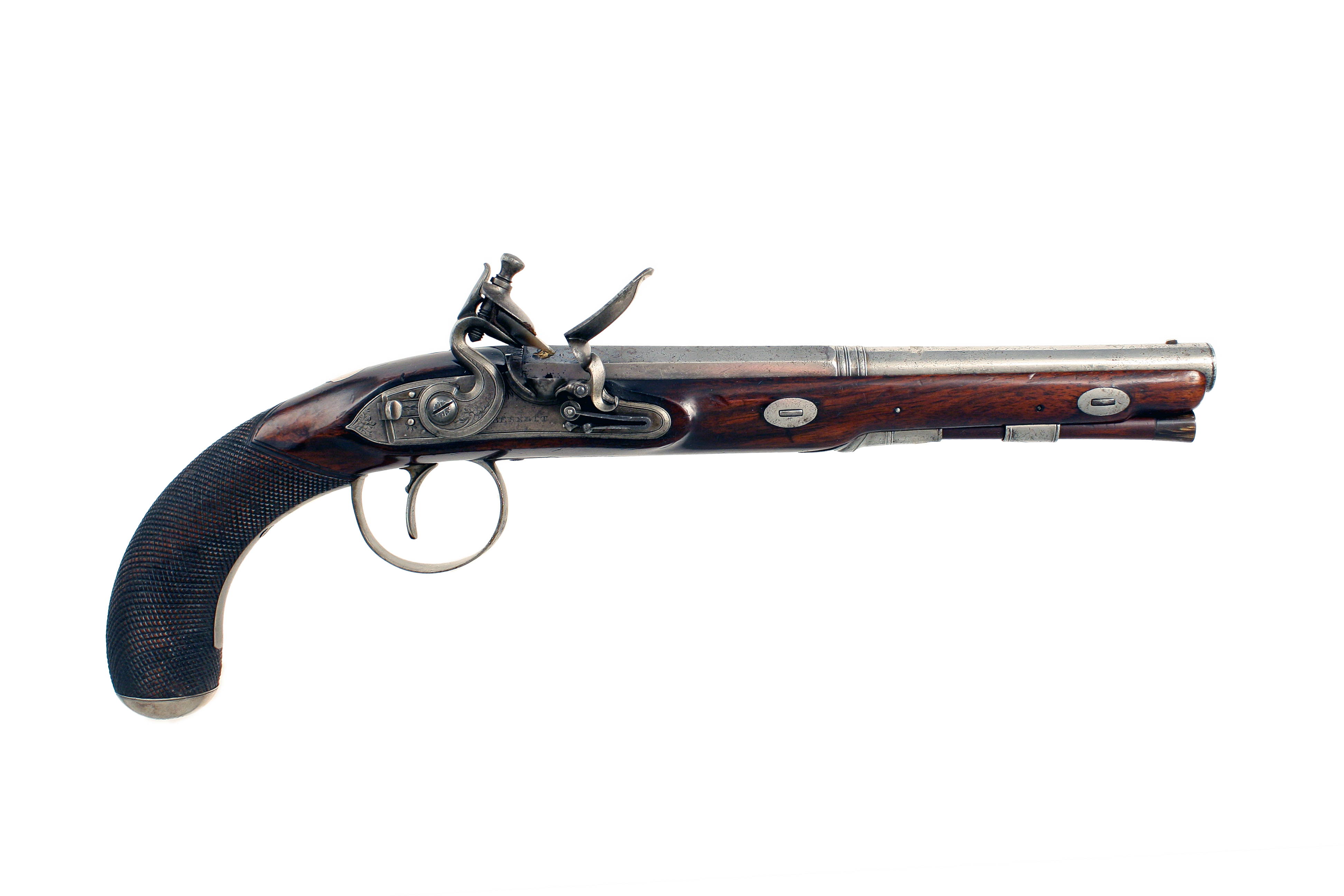
French Flintlock Long Barrelled Rifled Pistol. Ref X3391. A French&194;&160;Flintlock Long Barrelled Rifled Pistol. 15 &194;&190;&157; overall, 6 &194;&190;&157; 70 bore turn off rifled three stage cannon barrel, plain octagonal breech and tang, rounded bevelled &194;&160;cock, figured half stock with apron around the barrel tang. Iron mounts comprising sideplate, spurred pommel of flattened ovoidal form, and trigger guard. Circa 1670 Rare early pistol in aged condition, old rusting to metal parts, stock with chips and a split. &194;&160; &194;&160; &194;&160; &194;&160; &194;&160; &194;&160; &194;&160; &194;&160; &194;&160; &194;&160; &194;&160; &194;&160; &194;&160; &194;&160; &194;&160; &194;&160; &194;&160; &194;&160; &194;&160; &194;&160; &194;&160; &194;&160; &194;&160; &194;&160; &194;&160; &194;&160; &194;&160; &194;&160; &194;&160; &194;&160; &194;&160; &194;&160; &194;&160; &194;&160; &194;&160; &194;&160; &194;&160; &194;&160; &194;&160; &194;&160; &194;&160; &194;&160; &194;&160; &194;&160; &194;&160; &194;&160; &194;&160; &194;&160; &194;&160; &194;&160; &194;&160; &194;&160; &194;&160; &194;&160; &194;&160; &194;&160; &194;&160; &194;&160; &194;&160; &194;&160; &194;&160; &194;&160; &194;&160; &194;&160; &194;&160; &194;&160; &194;&160; &194;&160; &194;&160; &194;&160; &194;&160; &194;&160; &194;&160; &194;&160; &194;&160; &194;&160; &194;&160; &194;&160; &194;&160; &194;&160; &194;&160; &194;&160; &194;&160; &194;&160; &194;&160; &194;&160; &194;&160; &194;&160; &194;&160; &194;&160; &194;&160; &194;&160; &194;&160; &194;&160; &194;&160; &194;&160; &194;&160; &194;&160; Images courtesy of West Street Antiques (https://antiquearmsandarmour.com/)
Page 21 of 154